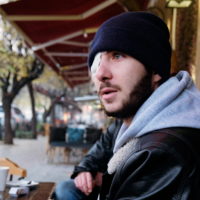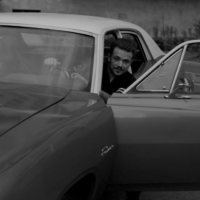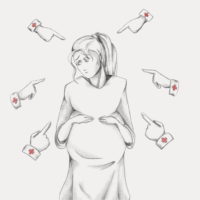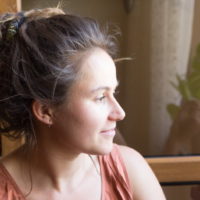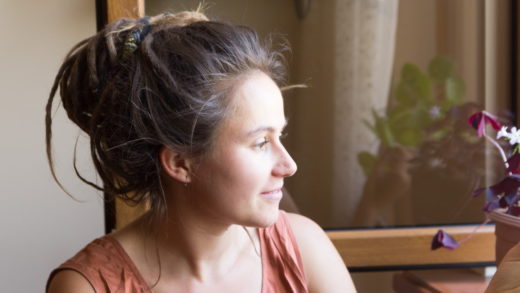

— My name is Melanya. I am 25. I have two children: Aren is 4, Lena is 2. I am from the village of Ivanyan in the Askeran district. I am a nurse, married… A widow now.
Melanya says this in a calm voice — only her eyes, which, I imagine, always had a mischievous twinkle in them, become somehow empty. And her slender fingers, slightly roughened by work, with their closely trimmed nails, clench in her lap. Around her neck is a delicate chain with the first letter of her husband’s name — “К”.
We are sitting on low children’s chairs in the playroom. I think she has the face of a Brazilian fashion model and the thin body of a teenager. And a voice that brings to mind a springtime brook. A slender stream of meltwater coming down from the mountains.
Melanya, as she herself says, is both an Artsakhtsi and a Hayastantsi. Her parents moved to Artsakh from the town of Masis when she was 5. There she went to kindergarten, finished school, then medical college. She found work as a nurse at the hospital.
One day a colleague asked the young woman to give her injections at home. Every time she went to give another injection, Melanya would meet the woman’s young relative, Karen, in her house. It turned out that her colleague had actually arranged for them to look each other over as prospective spouses.
— I was considered a home-loving, lively girl. Well, the sort who respects her elders, helps everyone, doesn’t talk back. There are 6 children in our family; our parents worked, and it was my grandmother who brought me up that way. Karen and I began talking, but our first real date was on a special day — January 6. We didn’t have a wedding, he abducted me, — Melanya laughs, and the twinkle returns to her eyes. — But afterwards we had a big engagement celebration and were married in church.

Distant relatives temporarily let the newlyweds have their house. Karen was serving as a contract soldier; Melanya continued working as a nurse. There were plenty of everyday difficulties, but they managed together.
During the 2016 war, which is called the Four-Day War although it lasted much longer, Karen was on the front line. Melanya was pregnant with their first child.
Karen tried to persuade her to leave Ivanyan, but she flatly refused. She went down to the bomb shelter when there was firing in the direction of Aghdam; the rest of the time she looked after the house and waited a whole month for the first phone call from her husband.
For the past three years Melanya had worked as a nurse in a kindergarten — just as bright and beautiful as her temporary home is now. Her husband, having left military service, took on various jobs.
— He was fearless, always achieved whatever he wanted, always helped those in need; the word “no” did not exist in his vocabulary. He had a difficult childhood. His father left the family when he was 4 months old.
Karen wanted his children to have everything he hadn’t had. He didn’t shy away from any work — he quarried stone, too, — a kind of white stone for building, I don’t know what it’s called, — and worked in the fields. He never came home without presents for the children, he always brought them something, however small.

Early on Sunday morning, September 27, Melanya was doing housework when she heard a sound like a powerful explosion. She ran outside. Thick smoke was billowing from the direction of Stepanakert. Melanya quickly gathered the children and ran to the basement.
— Somehow I understood straight away that this was the sound of war. I remembered it from 2016. Though back then the explosions hadn’t sounded so close. Back then towns and villages weren’t being bombed.
About an hour later the Azerbaijani armed forces were already shelling her village. Melanya has three neighbours. A shell fell into each yard. One house and the car standing in its yard burned down. Two shells did not explode, but damaged their house and the one next door.
For several days Melanya and the children stayed mostly in the basement, amid constant explosions that seemed to come from everywhere. On October 3 Karen persuaded her to pack and move to Armenia with the children. He drove them to Yerevan himself, promised he wouldn’t go and sign up as a volunteer, and went back.
The next day he called and told her in a cheerful voice that he had been called up, but his wife shouldn’t worry — he was stationed not far from their house, and he wouldn’t be on the front line, “in dangerous places”.
— He called again on the evening of October 8 and said: “Don’t worry about me, I’m fine, I’m in a safe place. Look after the children. We will definitely win.” My spirits lifted; a television crew had just come to see us, and I gave them an interview in a happy voice, talking enthusiastically about our imminent victory.
On October 9 Karen was gone. He was killed in an artillery bombardment. In the very “dangerous place” where fierce fighting was going on. He was 29.
— He deceived me, he was on the front line from the very beginning. He gave his life defending his homeland.
Gave his life defending his homeland. Melanya says this phrase many times during our conversation. Staring into nothing. As though trying either to find some justification for the death, or, through endless repetition, to make what has happened sink in for herself.

Melanya says Aren is very much like his father. In his walk, the way he talks, the way he takes offence. Sometimes she feels it is a little Karen smiling at her.
— The house we lived in isn’t ours; distant relatives let us stay there temporarily. Karen said he would work hard and build us a house.
He also had a great love of cars. He wanted to teach me to drive, too. He would say, why should everyone else have one and not you? He promised his son he would buy him a car, a big one he could ride in. And now, there, he went to war and died for his homeland so that his children could live in peace.

It is noisy in the large playroom of the two-storey kindergarten. And very bright. Suddenly I feel as though film lights are hanging above us. The people gathered around are the film crew, and Melanya and I are sitting and reading our monologues from a script someone has written. Soon we’ll hear — cut, got it, the assistant director will snap the clapperboard shut, and the war will disappear. And her husband’s death will disappear.
Melanya voices the same feeling I have of the unreality of what is happening.
— On the first day, after I found out, my son asked me why I was crying, where Dad was. I told him Dad had got a job working for the Spider[-Man]. He’s his favourite character. And he isn’t calling because the Spider broke his phone so he wouldn’t be distracted from his work. I don’t know how to tell him. What should I say? That his dad died a hero so he could have peaceful skies overhead? How can I tell him when I still don’t understand what has happened myself? I keep feeling he’ll call any moment.
Her voice trembles, her eyes fill with tears, but through sheer willpower she keeps them from falling. I have no willpower. Not even enough to stand up and simply hug her. I can afford to slump like a rag in my chair and not wipe away my tears — it isn’t me a four-year-old son runs up to, it isn’t into my eyes that he looks anxiously.
Melanya smiles at him, strokes his head, and the boy runs off to play. Her daughter, who until then had been studying me with cautious curiosity from behind her mother’s back, climbs onto her lap. The little girl has Mongolian eyes and gold earrings in her ears.

Melanya’s father, grandfather and her husband’s younger brother are on the front line. Her mother, sisters and grandmother have also moved to Armenia and are staying with relatives. The relatives’ house is small, and Melanya’s uncle’s wife and her children came with her too — there wouldn’t have been room for everyone.
— I’m glad we came here, of all places. It’s warm here, there are amenities, the children have things to play with. I’m very grateful to the municipality, to the kindergarten director; they provide us with everything.
Melanya doesn’t know what will happen next. “Let there just be peace, let our boys stop dying, God will help with the rest, some door is bound to open,” she says quietly. She no longer wants to go back to the village she loves — everything there reminds her of their happy life together, the children will keep asking questions there.
— I have a very hard road ahead of me. I know I’m strong. I know I must get through it, step by step, but for now I have no idea how. I know the person I love is gone. They told me his body burned there, on the battlefield. But my heart doesn’t want to understand it, my heart wants him to be alive. If only he’d come back without an arm or a leg — if only he’d come back.