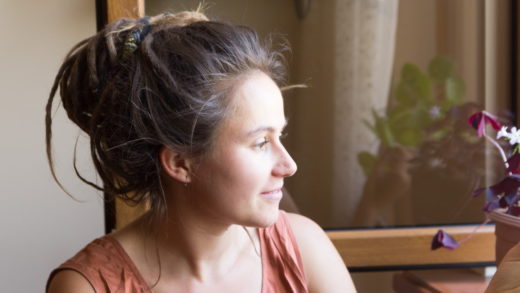
Ivan Belkov — an artist living in Spain — published this story on Facebook in the first days of the 2020 Armenian-Azerbaijani war, because many social media users from Azerbaijan had begun saying that there had been no Baku pogroms and that Armenians had made them up. Using the hashtag #MyFamilyToo, Ivan started a movement that was taken up by other people who had lived through the same thing.
Facebook quickly deleted the original post because it contained the word “Azer”, which the social network considers offensive to Azerbaijanis, although in this case Azer is the actual name of one of the people in the story. Kalemon is publishing Ivan’s story with minor edits.
1990
Mom put us to bed and went to the bedroom to get ready for bed herself — for her, it is a whole ritual. Dad had been sent away on duty back in October. As we later learned, most of the men in our building were away on duty or at their posts at the time — officers’ families lived there.
I woke up because Mom was trying to drag me down onto the floor, her head hunched into her shoulders at the sound of explosions and the rattling of the windowpanes. My sister reached for the lamp, but Mother stopped her sharply: “Don’t turn it on. They’re shooting at windows with lights on.” Mom crawled towards the door out of the room and beckoned us to follow her. The three of us crawled like that to the living room, which was bigger and where we could stay farther from the windows.
Mom left us there and went into the bedroom to gather our documents in case of evacuation. I could hear her praying, then swearing, shaking the wardrobe in the dark as she searched it for papers. Sometimes she would give a little shriek when another burst of automatic gunfire swept across the wall of the building.
At last she came back to us. In one hand she carried a bag of documents, in the other our clothes, so that my sister and I could get changed and be ready. When the preparations were finished, we turned on the radio in case the evacuation time was announced and sat on the floor by the sofa, pressed close to Mom. Cheerful music was playing on the radio. I remember its refrain as if it were now: “Sara Barabu, she has a cow called Moo…” (a song by the band Sekret, written in 1984 — Kalemon); they played it very often that night, until the radio fell silent. Neither the radio nor the television worked until morning. We did not know what was happening outside those walls.
I slept with my head on Mom’s lap. She sat like that all night, waiting to hear whether they would say anything on the radio. When morning came and the radio started working, we heard the presenters’ upbeat voices talking about the “achievements” of the great country and mentioning in passing that “the conflict in Azerbaijan has been resolved”. And cheerful music started playing again.
Meanwhile, the shooting continued, though with long breaks. It was impossible to get through to anyone by phone; the lines were down.
Soon they started firing at the building again. The glasses and plates in the sideboard began rattling again, the very ones every family keeps for a “special occasion”.
We lived on Ivan Krylov Street, not far from the Academy of Sciences metro station — I do not know what the street is called now. Our building stood between two high-rises, from whose roofs Azerbaijani militants were firing at us. When they stopped shooting, they waved some sort of black cloths and shouted something. If anyone went out onto a balcony — usually it was women — to ask them to stop firing, they were immediately gunned down.
Mobs of bandits did not break into our building to loot and murder, as they did in other buildings. Perhaps because the militants killed anyone who approached the building; they did not care whom they shot. Ambulances tried to reach us from the nearby ambulance station, but not a single one made it: they were fired on too. The militants rolled one of the shot-up ambulances into the middle of the courtyard. Anyone who approached the vehicle was gunned down from the rooftops. The bodies of the murdered doctors remained inside for several more days.
That evening, a quiet knock at the door broke through our stupor. A neighbour had come with her little daughter and asked to stay with us — she was very frightened. Later another neighbour came. That was how the flat began filling up with people. In other flats, too, people began forming “communal flats” of women and children, of every nationality. Fear united everyone. That was how the second night began. People slept on the floor in the rooms and the kitchen.
To distract the children, Mom brought out a large cloth bag of dried bread cubes. She often cut stale bread into cubes and dried it. We did not know why, and always laughed at her collective-farm childhood in Plemkhoz (a village in the Volgograd region — Kalemon). But now the bag came in very handy. After all, cooking was impossible too: as soon as a human figure appeared at the stove beside the window, they would soon start shooting at that window. Going to a shop was out of the question. We were finishing off everything in the fridges and stored in the pantries. How delicious the dried apples Grandma had sent in the autumn seemed then!
The women went to neighbouring “communal flats” and sometimes brought back sad news of wounded and murdered neighbours. Someone had been hit by a stray bullet. Someone had forgotten themselves and stood up to their full height by a window.
My mom is a chemist and biologist, and knows more about medicine than the others do from their school life-safety lessons. So people always came to her for medical advice. Neighbours who had wounded or dead people in their flats came to ours asking for help; Mom would take the first-aid kit and go to help.
***
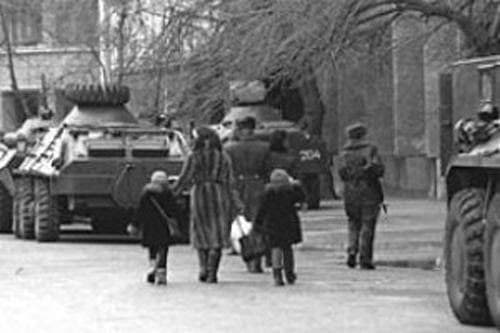
The next day, an armoured personnel carrier drove into our courtyard and began circling the building, periodically firing at the roofs of the buildings from which civilians were being shot at. Later Aliyev would lie that the Soviet army had fired at residential buildings for no reason.
When the shooting died down, relatives began coming to pick up some of the neighbours and take them away. We and that first neighbour with her little girl were the only ones left in the flat. By then Mom had realised that no one was going to evacuate us. With no understanding at all of the situation, we remained sitting on the floor of the flat, left to our own devices, two women and three children. Towards evening there was a loud knock at our door.
Everyone flinched. The voice behind the door was familiar: it was Mom’s colleague, a man named Azer. They worked together at a maritime border outpost. Mom opened the door and, in tears, began asking him what we should do. Azer told her to get ready quickly and take only the documents — he would take us to the outpost in a truck.
Mom looked at the neighbour. She was holding her daughter close, her eyes full of tears. Mom turned to Azer and said she would not leave without them. The man began explaining that the truck was full and there might be additional problems at the outpost. Mom began pleading, and the man gave in.
The woman grabbed her bag of documents, took her daughter by the hand and rushed down the stairs after us. A truck stood outside the entrance; two sailors with automatic rifles helped us climb under the tarpaulin into the back, packed with people, and the truck sped off towards the sea.
Soon two cars with Azerbaijanis in them shot out of a street and began firing at the back of the truck. The back was open, and it was clear that the truck was loaded with women and children. The sailors returned fire and managed to keep the cars at a distance. The truck darted through side streets, trying to lose them, but only managed it right at the gates of the border outpost. It is a miracle that only one woman was lightly wounded in that truck packed with people.
At the base we were fed. We began to feel calmer. I do not remember exactly how long we spent there. I remember that we slept for a long time.
At the outpost they were preparing a ferry to take people to safety. The overcrowded ferry left without us but soon came back, because ships belonging to the Caspian Shipping Company, which had gone over to the side of the Azerbaijani militants, began firing at it.
We were woken early in the morning. They said evacuation by road had begun and a plane was waiting for us at an airfield outside Baku. We got ready and went out into the courtyard, where soldiers were already standing with automatic rifles in their hands. Azer explained that the outpost had come under fire too and it was no longer safe to stay there. They put us in a truck, under a tarpaulin with other families again. We began waiting to leave.
Suddenly Azer came and moved us and the neighbour to another truck, and the first truck left. Only later did Azer tell us that a Russian officer without an automatic rifle had been accompanying that truck. Armed men stopped the truck and shot him dead along with everyone in it. There was no information about survivors. As for us, Azer himself would take us, and he would bring an automatic rifle for “such an occasion”. This time they also closed the back of the truck tightly with a tarpaulin.
By the time we left the base, it was already daytime. In central Baku our truck picked up a few more families. Our truck joined a small convoy of vehicles. Through little holes in the tarpaulin, we looked out at Baku and said goodbye to the city we had once loved. The convoy moved slowly, as if creeping along. Single shots could be heard in the distance.
Along the way, militants often stopped us at checkpoints. Everyone pressed themselves against the floor of the truck, fell silent and listened to Azer’s voice. He argued with someone, sometimes shouting in Azerbaijani. We travelled like that until evening. At another stop, there was a banging on the side of the truck and a shout: “Get out!” The tarpaulin was thrown back, the tailgate lowered, and we all saw a large, unpaved field. The truck had stopped beside a humming Il-76 aircraft. As far as the eye could see, there was no fence, no buildings, not even a hut. It was waste ground.
We said goodbye to Azer, thanked him for saving us and boarded the plane. It was not a passenger plane but a cargo plane, a two-storey “hangar” for transporting equipment, with a few benches on the upper deck. The upper deck was already occupied by people who had arrived in other vehicles before us; we got the floor on the lower deck. We sat in the middle. We took off late at night. All that time more vehicles kept arriving with families and wounded people, while the plane kept its engines running, ready to take off at any moment.
On take-off the plane began shaking violently, and people rolled across the floor, since there were no seat belts. As everyone sitting there was braced against someone else, we rolled in waves. We rolled during the flight too, when we hit air pockets, and even more on landing. No one left without a scrape to remember it by.
The plane landed, and the doors at the tail opened. We saw an endless line of buses. They pointed us towards the nearest Ikarus, and we ran to it. Once we were on the bus, Mom asked the uniformed driver: “Where are we?” The young man answered with a smile: “In Moscow.”
We lost all our possessions, our flat, clothes, furniture and that dinner service “for better times”, but we kept our lives. Later we were denied refugee status on the grounds that there were “No deaths in the family”.
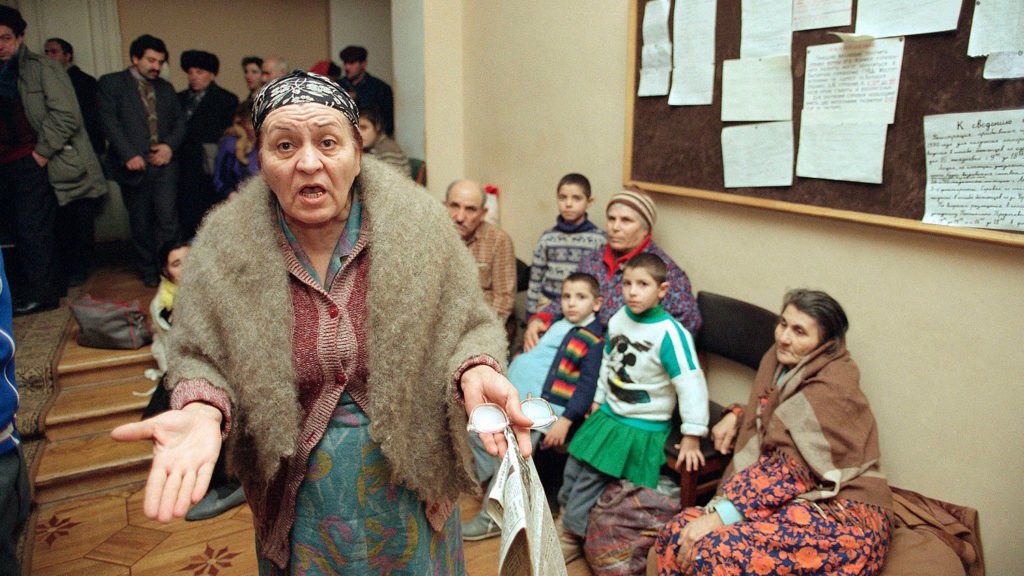
We were lucky — we had a home to go to. But mixed Azerbaijani-Armenian families had nowhere to flee; they were welcome neither in Baku nor in Yerevan. Many stayed in Baku and prayed they would come through unharmed.
Today, when I see the news [about the war in Nagorno-Karabakh], I remember my fear and feel painful sympathy for all the Armenians caught in this meat grinder once again. I kept this story inside me for thirty years and told it only to those closest to me. It is not the easiest memory of my childhood. I avoided speaking about all this in public, but now everything has changed.
There is an Alley of Shahids in Baku — that is what they call those of their own who died when Soviet troops entered the city. But there is no alley for the Armenians and Russians killed by Azerbaijanis in those days.
The Party Said to Keep Quiet
After we got off the plane and onto the buses, we were taken to military barracks outside Moscow.
The barracks were neat, with rows of made-up single beds in large, bright halls. The officers’ recreation rooms were turned into children’s playrooms. New toys and board games kept arriving. Some were left in the playrooms, and some were given to the children. That was how I chose a large plastic Buratino as a present and ran to show it off to my sister and Mom.
We did not go out for walks, because we had no winter clothes. We had fled Baku in autumn jackets and coats.
All those days, neither Dad nor Mom’s parents knew what had happened to us. It was impossible to reach Dad at his unit by phone. So Mom tried calling her parents from a payphone and the telegraph office. Anyone who has ever been there remembers the queues and the terrible connections.
After many attempts, Mom finally heard Grandma’s voice on the line and shouted: “Mom, we’re alive! We’re in Moscow!” But the connection broke off again. Mom hung up, went outside and sat on the steps, covering her face with her hands. And then a telephone operator ran out of the building and shouted: “Lady, I’ve got through to your number, the line is good, hurry into the booth!”
Mom jumped up and ran into the booth she had pointed out. She heard familiar, beloved voices at the other end, and only managed to say again: “We’re alive, we’re in Moscow, and tell Sergei…” — after that no one could speak properly any more. Everyone was sniffling and crying.
Back at the barracks, Mom sat on the bed and said one word to us: “Got through.” And fell into a deep sleep.
Mom gathered the active women in the barracks, and they went to Ostankino to demand that the truth be shown on television. But they were not allowed past the gatehouse. All the correspondents who presented political programmes at the time gave the same answer: “It is forbidden to talk about Azerbaijan.”
Fairly soon, tickets to Volgograd were bought for us. They did not give us the tickets — they simply put us on the plane according to a list. Families were sent only to places where their immediate relatives lived. Mom’s parents lived in the Volgograd region, so we were sent to Volgograd. After landing, we made our way to the bus station and bought tickets for the next bus to Kotovo.
Grandpa and Grandma met us at the bus station. For a long time they would not let us go, holding us close and covering us in kisses. I still remember that bitter cold and my cheeks wet with their tears.
When my sister and I were admitted to the local school, I could not help remembering my class in Baku. There were children of different nationalities in it, but most were Azerbaijani. Ours was a friendly class; we shared the breakfasts we brought from home and let each other copy our tests. One girl’s mother made sweet pastries and baklava every week, and the girl brought them to class and shared them with everyone. Yes, everyone brought treats — after all, this is the Caucasus, where people cannot help spoiling children with sweets and fruit — but it was that baklava I remembered most.
Dad came home on leave, and life began to take its course. One evening the news finally showed the barracks with the refugees. Apparently the women had got their way — but the report talked about what the refugees were being fed and how happy the children were with their new toys, while not a word was said about the pogroms or what those very refugees from Baku had fled.
Mom kept writing to every authority, asking for us to be granted refugee status, because without it you could neither get a job nor join the housing waiting list. The answer was always the same: “You are not entitled to it; you have a flat and a job in Baku.” Absurd, but Mom was required to work two weeks at her workplace before she could resign.
There was no other option, and Mom went to Baku. My sister and I howled and began begging her to take us too. Our friends were in Baku, and our black cat Timka, whom we had given to the neighbours on the ground floor. But Mom was adamant.
Mom told us about that return to Baku. There were many people in black clothes walking the streets, which had been rare before. Our flat had not been touched yet, so she stayed there. She and our father agreed that they would rent the flat to the military enlistment office and take our belongings away.
One night, when Mom was already asleep, a short burst of automatic gunfire rang out near the building. By then the population had quite a lot of weapons, and sometimes someone would fire into the air for no reason. Those shots were enough to give Mom a severe fright that brought on partial paralysis of her body.
In the morning Mom struggled to reach the phone and called Azer. He took her to a hospital for officers, popularly known as the “KGB men’s hospital”. There were many Armenians from Sumgait and Baku there, and a few Russians. The stories of how they had ended up there did not help her recover.
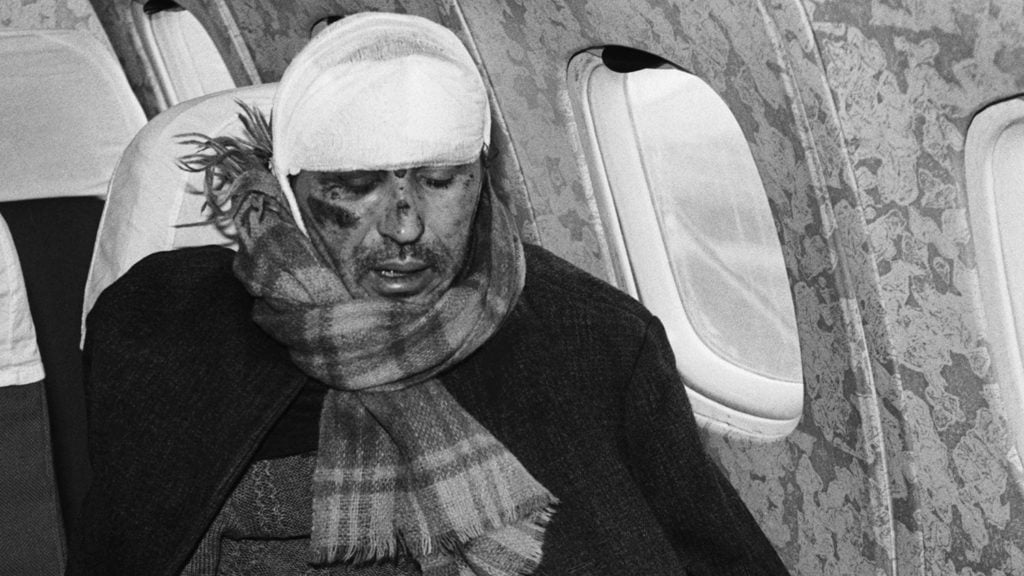
Dad flew in, and my parents decided they had to gather the bare essentials and fly out immediately. They bought tickets to Mari El and soon flew away. Dad carried Mom in his arms from the building entrance to the car, from the car to the airport, and like that all the way. Mom was admitted to one hospital, then another; they tried to help her recover and undo the effects of the shock.
In late autumn, when Mom could already manage without help for long stretches, Dad went to Baku alone — to collect our belongings and rent out the flat.
He came back with empty eyes, bringing a few things with him. When we asked questions, he answered briefly: “The military unit is gone. Other people are living in the flat. I brought everything the flat’s new owners allowed me to take.” To this day, whenever the Baku flat comes up, Dad immediately falls silent. Something happened there that he simply does not want to tell us.
On his return, Dad applied for refugee status at the military enlistment office. He described everything that had happened. But they began pressuring him, saying our family did not deserve the status because no one in the family had died. Dad wrote to the unit’s command, enclosing the documents that had survived, but to no avail. Dad’s superiors began requiring him to sign papers which said that my parents had imagined everything. Dad refused.
Dad was discharged from the army. They offered him two options — discharge or a court martial for spreading false information that discredited the Soviet army — I do not remember the exact wording. From that day on, my parents were civilians without work, without any entitlement to housing, medical treatment or assistance.
Mom kept going from one authority to another, asking for housing. But everywhere she was refused. At one institution a woman, the head of a department, shouted at Mom: “I know your sort, I bet you worked as some secretary-slut! Flew out on the first plane, and now you’re begging! You won’t get a flat!” Mom came home, locked herself in the bathroom and cried for a long time. That evening she shut herself in the kitchen with Dad and told him about it in a quiet voice. But we heard everything, having crept up to the door. We knew that when they were alone in the kitchen, they were talking about Baku.
Late in the evenings, Mom sat in the kitchen and copied out the same letter by hand, then sent it to every media outlet that existed at the time. She wanted to tell them about the events in Baku. But she never received an answer. I think that somewhere in a Komsomolskaya Pravda office, her letter, its pages yellowed by now, is still lying around in an archive. Or perhaps not.
With each year, there was less and less talk of Baku in the family. If anyone asked, we grew used to answering briefly: “Yes, we lived in Baku. We left in 1990.” If anyone wanted to know more about why we had left, we answered: “Dad was transferred to another unit.” My parents did not believe anyone would believe this story.
Later, a “Special Risk Unit” appeared in Russia, which took in Chernobyl workers and testers from Semipalatinsk-21 (Kazakhstan). Since my parents had tested nuclear weapons in Semipalatinsk-21, where, incidentally, I was born, they were admitted to it. A few years later, in 1997, thanks to that work, our family was allocated a flat.
My parents are retired now.
Dad, as a Russian army officer and a member of the “Special Risk Unit”, receives 17 000 roubles (185 euros). Mother receives 15 000 roubles (163 euros). It seems to me that these figures show how the country repaid them for their hard fate and selfless work better than any words could.
Afterword
It has been 30 years now, but I remember the kindness of the people of Baku too. Their traditions. The weddings, when big tents were set up in the courtyards and anyone who came in was welcome. Their enormous love for children, how they always gave us fruit and sweets for no reason, just because we were there. The undisguised admiration for Mom’s beauty in the streets, which irritated Dad a little but flattered Mom. The gentle sea. And courtyards full of fruit and smiling people.
And I also remember the huge bay tree in our courtyard. Around lunchtime, housewives of every nationality would come down to pick fresh leaves and chat with their neighbours, sharing recipes, cooking secrets and the latest gossip from the bazaar. Every so often telling us children, running around nearby and shrieking at the tops of our voices, to go to Shaitan. That tree has stayed in my memory as a symbol of the Baku I loved.