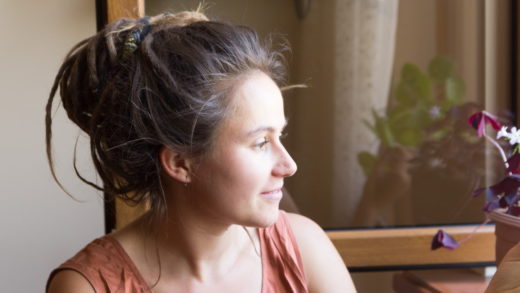

Nata takes powerful anticonvulsants. When the blockade began, she realised she had only a few weeks’ supply left of the expensive medication brought to her from abroad, and started to worry. But almost immediately she felt what she calls a strange calm — “an unmistakable sign that everything will be all right”.
“All right” means that the road connecting Artsakh with Armenia and the rest of the world will reopen: “As long as it’s on terms that aren’t frightening for us,” — and that a new war won’t begin: “Enough already, I feel for the mothers, my own son will be taken into the army in a year and a half.” In the end, things will be all right, because they can’t stay bad for long, Nata insists.
Washing windows to keep warm
“I’m so calm that my calm is starting to worry me,” Nata laughs. Our conversations depend on the rolling power-cut schedule, since the internet often cuts out along with the electricity.
Nata checks the Artsakhenergo company’s page for power cuts in Martuni — officially, three times a day for two hours. But reality doesn’t always match the schedule: after the peace agreement was signed in 2020, only six of Artsakh’s thirty-six hydroelectric power plants remained, and their capacity was no longer enough to supply the entire population, so electricity also came from Armenia, but when the blockade began, Azerbaijanis put the high-voltage transmission line out of action. Sometimes the power is out for half a day, or even longer.
Nata heats her home with electricity. The building’s layout allows only the flats at the sides to use gas. The central flats, like Nata’s, have no way of venting fumes — they can’t even install a wood-burning stove.
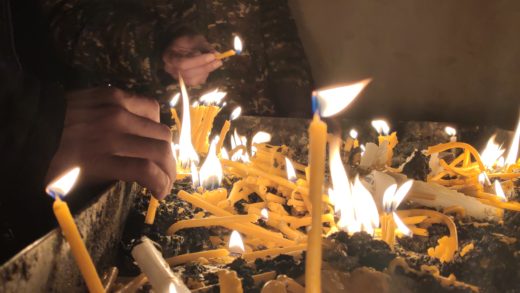
In the evening, Nata says, they light a candle, put jackets on over their jumpers, wrap themselves in a blanket and play cards with her daughter. During the daytime cuts, they try to keep moving so they don’t freeze. Just recently, they embarked on a big clean-up.
— People probably looked at us and thought: what nutcases, — Nata laughs, — no electricity, no food, no certainty about anything, and there they are washing windows.

Nata was born in Stepanakert. In the 1990s her family moved to Russia, returning to their home city when she finished school. Nata moved to Martuni when she married. She has two children. Her daughter goes to school, and her son is studying to be a financial manager at a college in Stepanakert. Or rather, they were studying: educational institutions in Artsakh have closed because of the blockade. After classes, her son works part-time at a shawarma place. Or rather, he did: food outlets have closed too.
(At the time of publication, schools had partially reopened, although power disruptions make it difficult to heat them properly — Kalemon).
Nata has been a hairdresser for 20 years. When the time came to choose a profession, she was invited to work in radio — a good voice, a knowledge of Armenian and Russian, a way with stories. But Nata felt shy — “Radio? People will gossip that I just sit there chatting.” She thought about enrolling in the Russian Language and Literature department, but realised that with her boundless energy she would find it hard to sit listening to lectures for hours; she needs to be doing something with her hands all the time.
So she followed her mother’s advice and trained as a hairdresser, and has never regretted it. She is known in Martuni and Stepanakert, has no shortage of clients, and all her trainees find jobs successfully.
Now the rolling power cuts have brought work at the salon to a halt — it’s cold, there is often no water, hair dye is running out, and her clients aren’t in the mood for beauty treatments right now anyway. But Nata says that even if people run out of money and there is no water left at all in the salon, she will go from home to home and make women beautiful for free: Nata knows that a good hairdresser often takes the place of all the doctors and psychologists put together.
Tea instead of worrying news
Shortly before the 2020 war, Nata began having health problems — severe weakness, dizziness. A few days after the war began, people started being evacuated from Martuni. Nata was barely persuaded to leave — she couldn’t tolerate long journeys. The men stayed in Artsakh, while she and her daughter, her sister with a small child, her mother, her aunt and her elderly grandmother were given shelter in a hotel in Vayk.
There, Nata’s ill health, which extended to fainting, was put down to distress caused by the war. At the local hospital they checked her heart and blood pressure, found nothing alarming and prescribed sedatives.
She returned to Martuni as soon as the war ended. Her flat got away with cracks and holes in the walls from shells — unlike the flats whose windows faced the inner courtyard: their windows were blown out.
The weakness and fainting didn’t go away, but the doctors kept insisting that it was all the aftermath of the stress she had been through — war, destruction, relatives and acquaintances killed. Until one day Nata lost consciousness right there in the street and went into a coma.
— My friends and I were walking across a bridge in Stepanakert. I felt ill, a friend suggested buying some water at the supermarket, and that’s it, I don’t remember anything else.
Nata came round in hospital. She immediately recognised the face of a doctor she knew leaning over her, saw traces of earth on her clothes, remembered losing consciousness “a few minutes ago”, and was surprised to learn that she had been in a coma for more than three hours. An MRI scan revealed a tumour in her brain, and she was urgently sent to Yerevan.
She had to travel to Yerevan several times for thorough examinations, which established that the tumour was benign and operable. Nata found the journeys harder than usual: they fell in the summer heat, and at checkpoints they often had to wait for hours for Azerbaijani convoys to pass.

— Still, at least I saved myself that way, by having the bright idea of fainting, — Nata laughs. — Seriously, though, I was so lucky to end up with [neurosurgeon] Andronik Kalayjyan and his team. They’re otherworldly, they flew down to us from heaven. They save so many lives, do such work; until I saw it myself, I couldn’t even imagine it. I’m certain our neurosurgeons are every bit as good as the surgeons in Israel and Germany.
Then came the postoperative recovery period, when she learned to walk and talk all over again. Nata now takes anticonvulsants, which some people take for up to several years, others for life, and every six months she sends Yerevan a follow-up MRI scan of her head, done at the hospital in Stepanakert.
Nata has to take care of herself: she mustn’t be out in the cold, walk or stand for long, or listen to loud noises. When her husband starts watching the news on television and swearing loudly at the screen, Nata goes to her neighbour’s: “Let’s have tea, I’ve got hold of some nice sweets.” Admittedly, there are hardly any sweets left now either — “Never mind, I put on a few extra kilos after the operation, just the thing to lose them,” — but there is still tea.
Nata tries to avoid queues, where people are on edge and shout at one another.
Queues form for food bought with ration coupons — a litre of sunflower oil, a kilogram of rice, buckwheat, pasta and granulated sugar per person per month; for bread — Artsakh still has grain, but power disruptions sometimes leave bakeries idle all day; for milk — brought from dairies to Stepanakert every day, and to the regions twice a week; for eggs, which often run out halfway down the queue; for toilet paper, of which there is less and less. Soap, cleaning liquids and hygiene products disappeared from the shelves in the first days of the blockade.

On 24 December 2022, Nata, who found it hard to stand even in a relatively short queue, ventured to join a march by Artsakh residents to the Russian peacekeepers’ checkpoint on the Stepanakert–Shushi road, demanding that they intervene and force the road of life to be opened.
— We have a well-known eye doctor, and I saw a call for the march on his Facebook page and thought it was my duty to go out too and show the world that we aren’t accepting [the situation], but demanding that the road be opened. I was shown on TV channels, interviewed; people I knew who were aware of my illness started calling, asking how I’d managed to cover that distance. It’s true, I hadn’t walked that far since the operation, but that day such strength suddenly came to me; I also took my medication, including a painkiller, and went.
— We gathered in [Stepanakert’s Renaissance] Square, went to the mass grave (the Stepanakert Memorial Complex — Kalemon), prayed and set off towards Shushi. We walked briskly, and at first I didn’t feel the cold — all my attention was on the children with us: I told them not to fall behind, to pull their hoods up, to hold their placards high. But nearer Shushi — it’s high up there — there was an icy wind, and I’d also worked up a sweat walking fast, and started shivering.

— We stopped not far from the checkpoint; [the peacekeepers] let only a few men go further. The women and children stood for a while and went back, while the men stayed overnight in the cold [Stepanakert] airport (where the peacekeeping force’s command headquarters are based — Kalemon), and the next day went to the government building, continuing to demand a meeting with [the commander of the Russian peacekeeping contingent, Andrey] Volkov, who never did come out to them. I don’t know what the march achieved, but it mattered to us to go out and tell the world that we exist, that we have demands, that our freedom and our lives are under threat.
Fighting without knowing what for
Nata’s sister’s little boy loves crisps. His mother made a deal with him: she would buy him junk food, but only once in a while. “The next once in a while has already gone by, so why aren’t you buying me crisps?” the boy whines.
Never mind crisps, but if they can bring us grains and granulated sugar, why can’t they bring vegetables and fruit? Nata wonders. Healthy adults will somehow get by on what there is, things were much worse in the 1990s, but children, teenagers — they’re growing bodies, they need fruit and vegetables. And what about people with diabetes, for whom gluten is contraindicated and who can eat only buckwheat out of the entire range available on ration coupons? Or people with cancer, or kidney patients on dialysis?
Nata herself can’t live on grains and needs vegetables and fruit — the medication she takes after the operation has enlarged her thyroid. (At the time of publication, carrots had been brought to Martuni for the first time — 1 kg per family. The shop staff didn’t know where they had come from. In Stepanakert, they had begun selling 1 kg of oranges and mandarins per family — Kalemon).

Villagers who preserved vegetables and fruit in jars over the summer and have chickens and other livestock are better off than town dwellers, but their produce is only enough for their large families and neighbours, with nothing left to sell.
Nata says she has heard that some people put their chickens to sleep for several days to save on feed. They simply don’t let the chickens out and turn off the light in the henhouse; the birds think day hasn’t come yet and keep sleeping.
— If only you could do that with people — switch them off and that’s it, off to sleep for a few days.
But switching people off doesn’t work. At night, Nata is often tormented by insomnia, and in her mind she asks questions — sometimes of the authorities, sometimes into the void. There are many questions, and fewer and fewer answers.
Nata thinks about how people had only just begun to put their lives back together after the war, and then came the blockade. Children and young people have been deprived of the chance of an education. First the Covid lockdown, then the war, now the road closure. Instead of studying, learning, moving forward, more than a hundred thousand people are sliding back into a primitive existence.
She wants the authorities to tell the people honestly how long the road will stay closed and on what terms it will reopen — so people understand what lies ahead. Otherwise, uncertainty takes a toll on their mental state: people turn angry, lash out at each other over the slightest word. And any attempt to think through a possible solution brings accusations of ties to one political party or another.
— We Armenians are very strong, we’re all fighters. We’ll endure hunger and cold, as long as we know what for. That’s what we demand to be told. And then we’ll endure as long as necessary — without food, without electricity. The hardest thing is to fight without knowing what you’re fighting for.
Angry because they’ve been abandoned
Nata was a child during the first Karabakh war. Her memories are fragmentary, but every one has an element of the extraordinary solidarity among people.
It was worse then — there was no food and constant bombing. Nata remembers shells hitting the buildings on either side of their house. Her family, sheltering in the basement, was buried under earth, but they managed to get out. Every morning, under bombardment, her father walked to the next village and brought the children a little milk.
In April 1992, her mother’s relatives from the village of Maragha reached them — those who had survived the terrible massacre. Afterwards, they were flown out of Stepanakert at the first opportunity in little crop-duster planes. While the relatives were staying with them, Nata’s grandfather ground grain with millstones, and her grandmother baked blits (flatbreads) from this “dirty” flour for everyone, and that was their only food.
— However hard it was, people were together and helped each other. Now they’re tired. People have turned angry because they’ve been abandoned. In the 1990s there were heroes who united the people, not the other way round. There’s a large portrait of Monte at the entrance to Martuni. Every time we drive past it, my husband says loudly: “Hello, Monte.” Once I asked him why he didn’t just look at the portrait, or nod, for that matter, instead of greeting him so loudly. My husband replied: “Because he hears me. He’s in a very bad way up there. He did so much for us, freed our land, and we couldn’t hold on to it. That’s how I express my gratitude.
— We need to be together. I feel so awful when people start dividing us into Artsakh people, hayastantsi (Armenians living in Armenia — Kalemon), spyurk (the diaspora), when they start accusing one another — who voted for whom, whose relative is higher up, who’s richer. We’ve each shut ourselves away now, we’re apart, so we’re weak and easy to control. You listen to people on television, in the streets, everyone talking, talking, but not actually to one another — each to themselves. We’re always blaming someone, and that weakens us.

— I watched a video of the red berets dragging soldiers’ mothers (who were planning to keep Prime Minister Pashinyan away from their sons’ graves — Kalemon) out of Yerablur. I couldn’t get over it for days. If that’s how they treat the mothers of fallen soldiers, it’s frightening to imagine how they might treat other people. If we unite — in Artsakh, Armenia, the diaspora — there are so many more of us than them, we’re stronger, then they’ll be afraid of us. We’ve forgotten that it’s not the people who depend on the authorities, but the authorities on the people.
— We need to clean house among ourselves, get rid of the traitors, everyone who’s turned our state into a business, who sends their wives and children on holidays abroad at our expense, and a new leader will emerge on their own. If no one on the inside is stuffing their face, we can’t be beaten from outside. Something needs to go “click” in people’s heads so they wake up. I keep thinking, thinking on sleepless nights, but I haven’t yet managed to work out what that “click” should be.
So heavy, yet you give up so lightly
The neighbours have nicknamed Nata “the Director”. Because I like getting everyone together, and I’m a little rough: I say everything to people’s faces, she laughs. Even when Nata lay weak and helpless herself after the operation, everyone still came to her with their problems, insisting she gave them good advice — as though they’d been to a psychologist.
Nata says that helping others makes her feel better herself. Just the other day, she was queuing with her neighbours and noticed that the shopkeeper’s hands were already shaking — so many people to serve, and he’d run out of plastic bags too. She went home, brought some bags and, together with her neighbours, started helping him weigh and hand out the food.
— I was joking too, making my friends laugh so the wait would be more cheerful. Then a man who apparently didn’t like us laughing our heads off turned to us and asked seriously: when the road opens, what would you like them to bring first? The women fell silent, and I said: Sanitary pads, of course! He got embarrassed and turned away — well, what? He should keep his nose out of things that aren’t his business!
But Nata too, of course, has days when she wants to hide under a pillow and cry.
— When I was in intensive care after the operation, my beloved grandmother died. Then my aunt died. I was very ill myself while I was recovering. They assigned me disability group three, but I cried on my way to the assessment panel, I didn’t want to have a disability, I wanted to be healthy and strong, I never made use of [the benefits the group entitles you to]. We spent all our money on expensive medication, on staying in Yerevan during the operation (we don’t have anyone there), I couldn’t work. Things were very bad then.
— But I’m a believer and I talk to God a lot. Both when I’m doing well and when I’m not. If this were the end, I tell myself, you’d have croaked long ago. If you’re holding on, it means God is holding you up, don’t let him down. Or I shame myself: so heavy, yet you give up so lightly. If you give in to panic, slide into depression, you could die that way. Yes, there are hard days. Yes, you can cry, but you must never, ever give up.

On one of those hard days, Nata wrote on social media:
“There is no electricity in Martuni, no gas, no water, it’s very cold in the shops and my soul hurts very, very much. And no help at all.”
She was surprised and touched by the number of supportive messages — not just from Armenia, but from other countries too. Women she didn’t know from Georgia and Russia wrote that they shared her pain, asked how they could help and offered to send money. Nata dismissed the offers of money straight away — there was nothing to buy with it anyway. But it turned out that words of support and prayers from outside mattered a great deal: “I felt so warm straight away that I forgot there was no gas or electricity.”
But one message upset Nata. A woman from Martuni wrote: “Why are you panicking? Yes, there’s no electricity, so what, it’ll be back soon.” What upset Nata wasn’t that the woman who wrote it had a detached house heated with wood, with running water in the yard, and didn’t understand people living in flats without those possibilities — in Nata’s flat, on the second floor of a four-storey building, the pump stops pumping water when the electricity goes off. It was that more and more people were getting used to the idea that a lack of electricity and other hardships were normal. And getting used to it eventually leads to a feeling of helplessness and an unwillingness to act, Nata is certain.
A walk around New York
In the evenings, when sometimes the power is off for a long time and they grow tired of cards, Nata and her daughter dream.
Her daughter dreams of going to medical college in Stepanakert after school and then, if the family’s finances allow, to Yerevan Medical University. She very much wants to get a job, like her brother.
Nata says her son has worked part-time since he was 12, and that she and her husband support their daughter’s wish too — “Once she goes to college, let her work and spend her own money on clothes.”
Nata herself dreams of a large beauty salon of her own, where different specialists will work — “and people will be hired on merit, not through connections.” She longs to visit New York, which she fell in love with long ago after watching the film Home Alone.

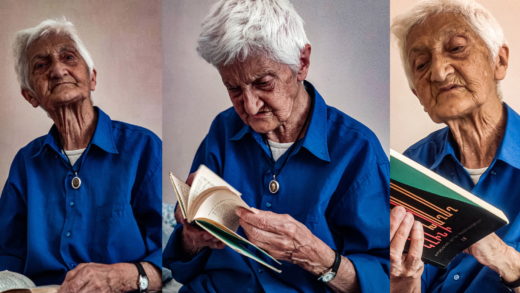
Nata loves reading medical and psychological encyclopaedias: “When I talk to them, doctors always ask whether I have a medical education. I say — no, but my profession is like yours: you have scissors, and so do I” (laughs) — and dreams of trying her hand at psychology.
And of them, “ordinary people”, being left alone, allowed to live in peace in their own homes, on their own land.
— Now I’ve told you about being offered a job in radio when I was young, and I’m dreaming of making that happen too.
— Will you go to Stepanakert to try out when the road opens?
— I don’t know anyone [at the radio station], and besides, I’m not 19 any more, it’s scary, but maybe I’ll gather all my courage and go.
Nata asks me about herself. Learning that we have horses, she adds another dream: to come and visit when the road opens, and treat herself to a photo shoot with them. And I tell her about mine: curly, fiery-red hair, and ask her to book me in for the treatment soon.
And since we’re discussing our interconnected dreams that are no longer dreams but plans, I ask for a postcard from New York into the bargain.
Since 12 December, the Berdzor (Lachin) corridor — the only road connecting Artsakh with Armenia — has been blocked by Azerbaijanis calling themselves “independent environmentalists”.
The “environmental defenders” demand an end to “the illegal exploitation of mineral resources on the territory of Azerbaijan” and permission to monitor the mines. These are the Drmbon and Kashen mines in Artsakh’s Martakert district, which Azerbaijanis tried to enter on 10 December, but were stopped by the mine’s security guards.
The road closure cut off 120,000 residents of Artsakh — including children, older people, people with disabilities and those who need special medication — from the outside world, separating children from parents who found themselves on opposite sides when the road was closed. From the very first days, Azerbaijan has regularly cut off the gas supply to Artsakh — the pipeline passes through territory that went to Azerbaijan after the 2020 war.
There are rolling power cuts in the republic, and often no water. Many foodstuffs and basic necessities have disappeared from shop shelves (a ration-coupon system has now been introduced for them), vital medicines and baby food from pharmacies, and there is a fuel shortage.
Seriously ill people who need to be transferred to Yerevan hospitals are waiting in intensive care. Red Cross vehicles have taken several of them across; some could not be saved.