
Part One: Maral
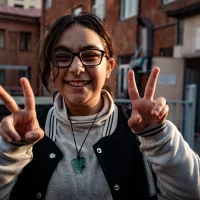
— A real, professional one! Can I take some pictures?
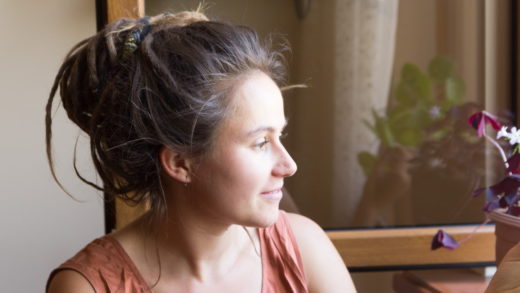
I hand Maral the camera, and she points it at people, buildings, the street, trying to compose a shot and jumping with delight when she thinks she has got it right.
Her mother promised to save up and buy her a camera if Maral does well at school. And she is trying as hard as she can, because she wants a camera “more than a guitar”, and her village school is so boring. The school in Yerevan, where she has been going along with her friend Liana for the past few days, is a different matter altogether.

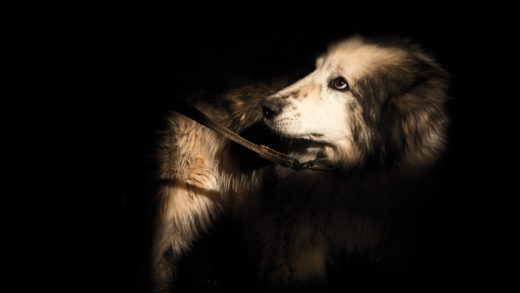
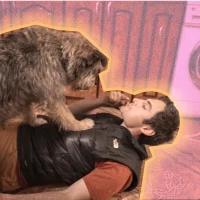
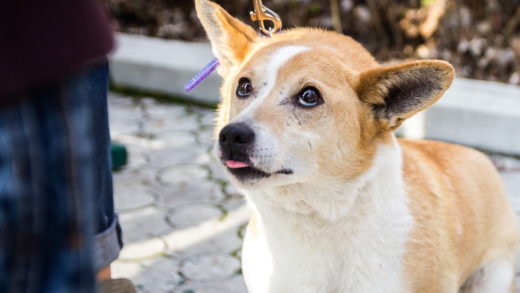
I have brought Aslan along to the photo shoot. The girls vie with each other in their delight at him, stroking him and asking to walk him on the lead. I tell them that Aslan is 13, that he has heart failure, takes medication for life and goes to the clinic once a week to have fluid drained from his abdomen and lungs — today happens to be his next appointment — and that he will not live much longer.
I am already beginning to regret those last words. They usually bring sad exclamations or tears, and I want Aslan to have as much joy as possible now. But the teenagers — Maral is 12, Liana 16 — take the news with surprising maturity. They shower Aslan with still more affection, try to cheer him up, slow their steps to match the gait of a dog who now finds it hard to walk fast.

The Road Is Closed
Maral lives in Artsakh, in the village of Mets Shen. On December 1 she came to Yerevan with her mother for an operation to correct her strabismus. They were supposed to return home on December 14.
They already knew that the road had been blocked by Azerbaijanis calling themselves “independent environmentalists”. Maral’s mother, Sevan, spoke to police officers from Mets Shen, who promised to alert the Armenian military and Russian peacekeepers so that they would let them through. The Armenian soldiers did indeed let them through, but the peacekeepers initially forbade them to go any further.
Sevan is a nurse and the only healthcare worker in Mets Shen. After lengthy arguments with the peacekeepers and a three-hour wait at two checkpoints, she managed to secure permission to enter — on condition that the car taking them to the village would come back.
— We passed the [second] checkpoint and I started shaking, — Maral says. — I suddenly thought that the road might never reopen, that we might lose Artsakh, and I became very anxious.
Her mother went on, while Maral returned to Yerevan. She needs to remain under the doctors’ supervision for at least another month. Planning that far ahead is an unaffordable luxury now.
She is now staying at the home of Armine Barkhudaryan, Liana’s mother and a doctor with “Travelling doctors”, the organisation that helped make her operation possible.
She misses her parents, calls them every day and asks what they need. She feels sure the peacekeepers could not possibly refuse to pass on a parcel of food and medicine.
But her mother says that the most useful thing to do now is to join the picket — the one Artak Beglaryan, adviser to the state minister of Artsakh, organised outside the UN building in the first days of the blockade.

Sevan disagrees with the choice of location for the picket — in her opinion, a sit-in would be better held outside the government building or the Russian embassy — but believes that coming together is much more important.
— I go there, and journalists immediately start interviewing me.
I’m shy and I find it hard to talk to people, but I never say no — the louder we shout, the better the chance that the world will hear us. Or maybe I’m naive and the world doesn’t care, but it’s better to go [to pickets] than to do nothing at all. Just recently they recorded a video appeal with me, and it spread on Twitter. Let’s see how many likes the video has got.
Maral opens Twitter and exclaims:
— 12,000, wow!
— Is that good? I don’t really understand Twitter.
— I’d say — very good!
I’m Used to War
We sit drinking tea in Armine’s flat, which has temporarily become Maral’s home. Maral speaks a mixture of Western and Eastern Armenian, weaving English words and a pinch of the Artsakh dialect into her speech.
— Are you afraid? — I ask.
— Not for myself, — Maral answers after thinking for a moment. — I’m used to war.
— Can you really get used to war?
— You can, when you’ve seen it since childhood. I worry about the children in Artsakh: I don’t want them to see what I saw in Syria.
— And what did you see?
— Children’s corpses — one missing a head, another an arm, pregnant women with their bellies slit open, children being thrown into boiling water. I was about four, but I still remember it.
Maral was born in Kessab, a town on the Turkish border populated mainly by Armenians. In March 2014, al-Qaeda militants attacked the town, massacring dozens of Armenian Christians. Maral’s family fled to Latakia and returned two months later, when the Syrian army had restored relative safety and the destroyed infrastructure in Kessab.
Their house, right on the border with Turkey, was almost unscathed — Maral recalls that only the walls were riddled with bullet marks and covered in inscriptions: “Allahu Akbar” and “You’re next. We’ll come for you.” The Turks used the four-storey house as a lookout point — from there, the whole town lay in plain sight.

Maral’s mother served in the military. The girl says that Turks began following her and her father, making little attempt to hide it, calling from unknown numbers and threatening them.
— When I took the bus to school, I saw them standing on high ground, watching us. More precisely, they were Arabs who had gone over to their side.
— How could you tell they were Arabs?
— Most of them grew beards, but no moustaches. And their hair was always dishevelled. But they didn’t come close (she smiles slyly), they knew Sevan’s daughter could fight.
But then the Turks called Mum and said that if she didn’t leave her job and the country, she could forget about her husband and daughter. And within a few hours we packed our things and moved to Yerevan, like many other Syrian Armenians before us.
Two Years, Two Moves
The historical homeland proved entirely unprepared for the influx of refugees. The state gave them no legal status and set up no housing programmes. Maral says she had to leave her first school because it upset her that children kept coming up to her and asking who her family were: Turks or Arabs?
With the money they had saved in Syria, Sevan and her husband Garo opened a small eatery. Garo is a cook; in Syria, the family owned two restaurants. But the small business went under during the Covid pandemic. Sevan took a job as a nurse in a hospital, and Garo found work on a building site.
A year and a half ago, a friend called Sevan and suggested she move to a border village in Artsakh to work as a nurse at its medical station. A week later, Sevan moved to Mets Shen with her husband, daughter and three cats. Garo got a job as a night watchman at the local school..
— You see, — Maral says in response to my surprise at how hastily such a serious decision was made, — patriotism — homeland, Armenia, Artsakh, Sis-Masis, Sevan, Tatik Papik — is drummed into us Syrian Armenians from childhood. Everything for the homeland, nothing is higher than the homeland and serving it. Maybe I’m not much of a patriot myself, but Artsakh is my home. It’s… How can I put it? When you realise that nowhere else in the world could you feel this good.

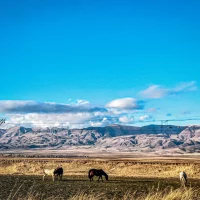
Mets Shen has very beautiful nature, Maral says. Many people keep pigs and cows, and she can spend hours watching the animals graze on the green hills. But there is absolutely nothing to do in the village. Many are leaving. There are thirteen pupils at the school now — four in her class, and none at all in the final three grades. Three more pupils, who live in one family, are going to leave the village, and if she makes the same decision, there will be so few children left that the school may have to close.
— I don’t want to leave Mets Shen, — Maral says. — I love Artsakh very much. People in Yerevan are kind of nervous, but there they’re cheerful and calm. But I have no idea what I’ll do in the village after finishing school. When we lived in Yerevan, I went to all sorts of clubs — dancing, swimming, drama — but there are no activities here at all.
About 50 people live in Mets Shen. The oldest, Maral says, is 93. Every morning he comes down to the centre of the village and sits there until evening. Sometimes his son comes to visit him. And the youngest resident was born last year. A few other people, who came to the village on business and cannot return home because of the closure of the Berdzor corridor, are temporarily staying in the villagers’ homes.
There are only two options for work in the village — either the village administration or the school. Maral’s parents dream of sending her to a military school, but have left the choice to the girl.
The New Road
Maral says that before the new road linking Artsakh to Armenia was built through the village, life in Mets Shen was considerably calmer and safer. The road was uneven and stony, and cars drove slowly. Now it is smoothly asphalted, cars and heavy lorries alike hurtle along it at breakneck speed, and animals being run over have become commonplace. Children living “on the other side of the road” have to run across it twice every day: on the way to school and back.
The highway was built by Azerbaijani workers under Turkish foremen. A Russian peacekeeper, Syoma — a young man of about 26 or 27 — kept an eye on them.
— He was very nice, we all loved him. Sometimes the workers made remarks or took pictures of our girls on their phones. Syoma would chase after them and make them delete the photographs. After work he would change into shorts and play volleyball with us.
Maral says that many of the workers tried to make friends with the villagers; some even spoke flawless Armenian. The adults did not forbid the children to talk to them from a distance, but would not let them go close. Toothless old women came out to the road, cracked sunflower seeds with nothing but their gums and quietly directed good-natured curses at the workers.

There were times when the construction workers needed medical help: they got sunburnt, for example, or someone’s blood pressure went up. When the first worker, a Turkish foreman, came to Sevan asking for help, she looked at his burnt arm and said pensively:
— I could spray some acid on it, make it even prettier.
The Turk did not appreciate the joke, took fright and ran away. But Sevan sent a peacekeeper after him and treated the burns. Maral says that the foreman was effusive in his thanks and declared that Sevan was his sister from now on.
— But that made Mum really indignant. She told him never to dare say it again. She had helped him as a human being, because she had taken the [Hippocratic] oath, but she hates him as a Turk and cannot be his sister. But that didn’t stop him, — Maral laughs, — and right to the end he kept saying how much he loved me and Mum. Behind her back, though — everyone was a little afraid of Mum.
Maral says that Syoma’s superiors found out he was playing volleyball with the children, and he was transferred. For the last two days before the roadworks were completed, the villagers were left alone with the Azerbaijani workers.
Delicious Falafel
In the evening we head down to the UN building together. Traffic is backed up on Marshal Baghramyan Avenue. Maral says that being a girl in the village is not easy.
— Nothing but demands and prohibitions. You have to wear dresses and skirts, keep your legs together when you sit, be modest and obedient, otherwise no one will marry you. In short, dead boring. I don’t like dresses, I like wearing trousers. I can also shoot and fight.
As we slowly move forward in the stream of cars, Maral tells me about her first fight, when she was about seven.
— That was back in Syria. There was a boy at our school, Yousef, who used to beat me up all the time — I would come home with a black eye one day, a broken tooth another, and cry. Mum would get angry, she’d say — I’m a soldier, and my daughter can’t defend herself. If I see you crying again, I’ll beat you. One day I’d had enough — this Yousef on one side, Mum on the other, you don’t know which is scarier. And when that boy pinned me against the wall yet again and said in this smarmy voice, “Well, what are we going to do today?”, to my own surprise I said, “We’re going to beat up Yousef.”
— Mum taught me a boxing move — a left hook to the jaw. I hit him, and he fell. And I started crying — it was the first time in my life I’d hit someone. Later I got used to it and it became easier to punish people who hurt me. Once a boy broke a pen Mum had given me. And Mum was at her post, and we hadn’t heard from her for three months. My eyes filled with tears. I kneed him in the face. There was a commotion, the teacher and headteacher came running. But I wasn’t punished, and Mum returned that very day. That boy and I became friends afterwards, but Yousef was expelled from school.
In the centre we park in the courtyard of a block of flats and go the rest of the way on foot. It is impossible to walk calmly through the streets with Maral — she will not pass a single stray dog or cat by. Seeing a fat ginger cat clumsily trying to cross the street, hiding under the wheels of cars, the girl runs up to him, picks him up and carries him across the road — to the safety of the grass.
Maral misses her cats, who, family though they are, have completely different personalities. Sevuk, for instance, is a homebody. Her daughters Mimi and Bloch like the wandering life — they can disappear for days, even months, despite being spayed.
Maral peers admiringly into the windows of clothes shops.
— We lived very well in Syria. Healthcare workers and soldiers both earn a lot there. But in Mets Shen money is tight, and I can rarely afford nice clothes. I even feel embarrassed going to Liana’s school because my clothes aren’t very good.
We reach the UN office. Like Maral, I am not sure how productive our participation will be, but I agree with her — it is better to stand there with the others and hope it will lead to something than to languish at home with a sense of one’s own powerlessness.
Speaking at the picket are Artak Beglaryan, former Artsakh ombudsman Gegham Stepanyan, who warmly greets “Sevan’s daughter”, former Armenian ombudsman Arman Tatoyan, and others.
The ninth day of the blockade. Tonight, the UN Security Council will discuss Azerbaijan’s blocking of the Berdzor corridor, and the speakers stress the importance of people coming together and expressing solidarity with Artsakh at this very moment.
It is very cold outside the UN building. There are not many people, mostly men. It seems to me that you rarely see Armenian men wearing warm footwear in winter, so when a yellow-and-black forced-air heater is switched on, they are the first to reach for the stream of hot air. They hold their feet in front of it for a few seconds and hastily give way to Maral and me. The girl sits on a chair, stretches her legs out towards the heater and blows on her fingers through the warm gloves I have lent her — she did not bring her own, it was still quite warm at the beginning of December.
At the picket we meet Anahit, the owner of “Ilik” café, and go to her place for pomegranate and rosemary tea and falafel. Maral, who comes from Syria and misses the food there, admits that she has not had falafel this delicious in a long time.
Since December 12, the Berdzor (Lachin) corridor — the only road linking Artsakh to Armenia — has been blocked by Azerbaijanis calling themselves “independent environmentalists”.
The “environmental defenders” demand a halt to the “illegal exploitation of mineral resources on the territory of Azerbaijan” and permission to monitor the mines. The mines in question are Drmbon and Kashen, in the Martakert district of Artsakh, which Azerbaijanis tried to enter on December 10 but were stopped by the mine’s security guards.
The blocking of the road has cut off 120,000 residents of Artsakh — including children, elderly people, people with disabilities and those who need special medicines — from the outside world, and separated children from parents who happened to be on opposite sides when the road was blocked. In the first days, Azerbaijan cut off the gas supply to Artsakh — the pipeline runs through territory that passed to Azerbaijan after the 2020 war; the supply was later restored.
Many foodstuffs and essential goods have disappeared from shop shelves, and life-saving medicines and baby food from pharmacies; there is a shortage of fuel.
Seriously ill people are waiting in intensive care, needing to be transferred to hospitals in Yerevan (at the time of publication, one patient had died and two had been transported by Red Cross ambulances).