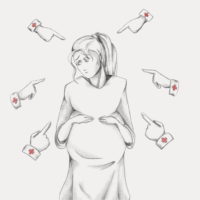

When I was twenty-four, I experienced obstetric violence. It is not something people talk about, and often they do not even call it what it is. Yet in late 2019, a special UN report was published that recognized obstetric aggression as a human rights violation and proposed ways of addressing the problem internationally. A woman has the right to dignified and respectful treatment during childbirth and related obstetric care. But do all obstetric practitioners know this?
You Do Not Deserve This Child
It was five in the evening when I woke up with a strange sensation. I got up, and my waters broke. “It is time,” I thought, “but why doesn’t it hurt?” I panicked, instantly imagined several possible bad scenarios, comforted myself and gave myself encouragement. I changed clothes, we called a taxi and went to the maternity hospital.
On the way, I was in something like a stupor: I felt, saw and heard nothing. Shengavit Medical Center was close to our home, so we got there quickly, and then everything happened very quickly. Three years later, only the pain in my tailbone that is still there reminds me it was not a dream.
We rode up in the elevator in silence. When the doors opened, I heard agonized screams coming from one of the delivery rooms. As I came closer, I heard another voice. It was the doctor “supporting” the woman in labor. She was shouting: “You do not deserve this child,” “Calm down immediately,” “Are you thinking about your child? Push properly,” “I will tell your child how you behaved.”
Two days later, that woman and I were going down in the elevator for an ultrasound of our uteruses. Her face was colorless; she looked exhausted and broken, as though she had not just given birth but had been undergoing a long course of treatment for a disease that was slowly killing her. I looked at her and thought something was wrong here: a woman who has just given birth should not look like a refugee from Auschwitz. I imagined how happy she had been about her pregnancy, and now she stood leaning against the elevator wall, groaning in pain.
She could barely stand, and we—the other four or five women who had just given birth—looked at one another in silence and, realizing that she was the worst off right now, gave her the only chair by the door to the ultrasound room. With difficulty, she perched sideways on the edge of the chair: she had had an episiotomy—a cut in the perineum—and could not sit upright.
Compared with her, I was lucky: I had not had an episiotomy.
Or Things Will Go Badly
It was six in the evening when I entered the delivery room. My gynecologist soon came in and, without a word, started the IV drip. I timidly asked what it was for, but she did not answer, just looked at me angrily. “It is because I am not having contractions, right?” I asked again. “What? Are you?” she cut in rudely. “Labor without waters. We need to speed things up, or things will go badly.”
I could not say anything in reply because I had not expected that. I had decided to give birth with her because, during my pregnancy, she had struck me as a doctor who preferred not to burden her patients with unnecessary medication.
She was rather callous in conversation, but I excused it because of her age and the Soviet-era ways in which she had come into her own as a doctor. When she said she was against epidural anesthesia, I became even more convinced that I could trust her.
Her answer was a slap in the face. I thought I was a worthless woman and mother, because in a “proper” labor the contractions were supposed to come first and the waters break afterward. With me it was the other way around, which meant I was about to kill my child. On top of that, I had the nerve to question the need to inject me with all-powerful synthetic oxytocin. The guilt lodged deep inside me, and I fought it for three years, including with the help of a psychotherapist.
The doctor started the drip and left. She came back twenty minutes later and increased the drip rate. She sat down next to me and called her son, who wished me an easy birth. I would gladly have thrown the phone out of the window and screamed in her face that she should be answering my questions, not chatting on Viber, but I did not. At that moment, I felt vulnerable.
The oxytocin was already working: the pain had intensified. She finished the conversation, ordered me to walk, and left.
I started walking. Each contraction hurt more than the last; it felt as though my lower back was falling off. I was not allowed to wear underwear, for a reason no one told me. Instead, there was the old-fashioned method: take a rag, put it between your legs and walk like that—holding the rag between your thighs. That is how I walked around the room—legs squeezed together, with my enormous belly, in splendid isolation, and there was nothing in the room to lean against except the stand holding the bag of saline. But it was so thin I was afraid I would break it.

At some point, I wanted to get down on my knees. I felt that my body wanted to take that position. I bent down, but just then a nurse passing by realized what I wanted to do, snapped, “Do not get down on your knees,” and left. The stand and I were alone again.
What the nurse said made my guilt even stronger. “Apparently, it is not safe for the baby, and I am thinking only of myself.” Of course, I could actually have got down on my knees, but then the nurse would have had to stay with me to help me get comfortable, and that was inconvenient for her.
Bear the Pain Meekly
When a woman gives birth without intervention, the pain can be quite bearable. Everyone feels it differently, so the brain manages labor according to the individual characteristics of the body. Natural labor pain begins and builds gradually, allowing the body to “digest” it.
In addition, the hormone endorphin is released during labor. Its purpose is to relieve pain in the body and help it cope with stress. Endorphin, known as the happiness hormone, improves a woman’s mood and helps positive associations become fixed in her memory. After all, one should give birth as often as possible—at least from nature’s point of view.
In artificially stimulated labor, as practiced in our maternity hospitals, the pain can be unbearable. When I gave birth, I was literally paralyzed. It felt as though horses were pulling my arms and legs in different directions and were about to tear me apart. I was incapable of thinking about anything else. A woman in labor is supposed to be relaxed, but my body was stretched taut as a string. I could not even groan, while the nurses standing nearby nodded approvingly: “How meekly she bears the pain.”
I felt like a doll with no will of its own. My body wanted one thing, the people in white coats another, but they had the final say. I was confused and could not concentrate; I did not understand what was right and what was not, and the same thing was happening in my brain, whose natural functioning had been disrupted from outside. It no longer had time for happiness hormones.
“I Hate Getting Them to Squat”
Over the past three years, I have read a great deal about obstetric aggression. Most authors point out that forcing a woman into any particular position is one of the most serious mistakes medical staff can make. There will be much less stress if the woman takes a position that is comfortable for her body—sitting, kneeling, squatting, lying on her side. Less stress means an easier, safer birth. Yet the common practice of giving birth lying on one’s back contradicts not only logic but also the law of gravity.
I would gladly send the delivery chair to a museum of the history of torture as one of its most outstanding exhibits. It is impossible to imagine a more uncomfortable contraption for childbirth than that chair: it is hard to climb onto, hard and narrow. I was afraid I would fall off, so I tried not even to move my arms.

The delivery room itself looked like an operating room—stark, cold and alien. It did not fit my sensitive and vulnerable state of mind.
When I reached the pushing stage of labor, I did not understand how to push. At one point, the gynecologist said to the midwife: “Try a few more times. If it does not work, get her to squat. How I hate getting them to squat.”
I used to believe that during childbirth everything should be done in whatever way was comfortable for the woman in labor. Yet the chair was raised high so the staff would be comfortable, the room was brightly lit so the staff would be comfortable, the drip ran without stopping—so they would be comfortable. I was supposed to relax, but how do you relax when you are lying on your back with your legs spread under bright spotlights?
Four Hours
At 21:50, my son was born. I had entered the delivery room without pain or contractions, but my labor lasted only four hours.
For the baby to come out, the cervix has to dilate to ten centimeters. In a woman giving birth for the first time, dilation can take quite a long time.
My labor was artificially accelerated. About ten minutes after I entered the delivery room, I was put on a drip of synthetic oxytocin. Oxytocin should be started at five drops a minute, then gradually increased by five drops every thirty minutes. I read that in the instructions. But my gynecologist started at ten straight away, and twenty minutes later it was a full thirty-six drops.
If she had followed the instructions, she would have had to come over to me seven times in three and a half hours—just to adjust the drip properly. Of course, that would have been inconvenient, and the doctor arranged things so that by the end of the fourth hour I had already given birth.
Oxytocin is a hormone the brain uses to stimulate and manage labor. Every woman’s brain produces a certain amount of oxytocin according to the characteristics of her body. Was that dose of the synthetic hormone acceptable for my body?
There is a new profession that has already become indispensable: lactation consultant. It is not a medical profession, but its practitioners have basic medical training and a thorough knowledge of how human mammary glands work. They help new mothers master the proper breastfeeding technique. The consultants note that women whose labor was artificially stimulated tend to have trouble breastfeeding. I, for one, was among them too.
Fortunately, in my case the doctors’ interventions were limited to oxytocin stimulation and the Kristeller maneuver. When the gynecologist saw that I was not pushing well enough, she decided to “help.” She pressed her forearm against the top of my abdomen to push the baby along.
The WHO (World Health Organization) considers this method high-risk and advises against using it: the doctor applying pressure cannot see the position and angle of the baby’s head and torso. If the baby passes quickly through the birth canal in this way, its head may be compressed and injured.
Of course, there are cases—for example, when there is a risk of fetal hypoxia—in which using the Kristeller maneuver is justified. But what is that risk connected with? No one can give a precise answer to that question, but in some cases it may be connected with unwarranted medical intervention in the process of childbirth.
Until the cervix has dilated to the necessary width, the body will not push the baby out. Artificial stimulation can cause confusion: the uterus starts pushing the baby toward the birth canal before dilation has occurred. As a result, intervention becomes necessary to get the baby out and save its life.
Wait Do Not Induce
There is a reason a woman in labor should be surrounded with love, warmth and care. In stressful situations, we produce adrenaline, a hormone that can mobilize a person’s strength and save them in danger. But that is not at all what you need when you are giving birth, because adrenaline suppresses the synthesis of oxytocin in the blood.
Pregnancy is a “hormonal hurricane.” A pregnant woman is sensitive; a woman giving birth is at her most vulnerable. She can hardly defend her rights actively. It is easy to intimidate her, to crush her. I was not strong that day either. I wanted to leave alive and healthy, with a healthy baby in my arms.
A few weeks after giving birth, I began studying articles describing international obstetric experience and practices. Sometimes the waters break before the thirty-seventh week of pregnancy—this is what is called “early labor.” The baby cannot go on living in the uterus, and the woman then needs to be delivered. This is a dangerous occurrence but, fortunately, quite a rare one.
Waters breaking without contractions starting after the thirty-seventh week happens more often—about one woman in ten experiences it. This is one variation of normal: in this case, it is possible to wait and try to stimulate labor naturally, for example with warm water, walks or pregnancy yoga. It is possible to choose intervention and stimulate labor artificially if there are indications for it. Doctors should assess the fetus using ultrasound and CTG, make sure that the fluid that has come out is colorless and has no pronounced smell, check the woman’s blood pressure, and so on. If these examinations show that everything is within the normal range, the pregnant woman can even go home.
When there are no indications for intervention, as in my case, there is nothing wrong with waiting for natural contractions. The statistics are approximately the same in different countries: six out of ten women will start having contractions within the next twenty-four hours, the others after two or three days, and only a small number of women will still not have contractions by then, which may be considered an indication for intervention.
The main thing here is to prevent infection, since the sterile amniotic membrane has been broken. After 24 hours, this risk increases, so it is important to observe hygiene rules—no sex, frequent changes of underwear, no swimming pools, avoiding crowded places, using sanitary pads rather than tampons, and showering regularly.
Meanwhile, it is precisely in the maternity hospital that there is a risk of picking up an infection—through the common practice of vaginal examination with the fingers. The WHO recommends examinations no more often than once every four hours: an obstetric practitioner, gynecologist or even an intern passing by may skip washing their hands before putting gloves on. There are also cases where a medical worker takes off their gloves, puts them on the chair and leaves, then returns, puts them back on and performs another examination.
Nevertheless, if you ask why gynecologists and obstetric practitioners prefer intervention when there are no contractions, they will say that it is precisely infection they want to prevent. Armenian maternity hospitals practice artificial stimulation of labor even though the Armenian Ministry of Health’s official protocol states that it is possible to wait at least 24 hours and that the staff should be prepared for prolonged cervical dilation.
The protocol also says that the woman and her partner should be informed both about the option of stimulating labor and about the option of taking a wait-and-see approach. Medical staff should act according to the woman’s wishes.
It turns out that my gynecologist grossly violated the ministry’s protocol and my rights. I should have known about the option of waiting; I had the right to refuse stimulation and to consult my husband, whom she refused to let into the room. Her role was to keep me safe, but not at the expense of my rights.
Stop Asking Questions
I am better informed now than I was when I gave birth. For example, I know that with a breech presentation—when the baby’s pelvis faces the entrance to the woman’s pelvis, rather than the other way around, as normally happens—it is possible to give birth rather than have a cesarean, though I have no idea what I would do myself if I were in that situation. I know that next time I will try to avoid artificial stimulation, but I do not know how I will behave if the gynecologist insists.
I have doubts because I am afraid.

An atmosphere of fear reigns in our maternity hospitals. Doctors fear the death of the baby or the woman in labor, so they would rather pull the baby out, tearing the woman apart. They fear uncertainty, they are afraid to wait and not have complete control of the process. The women, in turn, are afraid too—and tense up.
Most problems will not arise if doctors start talking to women.
After my son was born, the doctor brought a pill and told me to put it under my tongue, without another word. I asked what it was for and heard in reply: “Stop asking questions. I am tired.” At first I was speechless, but a second later I was so angry I almost swore at her at the top of my lungs for the whole maternity hospital to hear.
I was sprawled on the chair, utterly exhausted, with freezing legs; my arms, neck and tailbone hurt badly; my perineum was swollen from the midwife twisting it with her fingers, and it hurt too; my son was somewhere I did not know, alone, and I was alone, hungry and tormented by thirst.
I pulled myself together and snapped: “You know what? I am tired too.” She probably had not expected that reaction, and she softened. It turned out she wanted to give me a harmless pill to make my uterus contract.
A woman in labor does not need much: warmth, care and someone to bring her water and massage her lower back. That is easy to achieve if you go into childbirth with your husband, another person close to you or a doula. There is no need to condemn yourself to being alone on this important day.
Change the System
When I went to the maternity hospital for consultations, I would first stand in line for a long time, then go into the office and wait several minutes while the nurse pulled my form out of an enormous stack and filled it in by hand. When I needed to go to another doctor’s office, she took the form and went with me. None of this made the line any shorter or the nurse any happier.
“You fill in so much paperwork, as though you were a secretary,” I said to her sympathetically. The nurse sighed deeply. It seemed to me that she was disgusted by all this red tape.
If the forms were electronic and kept in a shared database, any doctor could open my form with one click, without getting up from their chair. There would be no need to spend time filling in dozens of forms a day.

This concerns more than just nurses. In conversations with medical staff and various doctors, I realized that maternity hospitals almost always face problems of overwork and understaffing. One such conversation about obstetric aggression, problems in the system and possible solutions was with gynecologist David Abovyan, who agreed to comment.
— Are interventions during natural childbirth justified?
— Obstetrics is work close to God. If you want an easy birth, that means you should not interfere too much. The world is moving toward home births. Of course, we are talking about a healthy woman giving birth at term, without complications. The more we intervene, the worse things get.
At the same time, we have to create the right conditions: dim the room, put on pleasant music, and let one person close to the woman in with her—her husband, a doula, her mother. Someone close to her cannot be a hindrance. But that person has to be prepared. For example, with their husbands there, women give birth faster than if I had started oxytocin.
Doctors think that if we are rude and harsh, it will perk the woman up and make her give birth faster, but that is not so.
Let me tell you about one case: twins, [the woman] had barely managed to get pregnant through artificial fertilization, and she was no longer young, but the first fetus was head down [as it should be]. Despite that, we decided to do a cesarean because we were afraid. When she arrived with contractions, I was stuck in a hopeless traffic jam. At some point, I left the car and ran to the maternity hospital.
They were waiting for me, they wanted me to be at the birth, and I could not abandon those people. But I was late; she was already so far dilated that there was no point in doing a cesarean. And so this woman, no longer young, who had barely managed to get pregnant, had a smooth natural birth. This is exactly the kind of case where it is better when we are not there.
Incidentally, we often avoid cesarean sections and attend breech births or natural [births] after a previous cesarean precisely because women get to the maternity hospital late. Of course, there will be colleagues who say: “But what if?..” But you cannot live in fear.
— And what are the reasons behind obstetric aggression?
— Sometimes you end up spending thirty-six hours in the hospital. For example, you are called in at night to deliver a baby; your shift begins in the morning, that is already about thirty hours; the following morning, routine work begins—seeing patients—and there you are, two days in the hospital already.
This problem exists all over the world, probably except in Europe. It cannot fail to lead to burnout, because you too want to go home and see your child, who has [already] forgotten your face. This creates fertile ground for obstetric aggression, for inappropriate interventions.
I did my residency in Italy, and I did not see anything like that there. A doctor would leave the very moment his working hours—eight hours—were up. There were even times when the baby’s head had already come out, but his time was up and he left without looking back. No one said: “All right, I will finish, then leave.” Another doctor from the next shift would come in and carry on where the work had stopped. Every second counted—and this was Italy, where people’s temperament is similar to ours.
At our maternity hospital, we try to work together [and cover for one another] and limit the number of pregnant women [we work with], but in Armenian society, sometimes you cannot manage to say no. Sometimes two of your patients are giving birth at the same time. Sometimes there are complications or a need for an emergency cesarean section. You end up overloaded, with the doctor running back and forth.
There was a period in my life when I did not take any vacations at all, but then I realized that was very bad. Now I often go to conferences, which lets me forget the daily routine. When you meet the authors whose books you have read in person, when you listen to other specialists and learn from them, you come back refreshed.
Childbirth is a very unpredictable process, and our preliminary calculations and assessments are not a hundred percent certain. So doctors are often unsure, do not know what is better or right, and lean toward intervention: [they want] to intervene so they can keep the situation in their own hands. But it is a vicious circle that we need to break out of.
— Is that uncertainty not what causes the pervasive atmosphere of fear?
— Doctors are very unprotected now. They are afraid of lawsuits, which increases the tension in an already difficult profession.
For example, there is an unresolved problem in the world: a fetus that is healthy by every criterion is born at term, but stillborn. Unfortunately, there is no equipment that could detect this problem [and thus help] prevent it. But it is impossible to explain that to people.
Each of these cases needs to be taken separately and painstakingly investigated, every criterion examined from the first to the last day of pregnancy, but even then it is not clear whether the problem will be identified. Under the present conditions, we are not capable of doing this work. And when such cases happen, the family never forgives the doctor.
If something goes wrong during an operation, you may have less confidence at the next one, even if you are a master of your craft. A doctor deals with human life. There are many circumstances that are impossible to foresee; they arise spontaneously, and you have to find a solution quickly, on the spot. All this has a great impact on us, because we are not robots.
Medical malpractice insurance exists in the world. I think Armenian doctors would not object to paying a certain amount either, so that there could be a separate, independent group of specialists in particular fields who would handle both insurance and the investigation of cases.
— What can we do to stop the system from being so closed?
— The spiritual bond between doctor and patient is very important—if it is there, everything will work out. Both sides have to work on it and make an effort. And women need to stop resigning themselves [to arbitrary treatment], be informed and demanding.
Fortunately, the system is not as rigid now [as it used to be]; it is changing. Change comes from patients who have learned a great deal [on their own] and arrive already prepared. You can no longer work with the old methods. Sooner or later, a doctor who does not want to change will be left without patients. It would be good if [all] women were prepared: it is easier for them to change than for doctors.
But the responsibility, of course, remains with the doctor. When I take my car in for repairs, I believe everything the specialist tells me. I have no other choice; I am not a car mechanic. A woman, likewise, may not know a great many things.
A woman should have a clear opinion [on how she wants to give birth] and be demanding. Because if we have a woman who does not care whether she has a natural birth or a cesarean section, then if you ask the doctor, purely technically, which is more convenient for him—sitting beside a woman in labor for twelve hours or doing a cesarean in twenty minutes—of course the second option will be much more tempting.
Thank you for reading to the end!
If you want to support the creation of new articles, become our Patron by clicking the button in the box below. It will take a minute, and you will get access to additional content created especially for you. Thank you!
Become a Patron
We are building a community of caring, free and open-minded people. If you want to support our work exploring deep social problems through the personal stories of ordinary people, the best way to do so is to become our Patron.
The Text Is Finished, the Story Continues
Our mission is to help bring about changes in society by breaking taboos and freely discussing important subjects such as violence, poverty, discrimination, parental and medical ethics—and so on.
The stories told here will always remain honest and unbiased—in part thanks to our Patrons. You too can join by clicking the button and choosing how much to contribute. Thank you!


The creation of this article was supported by the Armenia civil society development program of the NGO NESEHNUTÍ (the Czech Ministry of Foreign Affairs’ TRANSITION Program)