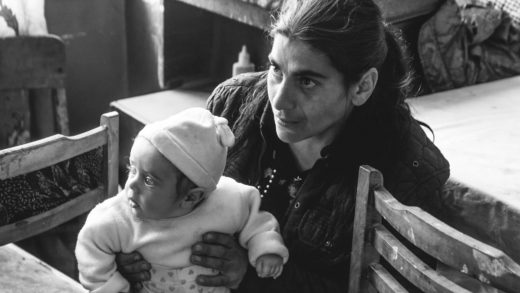

In the tidy room with its freshly painted white walls, little reminder notes lie everywhere. After the many blows to the head she has suffered over the years, Azatui has trouble with her memory — if she does not write something down, she forgets it in an instant.
A double bed, a plastic shelving unit with drawers, a couple of mismatched chairs, a little table and a heater that kept Azatui and her daughter warm all winter are crammed into the tiny space.
— Yes, it is very small, and the kitchen and toilet are shared, — Azatui says in response to my tentative movements (I must not bump into anything), — but what a pleasure it is to come home from work in the evening, lie down on the bed to rest and know that no one will yell at you: “What are you sprawling there for, you sheep’s spawn? Get to work!”.
Renovations are in full swing in the three-story building. The owner is renovating the little rooms on the two upper floors. An angle grinder cuts through metal, calling back and forth with the drawn-out rabiz, which gives way to Modern Talking and then yarkhushta [an Armenian folk war dance]. After a while everything falls silent — the builders go on their break.
It was Azatui’s diary that brought me to her (she herself calls it a book) — two thick notebooks that left me unable to sleep for several nights after reading them. I ask Azatui why it matters to her that the diary be published.
— I want as many women as possible to read my story. To understand that you cannot live like this, that there is another choice. There is a center where they will help them. During my time there I changed a great deal — I became stronger, more confident, learned to respect myself.
We will talk for several hours, and meet more than once afterward. From her accounts and her diary we will piece together Azatui’s story, which seems like the convoluted plot of a nightmare of a film. Spoiler: with a happy ending.

Chapter I. The Man with the Big Nose
I did not know the name of the man with the big nose. But as soon as I heard the music flowing from beneath his long fingers, I would come running and stare, spellbound, at the television screen. The instrument he played was called a piano — and I realized that I, too, had to learn to play.
The day came when Dad took me to a shop, bought me a new skirt, a shirt and red shoes, and took me to music school. The teacher said she would test my ear: she tapped a rhythm on the table and clapped her hands, and I had to repeat it. Then she asked who my favorite composer was. She had to explain to me what that was. That was how I learned that the man with the big nose was called a composer and his name was Arno Babajanyan.
They accepted me, but for the qanun [Armenian — “kanon,” a musical instrument] — I was 11 and already “too old” for the piano. I fell in love with the new instrument at once. Dad ordered a special chair for me. They taught me to sit properly, and for two or three months I practiced every day with an apple in my hand so that my hands would take on a rounded shape.
Dad had received his thirteenth-month salary and was supposed to buy coal for the winter, but at a family council it was decided to buy the instrument with that money. Dad’s friend, who worked at a qanun factory, engraved trees and birds on it.
When Dad came home from work, he would ask me to play. I could still only plink away clumsily, but he said my music soothed him.
My dad was a very calm, kind man. He never raised a hand to anyone or raised his voice. Only sometimes he would say to me: “Laugh a little more quietly, don’t laugh at the top of your lungs, you’re a girl.” Yes, I was quite the giggler. Everyone loved me for that cheerful disposition.

I studied music for five and a half years instead of the required seven. My father worked as an electrician. One day at work he received an electric shock and fell from a tower; he was in serious condition. Both my brothers were in the army, and I stayed home to help my parents. I did all the housework, then ran to the field, picked tomatoes, wheeled cauliflower to the garage in a wheelbarrow, and that was quite far and hard work. Mom and I cleaned the heads with a brush, then people came in a YerAZ and took them away to sell.
But the music school considered my absences justified, and in the end they gave me a diploma. Dad was very happy. Though he was just an electrician, he was obsessed with education. Mom was 17 when she married him, but he insisted that she continue her studies. He gave my two brothers an education too. As for me, after finishing school I was planning to train as a nurse.
Chapter II. A New Family
But my plans for an education were not to be. When I turned 17, Dad decided to marry me off. It was a “very good match for me,” the son of a man Dad worked with. We knew each other, but had not really spent time together. I did not like him, and Mom was against it too.
But Dad insisted, and I had to obey. With my easygoing attitude to life, I did not grieve for long — never mind, I would live with my husband, get used to him, come to love him. After all, I imagined all men to be like my father. And he was not at all hard to love.
When we married, my husband’s parents, his brother and his brother’s family lived in the house (they moved away later). Another brother and a sister already lived separately. The first two weeks of my marriage really were like being in my father’s house. My sister-in-law, who was much older than me — she had even taught me chemistry at school — would say: “With your arrival, there’s been progress in our house.”
But the “progress” did not last long. My husband’s family returned to what turned out to be their normal state. It was different from the facade they presented. What shocked me most was the way my husband’s relatives talked to one another in swear words.
At first I cried in horror — I had never heard such words in my father’s house — while they laughed at me and called me a psychopath.
They had no shortage of money or food, but my older sister-in-law and I always stood and waited for the others to finish eating, and then ate the leftovers ourselves. That was their way.
At first my husband took care of me. For instance, he made sure I did not go out into the vegetable garden in cold weather without warm clothes. But almost from the start I realized that I had no say. Only he could make decisions about the smallest things.
Our daughter was born a year after the wedding. My husband decided to name her after his grandmother. I begged him not to give my beautiful little girl such an old-fashioned name; I wanted to call her Goarik, but he would not budge. Two more years later our son was born. My husband would not let me call him Samvel either, after my favorite character from Raffi (an Armenian writer — Kalemon), and gave him another silly, ancient name after his grandfather.
When we married, my husband had a greenhouse full of roses. Over the next few years we built two more. We had no employees. All day I worked on the land — with the flowers, in the vegetable garden, sorting and tying roses for sale — and at night I washed clothes, cleaned and ironed until two.
At first my husband pretended to help me with the flowers, but every time, after just five minutes, he would complain of a headache or tiredness and go into the house. All his work amounted to delivering rose orders and sitting in front of the television.

I got up at six in the morning and went to bed at two at night. I was exhausted and sometimes could not wake up straight away when the children cried at night. So my mother-in-law kept telling her son that I was a bad mother and did not know how to care for children, and was a useless housekeeper to boot.
She did everything she could to turn her son against me. For instance, when tea was served at my father’s house, a sugar bowl was put on the table — everyone took as much as they wanted. But she made me put sugar in my husband’s glass, stir it and set it in front of him. If I dared disobey, a row would erupt. My father-in-law and brother-in-law backed her up. My older sister-in-law was kind, but afraid of them. No one took my side.
My husband began forbidding me to leave the house; he would not even let me go to my parents’ house. When they came to ours, they were given such a reception that soon they stopped visiting me themselves. This was how I saw them — a neighbor might say: “Azatui, your dad will be digging near your house in an hour,” and I would go up to the second-floor balcony and look at Dad.
Chapter III. A Gnat in the Coffee
My daughter was three and my son was one when my husband first raised a hand to me. One summer day the whole family was picking tomatoes in the vegetable garden. My son was asleep in his stroller nearby, and my daughter was busy with her toys. The children were always with me when I worked; they never got in my way.
My husband ordered me to make coffee. I made it, put it on the table and went back to the tomatoes. You have to pick them quickly in the heat or they wilt. In my hurry I forgot to cover the cups with a tray.
My mother-in-law, father-in-law and sister-in-law drank theirs quickly, but by the time my husband came over, a gnat had landed in his coffee. His relatives did not fail to point out that I had not covered the coffee. But they were at the table; they could have put the tray over it themselves.
Without a word my husband took the coffee, came over and poured it over my head. Then he grabbed me by the hair (it was very, very long), dragged me into the house and beat me. No one intervened.
From that day on he beat me for any “offense” — I had not cleaned the house properly, put the sweets in the wrong bowl, failed to pick the tomatoes from one bed, looked at him the wrong way, answered the wrong way, cooked the wrong thing.
He was also very jealous. Jealous even of his own brother. Once he beat me because, on one of our rare visits to his brother’s family, I held out a glass to my brother-in-law so he could pour juice into it.
At home he made a scene: “Were you flirting with him?” and beat me badly. Another time I “wisely” refused the juice his brother offered. But I could not resist adding: “Thank you, drink without me, I end up paying for it.” He beat me for that too.

One day I could not take it anymore — I took the children and ran away. He always locked the house when he went out, so that I could not leave and no one could come in. There were cameras in the house and on the grounds too, only they were not for burglars, but to watch me.
That time he forgot to lock the door. I took the children and ran to my parents’ house. That evening my husband came for me, begged me to forgive him, promised he would never do it again, and I went back. For a few days he really did behave quietly, but then it all started again.
Some time later I ran away again. It all began with me pouring water over his head while he washed it. He did not like the way I was pouring. He kept getting angry, but he could have moved his head under it himself — I cannot constantly sense where he needs me to pour.
Now I think — what a donkey you were, Azatui. Why didn’t you say — it’s your head, pour it yourself? But it is only now that I have wised up.
At one point he yelled: “Why can’t you pour properly?”, grabbed the kettle of boiling water and flung it at me. Then he began to beat me.
I was badly burned and literally moaned in pain for several days. But I was lucky that this time he quickly wore himself out, left me alone, and I managed to put soap on the burns straight away. There were hardly any scars left.
A few days later, when he again forgot to lock the garage door, I ran to my parents. Alone this time. My son was two, my daughter four, and I was twenty-one.
Mom took my side, as always. She told me not to go back, that she had not raised her only daughter for this. But Dad began persuading me to return, not to air our dirty laundry. He suggested that my husband’s parents were turning him against me, that time would pass and everything would work itself out. My parents, who had always been the ideal couple, were now forever quarreling over me.
This time no one came for me. Our houses were almost next door to each other. In the evening I could hear my daughter crying loudly on the balcony: “Mom, where are you? Come back, Mom.” I cried along with her, but tried to hold out.
I held out for three days. On the third day my son developed a fever. My older brother-in-law and his wife came to my parents’ house and began persuading me to return. My dad backed them up. Although he was quite liberal, times were different then: how could you leave your husband, with little children too, people would gossip.
Nothing would bring my son’s fever down, and I went back. Again, for a week my husband did not shout or beat me. My father-in-law assured me that his son had changed.
Chapter IV. Head Against the Wall
But this time too, of course, nothing changed. My husband began making me ask permission for everything — to sit down for five minutes to catch my breath from work, to put a child to bed, to go to the toilet.
A few years into our marriage he had Baxi (gas heating) installed in the house, but I was hardly allowed to use the hot water. He ordered me to wash the dishes in cold water (no point wasting gas); I could wash myself for five minutes at most, with all that long hair of mine, and then he turned off the hot water.
I wore torn clothes; my husband refused to “waste money” even on new sweatpants for work. I darned his old trousers and took them in for myself.
My husband kept beating me too. He might come up quietly from behind, and when I startled he would begin yelling: “What scared you, you sheep’s spawn? Hiding a lover, are you?” — and beat me.
Once he broke a chair over me. Another time, as I was running away from him, he put his foot on mine. I tried to pull free and broke my toes. They healed crooked, and to this day I cannot wear narrow shoes. But he did not even take me to a doctor. All he said was: “A dog won’t just drop dead.”
What he liked most was hitting me on the head, or grabbing me by the hair and banging my head against the wardrobe, the walls.
Over the years my eyesight deteriorated because of this, though before I married I could see better than an eagle. I had constant, severe headaches. When I could barely see anything anymore, I asked him to take me to a doctor, and he answered: “It’ll do as it is. A dog…”.
A few years later my daughter needed an eye doctor, and he was going to take her to an eye clinic. I managed to persuade him to take me too. After examining me, the doctor said I had developed keratoconus. It is an eye disease in which the cornea thins and takes on a conical shape. A person begins to see objects as distorted.

The doctor asked if I had suffered any injuries, since that is one of the main causes of keratoconus. But how could I tell her that hitting me on the head was my husband’s favorite pastime? The doctor said I needed to be fitted for glasses, that I must no longer bend down — and that several times a day I needed to lie down for about ten minutes with my eyes closed, or I could go completely blind.
But what rest? What do you mean, not bend down? It took me years to get even a pair of glasses out of him. The beatings continued, of course, and not only that. I had to satisfy his animal instincts at any moment. If he wanted it, he said: “Let’s go to the room,” and I had to obey. If I talked back, he raped me anyway, then beat me.
My little children were sleeping in the next room. I covered my mouth with my hand so I would not scream in pain. So he would get what he wanted and leave me alone. My hands were bitten all over.
Another way he amused himself was by hiding my clothes, the only clothes I had, so that I could not leave the room, and enjoying my helplessness.
He never touched the children, but he beat me in front of them too. When they were small, they huddled in a corner and cried in fear, and then my father-in-law would try to defend me. But when we expanded the greenhouse and my husband began making a lot of money — the flower business is very profitable, I would say second only to drugs — he stopped paying attention to anyone at all.
For as long as I can remember, we were constantly renovating. We had a luxurious house, nothing like a village house at all. Naturally, I had to clean up after every renovation. Just as I had to run the household and tie two hundred armfuls of roses every day. But all the fruits of the work were for him alone. He took the money and kept it in a wardrobe, whose key he always carried with him — even when he slept, he gripped it tightly in his hand.
I saw so little money that for a long time after the collapse of the Soviet Union I thought the rubles I had seen in my father’s house were still in use. I only learned much later that Armenia now had its own currency.
Chapter V. Witchcraft
We slept on the mattress I had brought as part of my dowry. Only once did I unpick the mattress, wash and fluff up the wool, and sew it back up. After that time my husband and mother-in-law would not let me touch it. Whenever I was about to, they shouted at me and demanded that I leave the mattress alone. I was very curious why, but did not dare disobey.
My husband’s parents fell ill and died in my care, one after the other. After my mother-in-law died, I waited until my husband was delivering flowers and I was alone, and quickly unpicked the mattress. It must have been intuition.
Two pieces of paper, tightly bound with white threads. Placed in two opposite corners, so that however I laid the mattress down, the papers would always be beneath my head.

I remembered older people’s stories about curses, which I had always laughed at. But just in case, I decided to follow their advice and throw the papers into running water. So the water would carry away the curse, they used to say. I threw them into a stream, then quickly sewed the mattress back up and put it on the bed.
Before, when my husband insulted me, I seemed to fall into a stupor, unable to say a word. I also often developed hellish headaches, different from the ones caused by the beatings. Medicine did not help them.
From the day I threw the papers away, the pain disappeared. And I stopped meekly enduring my husband’s fault-finding, as though I had woken from a doze.
He got very angry when I began answering back. For instance, he would say: “Put sugar in the coffee,” and I would say: “You have hands, put it in yourself.” He yelled: “You’ve got a lover, that’s why you’ve got such a long tongue.” And I answered: “Yes, I’ve got twelve. Their names are Black, Cherry…”. Those were the names of my roses.
And one December day I cut off my long hair. I put two mirrors opposite each other, gathered my hair in a ponytail and cut it short. My husband beat me badly for cutting my hair without his permission. But he could no longer drag me by it.
Chapter VI. A Secret Affair
My husband kept telling me: “The boy doesn’t look like me, you got involved with my brother,” even though my son is his spitting image. And in my head I would say — people accuse others of what they are guilty of themselves. I had no idea how close I was to the terrible truth.
After Dad died, my brother and his family moved to Russia, to his wife’s parents. My mom went with them. I lost touch with them for eight years because my husband controlled my phone. My brother called me, but my husband always answered and, on one pretext or another, would not let me come to the phone.
But one day my daughter happened to find my brother on social media. We waited until my husband took the flowers to sell, my son stood guard at the window, and my daughter and I called my brother. That was when I learned this story.
In Russia my brother did some work as a taxi driver. His wife worked as a dispatcher for the same service. Every morning he drove her to work, and in the evening they came home together.
One day my brother finds out that after he drives away she gets into a black jeep and does not come back until the end of the workday. So that evening he picks his wife up, takes her home, sends our mom out to visit someone, and suggests they have a little glass of brandy each — my sister-in-law likes her drink. My brother does not drink, but he gets her drunk himself and starts asking questions.
His wife admits that the black car belongs to some deputy. She also lets slip about her other affairs, and it turns out she had an affair with my husband too, when they were still living in our village. He records everything. In the morning he shows her the recording, beats her and throws her out into the street.
As I listened to the story, details began surfacing in my mind. What a naive little fool I had been! I remembered how often my husband went to my brother’s house while he was at work — on the pretext of helping him build a greenhouse. But it is not even for that that he should burn in hellfire, but for what he did at the forty-day memorial for my father.
That day he would not let me go to my parents’ house, saying the flowers would dry out, though they could easily have waited in water until the next day. So my brother sent his wife to help me finish quickly so I could go to my father’s grave. Even my husband came to help — unheard of.
And then he and my sister-in-law disappeared for about 20 minutes. When she came back, she said she had been in the toilet and accidentally got her shorts wet. And I, the fool, even joked — did you wet yourself, didn’t make it to the toilet? It would never have crossed my mind then…
Chapter VII. Escape
It was the second-to-last day of March. I had cooked buckwheat. He began yelling: “Is that food for a man?”. He said he would not eat it and sat down to play backgammon with our son.
The news was on television. The coronavirus epidemic had begun around the world, and my husband had news about it on all day. I wanted to watch a series, a concert. Quarantine had been declared in Armenia, movement was restricted, but coronavirus did not concern me very much — I had already been living in isolation for years.
I tried to change the channel. But that made him even angrier: “You’re going to tell me what to watch in my own house?” and he threw the remote at me. He missed, got up and came toward me to hit me.
My son held him back. When the children were little, they cried in fear when he beat me or shouted at me. And when they grew up, they tried to defend me. My son said he would finish school, come back from the army and buy me a house with a mortgage. He told his father: “Don’t you dare touch my mother!”. He was doing kickboxing then, had become strong, and my husband was a little afraid of him. But the children were not always home.
This time too my husband gave in to my son, but threatened: “Think about where you’re going in the morning. If you don’t leave yourself, I’ll send you to the next world.”
Then he ate after all and went upstairs to sleep. I stayed in the living room and thought all night. He could easily carry out his threat. Once he had put something in my tea — I realized straight away that the tea tasted different — and I secretly poured it out. Our dog licked the ground, fell asleep and did not wake up for three days.
I made a firm decision to leave the house as soon as morning came. I had not the slightest idea where I would go, but now I seriously feared for my life.
In the morning my husband came downstairs, shouted at me, went and opened the greenhouse vents to give the flowers some air, came back and flopped onto the sofa to sleep. He had left the key in the door.
I took the laundry out of the washing machine and asked my daughter to hang it on the second-floor balcony so she would stay there longer. I kissed her and, at her surprised look, said I had simply missed her during the night. I sternly told her to hang it straight and by color — all the neighbors knew I hung the prettiest laundry in the neighborhood.
I kissed my sleeping son too, and left the house as I was — in slippers, a vest and a tracksuit. I knew they would not look for me for several hours — they would think I had gone to the greenhouse as usual.
My husband always kept our passports. But at that time you could only go out with a passport and a piece of paper. So he would not have to go upstairs every time, my husband had tossed the bag of documents, including my passport, into the little cabinet by the front door.
I took my passport, climbed over the wire fence into the next yard and ran through the yards of the village, which was only just about to wake up. I put on a mask and tied on a headscarf so no one would recognize me. But I was afraid my husband would wake up, start the car and come looking for me.

I left the village and headed toward Yerevan. On the way I came across three patrol cars, told my story and asked them to help me, but all of them advised me to go to the police station in my own region, Ararat marz. After several hours on foot I reached Yerevan.
Cars paid no attention to me in the city either. In desperation I threw myself in front of a passing taxi. The driver was my dad’s age. With my face swollen from crying, barely able to stand, I pleaded: “Father, take me to the prosecutor’s office, I don’t know the city, I’m from the region, I’ve run away from my husband, he wants to kill me.”
The taxi driver turned out to be a kind man and took me there. But at the prosecutor’s office they said they were under quarantine, they could not accept any paper complaints, and I had to send my complaint online. But how? They advised me to ask someone on the street for a phone and type out the complaint. And I do not even know how to type.
I leaned against a tree and cried. Evening had come and it had turned sharply colder. My feet were rubbed raw, I was tired, did not know what to do, felt the whole world was against me. Suddenly a well-dressed woman came out of the prosecutor’s office and walked over to me. She held out a tissue and asked what had happened.
I told her my story. She called a taxi, paid, and told the driver to take me to central police headquarters. She wrote down her phone number so I could call her when I got there.
Chapter VIII. Think of Me as Your Brother
At central headquarters they listened to my story and… suggested keeping my husband in isolation for twenty days. Let him sit there and “think about his behavior,” while I went home. When I asked whether they could imagine what he would do to me when he returned, the police struggled to answer.
They simply could not get their heads around it — I had lived like this for twenty-six years, so what had changed now that I could not do it anymore?
I tried to explain that saying I only realized at forty-three that you cannot live like this was not quite right. No, it had been building up inside me for a long time; I knew that one day I would not be able to bear it and would leave. But at first the children were little, and I had nowhere to go with them. Times were different then. People were afraid of gossip; relatives advised me to wait, perhaps my husband’s character would change.
Then, when the children grew up, I wanted them to get a good education. My daughter graduated from university with honors and applied for a second degree, in law, by correspondence. But she had to give up her studies — her father first said he would pay, then refused. And the atmosphere at home was hardly conducive to studying or exams.
In short, I wanted the children to make something of themselves, and only then to think of myself.
I told the policeman I knew about the Support Center for Women Who Have Experienced Violence and wanted to go there. He asked me to think carefully — did I really want to go there? After all, it was a closed institution, with just a few women and staff members; you could not go out or make a phone call whenever you wanted. “Are you sure you won’t regret it?” he seriously asked me, a woman who had lived imprisoned in her own home for twenty-six years.
There was a policeman at the station named Rafo. I told him my memory was utterly useless, but I would remember his name because Raffi was my favorite writer.
Rafo called my son and carefully asked where he was and who he was with. My son answered that he was with his sister; I could hear my daughter sobbing on the phone myself. Apparently their father had sent them to look for me in one car, while he went in another. Rafo told my son where I was, and he and my daughter came to the station.

I told the children I was not going home. But I was very worried that now my husband would take his anger out on them, especially my daughter. Rafo gave her his number, and told me to think of him as my third brother, and he would be an uncle to my daughter. He would call her from time to time to see how she was. And she should call him whenever she needed to.
Then Rafo called the shelter, and they came to pick me up.
Chapter IX. The Safe House
That was how I came to live in the Safe House. That was the name of the shelter they took me to. It was a bright building with beautiful furniture and solar panels on the roof.
The women who, like me, had run away from their husbands, and the women who worked at the house, welcomed me very warmly. They bought me eye drops and headache pills. At first I was amazed, and then moved, to be treated this way by people who were essentially strangers.
We got up early in the morning and all cleaned the house and made breakfast together. It is a very unusual feeling — to have work I had done alone all my life shared among several people. Out of habit I rushed to do everything for everyone, but the staff stopped me.
The house had a library. I read “The Picture of Dorian Gray.” Everyone tried to talk me out of it, said it was a difficult book and too soon for me, but I read it in nine nights. I liked it very much; somehow I became stronger after reading it.
I compared the plot with my own life. I even thought that Gray had sold his soul to the devil, but I would never sell mine.
The center organizes various courses, sewing for example, but because of coronavirus everything was temporarily closed. And I am not used to sitting idle, so I began darning and sewing arms and legs back onto old children’s toys and dolls that were going to be thrown out. I sewed little bags and potholders for the girls.
Once a week I had an online session with a psychologist. The psychologist was pleased with my progress, said I was strong; it took some people years to get over traumas like these, while I was coping quickly, on my own. I felt the changes too. I began to respect myself, to understand who I was and what I wanted.

At the same time I missed my children terribly and worried about them. I was allowed two calls a week. One call was to my daughter. She said her father had turned the house into a prison and was controlling their phones. And that Rafo the policeman had kept his word and managed to call her without her father finding out.
My other call was to my aunt, the only relative I have in Armenia and one who worried about me. Once I called Russia — my brothers and Mom. But they advised me to go home rather than leave my husband everything my labor had earned. I refused, though it was hard being away from my children. At night I looked at the sky and talked to the wind. I asked it to kiss my children goodnight, the way I had always kissed them.
A wonderful little girl of about five lived with her mother in the Safe House. I grew very attached to her and called her my panda. Once she gave me a little fairy and said:
“Imagine it’s your daughter looking at you, and stop pining for her. Or better still, let your daughter turn into a fairy too and fly to you.”
It was there and then that I began writing a book about my life. I want very much for it to be published. So other women will read it and understand that a woman should not have to endure this, that marriage is not what I had, marriage is respect for one another, love. So they will know about the Safe House and that they will be helped, that they are not alone.
Chapter X. The Statute of Limitations
In my second week at the Safe House they took me to the office of the women’s protection center. Police officers were waiting there to take my statement.
It was very hard to recall twenty-six years of my life in detail. I did not yet know that three investigators would take turns on my case, and I would have to tell each of them my story all over again.
The most agonizing thing was remembering what my husband had done to my child. After my two children I became pregnant again. He warned me straight away — if it’s a boy, we’ll keep it; if it’s a girl, “you’ll have it taken out.” During my first two pregnancies he would not let me go to a gynecologist, but during this one a complaint was made that I was not attending the antenatal clinic, and he had to take me for regular checkups.
I had several ultrasound scans, and they showed that the child was a boy. But when I was six months pregnant, they said at the hospital that they had made a mistake and it would be a girl. He flew into a rage and made a scene, claiming I had deceived him. Even though he had been beside me at every ultrasound.
He ordered me to have an abortion and sign papers saying I was giving up my child of my own free will. I said I would not. Then my husband threatened that if I did not obey, he would take my first two away from me too. I knew he could. At the same time I was locked up alone within four walls, and there was no one I could turn to for help. In the end I agreed.

Many years later, a criminal case was opened against the doctor who took my child out, over the sale of children. Apparently my husband bribed him. He had a lot of money; he bribed everyone.
When I woke up from the anesthetic, they gave me some papers to sign. And I have allergies, so I have a hard time coming round from anesthesia. I had no idea what I was signing, or why. First they told me my child had been ill, then that it was dead, but I did not believe them.
I kept thinking: perhaps they saved my little girl and sold her to someone? And somewhere my twelve-year-old daughter is living now. Our neighbor had a baby girl that same year. For all twelve years I would open the door to go to the second greenhouse across the road and see that girl. “Hello, Auntie Azatui,” she greeted me brightly once she could talk. And I would say: “Hello, my girl.” I imagined she was my daughter. They should have gone into the same class at school.
I wrote a complaint, said I wanted a divorce and wanted this man — my husband — to answer for everything he had done to me, to my child.
But the investigator took the paper, skimmed it and said: “You needn’t have written so much, the statute of limitations for the crime is ten years, and twelve have already passed, there’s nothing to be done.”
Chapter XI. An Unexpected Blow
A month passed. One night I could not get to sleep, and when I finally fell asleep toward morning, I dreamed of my father. He came to me and brought my favorite chocolate, “Belochka,” and insisted I eat every bit.
I felt uneasy all morning. Usually Dad appears in my dreams to warn me of something bad. And that afternoon they called me downstairs and… I saw my daughter!
She said life at home had become completely unbearable, and she had found the support center’s number, which I had written on the first piece of paper to hand, which turned out to be her notebook. She was pale and had lost a lot of weight, but I was happy to see my daughter again, happy that she would be living with me.
Soon an unexpected blow came from my son. He suddenly changed his testimony and began denying that his father had beaten or mistreated me. He told me that if I withdrew my complaint, then when he returned from the army he would buy me a house with a mortgage, as he had promised, and everything would be all right. But if I refused, he would stop speaking to me.
I tried to explain why I could not go back to his father’s house. But he was like a different person. I know my husband’s cunning nature; he had definitely put pressure on him somehow.
I worried about how he was managing there without us, who was washing his clothes, where he would end up in the army, but I also know I must be strong and see this through. The sessions with the psychologist made me more confident. For years my “self” had hidden in a dark, moldy room. And now it had broken free. I learned the idea of a space of my own, where only I can decide who to let in or not. I must get used to thinking of myself first, and only then of the children and everyone else.
When they arranged a face-to-face meeting with my husband, I spoke calmly and confidently, not afraid of him at all, and once again described how he had beaten me, how he had made me a slave. At every word he shouted that I was lying, that God would punish me for it.

My son came too. I went to hug him, and he pushed me away and said: don’t touch me. Then there was a face-to-face meeting with him. The investigator asked what our relationship had been like. I answered: “Very good,” but for some reason he said: “Normal.”
I did not recognize him — he had become indifferent, cold, a stranger. He defended his father and blamed me. He even reproached me for leaving the house and going away. He said his father had never raised a hand to me, though he himself had stood between us more than once to stop him beating me.
Chapter XII. Roses Love Chopin
The agreement provided for two months, but I spent half a year in the Safe House. September third was the day my daughter and I moved into a rented apartment. The center gave us a little money and food to get started.
For several days after moving in we cleaned. The landlady is a woman my age; she has a little dog, and sometimes the two of them come to visit us. Thanks to her, within a few days my daughter and I found some temporary work — cleaning a beauty salon after renovations.
We came home dusty and very tired, but we were earning our own money. We bought a green clock for our home, a basic phone for me, cleaning products to make work easier, and some food.
When the salon opened, my daughter kept going there every day — my bright daughter with her honors degree cleaned and mixed hair dyes, and in the evenings looked through job ads on the laptop the center had given her.
The day before her 25th birthday there was a lot of work at the salon, and they called me in too. We earned 6 thousand drams, bought two shawarmas, some juice and a little cake, and celebrated together in our apartment. I made a wish that my son would be with us for her next birthday too.
On my daughter’s days off, she and I went around salons, shops and bakeries, trying to find work for me. My son had been called up into the army; I knew he was in Karabakh, and I very much wanted to find a job, save some money and go to see him.
We tried to save on everything, but there were days when we simply went hungry.
Sometimes the landlady tactfully invited us to lunch or dropped off some groceries. When things became completely unbearable, I overcame my shame and turned to the center for help.
My social worker said it would be easier for me to find work in the regions than in Yerevan. That in the regions I could do what I do best — grow flowers.
It is true. Give me any weed — I will make a flower of it. There are flowers that bloom once a year, but mine bloomed two or three times. Flowers are like little children. You need to communicate with them, so I talked to my roses. The children laughed, but roses really do understand everything.

Sometimes the roses wilted before my eyes when people came to buy them — as if I had not watered them for days. That meant the person had bad energy, an evil heart. They would leave, and I would return to the flowers, comfort them, stroke them, tell them those people had gone, we were alone, everything was all right. And after a couple of hours the drooping heads would straighten. I took a radio into the greenhouse when classical music was on. The roses grew best to Chopin.
But now I cannot work with flowers, because I am no longer allowed to bend down. I had to forget about greenhouse work.
Once I was taken on at a confectionery workshop for a trial period. My job was to glaze éclairs and make [Armenian] choco pies. Two wonderful women worked there and taught me. My little choco pies came out big, no matter how hard I tried.
On the evening of the third day, the confectionery’s director came through with a tray of choco pies in his hands. He slammed it down on the table and yelled:
— Who is making choco pies the size of their own head? Are you trying to ruin me?
And left. The workers began trying to calm me down — forget it, they said, he’s not usually like that, he must be in a bad mood, it’ll pass. But I had already decided that no man would yell at me and insult me, however badly I needed a job. I left and went on knocking on the doors of salons and shops.
Chapter XIII. Life
I learned that war had broken out on the afternoon of September 27. That evening, when my daughter came home from work, we began looking for information about my son. A few days later we found out that, despite having served for only two months and having problems with the tendons in his knees, he had been taken to the front line.
I had trouble concentrating on housework and my new job — as a cleaner in a supermarket. Every soldier killed might be my son. I went to church and prayed for them all — for mine and for the other boys.
I tried many times to reach my son by phone, but every time the company commander answered and found a reason why my son could not come to the phone. I was already thinking he was missing or dead and they were trying to hide it from me. When I told the commander about our family situation, he said he would make sure my son spoke to me.
Apparently he did. One day my son came to the phone. He said they had been on the parade ground and would call back when he returned to his unit. He did not call back, but some time later he began talking to his sister on the phone. It was she who told me: “He resents you for leaving home.”
Then, using my daughter’s phone, I wrote to him that I would not bother him anymore, that I was very glad I had left his father, had become independent, and though I worked as a cleaner, I supported myself and was not at the mercy of anyone’s whims. And he could do as he pleased.
Though I was dying of fear and worry for him, I kept my word. A few days later he wrote to his sister: “Tell Mom that when the war ends and I get leave, I’ll come to see you.”
He came, but behaved very strangely. He hinted that I was in some danger from his father, put his head in his hands and whispered: “I want to help you, but how?”. Then he began persuading me again to go home and withdraw my complaint, or he would cut off all contact with me. But I told him once more that I had already made my decision. Our relationship is better now, but not as it was before. I believe that one day my son will mature and understand me. Until then I will not put pressure on him.
Sometimes a neighbor calls me. She says our house, once so bright and cheerful on the outside, is now plunged in darkness. Even at night my husband does not turn on the light, and sometimes she hears him shouting into the void.

Several times I have come out of work and seen my husband’s car on the opposite side of the street. I paid no attention and went home, while he stayed for a while and then drove away. I realized I was no longer afraid of him. Just let him try to come near me.
I do not feel a drop of pity for him. I want him to be punished.
When I cannot sleep, I often think of my little dog Chalo. He came to us very small, his eyes still closed, and I raised him on cow’s milk. He followed me everywhere, and when I worked in the greenhouse he lay obediently between the beds and waited. Then my husband put the puppy on a heavy chain and forbade me to let him off.
After I escaped — he was four or five months old then — Chalo almost stopped eating and became a dog that bit. One morning the children found him dead — his kennel stood on a raised concrete platform, and he fell and hanged himself on his own chain.
My neighbor told me my roses are gone too. He did not look after them — he sold what he could, and the rest died of the cold. My parrots died when their hearts burst. My husband must answer for all of this.
If not before the law, then before God. The police closed my case for lack of evidence and witnesses. As witnesses they questioned a woman who had helped me in the greenhouse for a short time, and a neighbor. Both had heard his shouts and threats, seen me with grazes and tearful eyes, but in their statements they wrote that they had seen nothing. I suspected my husband was making advances to one of them, and he had lent the other money.
The divorce case is still going on. If there is a chance to appeal the criminal case, I most certainly will.

My daughter works as a cashier in a shop, has changed her name and plans to return to her studies. If I had the chance, I would get an education too. I would train as a specialist in Russian language and literature; I have always dreamed of it. But here even age or lack of money are not such great obstacles as my memory, which retains nothing.
My relatives invite me to Russia, but I do not want to go. My son is still in the army here; my father’s grave is here. On his birthday I went to my village, cleaned his grave and burned frankincense.
I miss Dad very much. He is still my ideal of a man. He was 63 when he died. Until his death he got up every morning, made coffee for my mom and my grandmother while she was still alive, brought it to their room, and only then left for work. Twice a month he took Mom to the hairdresser’s, saying — it’s time to freshen up your hair. Mom always felt young with him.
Now I feel peaceful and happy on my own. But if I want to have a partner, I will; I am a free person. I have never loved a man. I wonder whether this love exists at all, or whether only my parents had it, and it is only in books and television series? I would like to experience those feelings myself.
***
One last thing I will tell you. I gathered my courage and went with my aunt to the hospital where the child I was forced to give up was born. After digging through the archives, the women working there said they had no deaths registered on that date, and that I had actually given birth to a boy, not a girl. They refused to provide any further information, just averted their eyes and said they knew nothing.
But now I know for certain — my child did not die, someone probably adopted him, and I will do everything I can to find him.
This article was produced with financial support from the Council of Europe Office in Armenia.
The Council of Europe has published a special brochure explaining how the media can contribute to the spread of stereotypes about women and gender-based violence against them, and how to avoid this, in English and Armenian.
***
Domestic violence is, first and foremost, a gross violation of human rights. The EU Convention on preventing and combating violence against women and domestic violence is intended to protect women against all forms of violence, as well as provide mechanisms for prevention. The Convention guarantees a multifaceted professional response and support mechanisms.
The Council of Europe Convention on preventing and combating violence against women and domestic violence aims to prevent violence, protect people who have experienced violence, and punish those who commit it. You can read more here (in Russian).
***
In this regard, the Republic of Armenia’s legislation on domestic violence and gender-based violence still needs reform to bring it into line with internationally accepted norms.
The 4 pillars of the Convention in Armenian are available here.
***
Details of European Court of Human Rights judgments concerning cases of domestic violence in various countries (in Armenian) are available here and here.