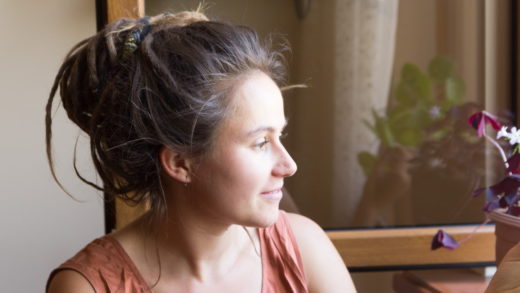

Chapter I: Meri — a mother twenty-four hours a day
Meri sets her alarm for five in the morning. Every 10 minutes, the alarm reminds her that she needs to get up. At six comes the final reminder, and then Meri gets up. This hour of continually slipping back into sleep is perhaps the only time of day Meri spends alone with herself.
When she talks about her children, Meri always uses the pronoun “we.” But this is not a mother’s inability to separate her grown-up children from herself. No, her children really do depend on her almost every second.
After a quick wash herself, Meri takes her daughter to the bathroom. Over the past seven years, Siranuysh, who previously used a wheelchair, has begun to walk — slowly, leaning heavily on her mother’s arms. Siranuysh’s bathroom routine can take a whole hour: in their apartment, as in all the previous ones, the bathrooms are not adapted for people with musculoskeletal difficulties.

When we have a home of our own, Meri says, her eyes lighting up, the first thing I will do is tear out the awkward bathroom, the narrow doorway, and make a new one — with every convenience for my daughter. I will order low countertops for the kitchen, and there will be handrails on the walls.
And then Siranuysh will be able to look after herself and move around the house on her own.
Then her son Samvel gets up. While he washes, Meri makes the children breakfast. After that, she and Samvel go out to classes for the whole day, returning home for quick snacks in between. Sometimes they take Siranuysh with them, but more often she stays at home — with her music practice and books.
***
On Sundays, they always go to Mass at a church nearby. Parishioners sometimes offer Meri money and ask her to spend it on the children. Meri used to feel awkward and refuse, but the priest told her that people were offering help from the heart and she should not hurt them by refusing. And Meri began accepting gifts of money and spending them on something the children would enjoy.
For example, if the weather is good, she takes them to a café after Mass. They especially like going to “Ponchikanots.” The food is good, it is inexpensive, and the staff treat my children very well, Meri smiles. They like Samvel best of all there: he is the only one who always clears away his tray and puts his plastic cups and plates in the bin.

Besides birthdays, the family always celebrates two holidays — Christmas and Easter. Every year they hold hands and wish that they will celebrate the next holiday in their own home. This winter, all three fell seriously ill with COVID — Meri did not have the strength to get up and look after her daughter, let alone celebrate Christmas. “We missed wishing for a home this year, what will happen now?” Samvel was terribly upset.
Meri says that every time she puts the winter clothes away in the overhead cupboards to get out the summer things, Samvel asks in a panic: “Are we moving again?”.
***
Over 21 years, Meri, who raised her children alone (their father left the family when the children were small, and his only part in family life was paying child support — until they came of age), has knocked on the doors of many organizations and government bodies under three governments. In two decades, Meri has learned to fight, learned the laws and her rights.
Yet her requests to various authorities for housing for herself and her children were most often met with bewilderment. The woman was either advised to place the children in a specialized institution, or people simply shrugged — there were supposedly no housing programs for people with disabilities. Government bodies nevertheless reassured her that if anything happened to her, the state would undoubtedly take care of her children. By placing them, for instance, in a psychoneurological residential institution.
Once, though, she was offered an “apartment.” A 24 sq. m. cubbyhole with no kitchen and a tiny bathroom in the Veterans’ Home. When they went to see the apartment, Samvel rushed out of “this prison” in horror and refused to go back inside.

Three years ago, Meri approached the “My Step” charitable foundation. According to her, they promised to resolve her housing problem within a few months and, in the meantime, undertook to pay her rent.
— They said they had taken two families under their care: ours and another with thirteen children. The landlord found out that Anna Hakobyan’s foundation was paying my rent and raised it from 90 000 to 200 000 drams. We had to move out. Three months later, they (the foundation) announced that for now they were working with large families, while their program for people with disabilities was planned for 2027, and advised me to apply then. But they did not resolve that large family’s housing problem either. Now kind people have organized a fundraiser to buy them a home.
***
Meri says she tries to arrange a cultural life for her children, that she uses every possible means to get them tickets to concerts by local and foreign performers. That each month she puts a little aside from their monthly disability benefits (56 000 drams in total), and in summer takes them to a holiday home somewhere in Armenia for two or three days. So they do not feel deprived.
I listen to her and think about children with disabilities shut away in homes — out of sight of neighbors with their unerring identification of the “genetic contagiousness, say, of cerebral palsy, because these children’s “promising” brothers and sisters still need to get married. I think about children who are not allowed outside so that they will not be upset by other people’s attitudes.
— What a good mother you are, I say, thinking all this and admiring her.
— No, Meri objects, I am a stupid mother. The state pays a biological parent 28 000 drams a month for a child with a disability, but pays a guardian 150 000 drams a month. The state does not care whether children who have a mother — but one day she will be gone — have a home. But it gives housing to those leaving children’s homes.
— If I were a good mother, I would have put my children in a children’s home when they were small. And I would have carried on working. After all, I am a Russian and English language specialist. I worked in good schools, in a good children’s home before the children were born. My friends advised me to give up the children, ask a relative to become their guardian, and let the state pay that money. I was a fool, I would not agree. They would have a home now.
***
Meri tells me that once she came up with a “very good way” to earn enough for an apartment — sell her kidney. It is forbidden in Armenia, but the black market has not gone away. That was how Meri found a young man who urgently needed a transplant. His family was selling their apartment to buy their son a kidney, while Meri was selling a kidney to buy her children an apartment. They quickly reached an agreement, and Meri was already arranging her future home in her mind, but it turned out that she was not a compatible donor for the patient.
Then another candidate for her kidney appeared, and again they turned out to be incompatible. Can you imagine such bad luck, Meri says, dismayed. I say nothing. I try to digest her disappointment.

— Our current (rented) apartment is on the second floor, with no lift, she says in passing, returning to the subject we were discussing before the kidney. — I take my daughter upstairs hanging on my arms.
— There. I seize my chance for “blackmail.” — How will you take her upstairs with one kidney?
— I will, I will. I can do anything, I will find a solution to everything, as long as the children have a home.
***
For the past year, the Armenian Apostolic Church has been paying the family’s rent, but they have only until the end of May. Meri persuaded the landlord to wait: amid the wave of arrivals from Russia (as Meri sees it), he suddenly announced that he intended to sell the apartment and they needed to vacate it. He agreed to wait until June, but raised the rent by 40 000 drams. Meri has no idea where they will go in June.
She has opened a bank account and asks everyone who cares to join the fundraiser to buy an apartment.
The apartment has to be in Yerevan, because all the children’s studies and rehabilitation are concentrated in Yerevan. And it must be on a high floor. Samvel cannot live on the lower ones. People bustling past the window, the sounds of children playing in the summer courtyard, and the loud calls of adults playing cards or backgammon late into the night affect him very badly. Once they lived on the first floor. Six months later they had to change apartments — Samvel walked around the house wearing a hat and headphones and called their apartment a “basement.”
My children, Meri says, love looking at the sky, at sunrises and sunsets. My children, like me, will be grateful for the rest of their lives to the people who do a good deed and take part in the fundraiser, she adds.
Chapter II: Samvel — creator of the world of ENDO and polyglot programmer
Samvel’s wooden construction models, which inhabit several wooden shelves, are the biggest headache when they move. Meri places a few at a time on a tray and carefully carries them from home to home — fortunately, all thirteen apartments so far have been within walking distance of each other.
When we have a home of our own, Meri says, we will put all these wooden animals, flying machines and ships behind glass. Otherwise, you cannot imagine, she laughs, how difficult it is to dust them.
Lately, Samvel has lost interest in assembling wooden figures. He draws more comics — in large and small school exercise books. Sometimes for fun, but more often out of desire, Samvel says, and explains: “Fun is when you have nothing to do, so you go ahead and draw something for yourself. Desire is when you want to, and you draw from the heart.”
***
Samvel opens a thick squared exercise book and takes me into the world of ENDO. It is a beautiful world that survived the destruction of many other worlds. Trees grow and flowers bloom there as though it were always spring. It is inhabited by people and “unusual people” (either animals or robots) who fight external enemies — horned monsters — for the right to live freely on their own land.
There are many girls in the world of ENDO — invariably long-haired, long-legged and full-breasted. Their roles are strictly divided: they are either princesses with innocent eyes and modestly folded hands, “who love flowers,” or warriors with stern gazes and weapons in their hands. And one with delicate wings and a resolute gaze — the monsters slaughtered her race of angel-like people, and she alone survived and found refuge in the world of ENDO.
Samvel turns the pages. Passing a threat to ENDO’s inhabitants from the other world, in the form of hands stretching out as though from a cauldron in hell, and a race of monks, we reach a giant robot. Beside it is a much smaller robot. The little robot is the big robot’s home, Samvel explains.

— But how does it fit in there? My eyes widen.
— In this strange way, Samvel says, surprised at my failure to understand. — When the giant robot needs to go home, its artificial intelligence travels along a wire into this box — the little robot.
It is not only the enormous robot that has a home. All the characters on Samvel’s pages have houses in the background. With meticulously drawn windows, cladding and other details. All the drawings are black and white.
— I like colors, but I do not want to spoil my work with unprofessional coloring, Samvel explains.
***
Samvel speaks loudly, clearly enunciating every letter, and never once looks me in the eye. If he does not feel like it, he will not speak at all; if he gets tired, he will break off the conversation halfway through and leave.
Samvel has autism. I went through every circle of hell, Meri says, before he was diagnosed. The diagnosis was first voiced when he was 8. Before that, the child had shown behavioral problems — he did not speak, he screamed, he banged his head against the walls. The doctors Meri took him to either shrugged or said the word “schizophrenia.”
Every kindergarten refused to take him. Only one agreed. Meri had to pay doctors to issue a certificate saying that her child was healthy, “normal,” and could attend an ordinary kindergarten. With the same difficulties, and only thanks to their mother’s stubbornness, Samvel and his sister started school.
Outbursts of aggression can still happen now, when Samvel is already 21. But now there are specialists nearby, parents of other children with autism who support one another, vitamins that he takes all year round.
Drawing comics is like the very best therapy for him, Meri says. Through them he releases his tension, aggression, his desires. Everything he cannot or does not want to realize through the outside world, Samvel expresses and lives through in his comics.

Samvel also relaxes by composing music. He sits down at the piano and plays. But this cannot be discussed, nor can his favorite music. It is personal, he warns.
******
Samvel has a busy life. Meri shows me her diary, and my eyes pick out words at random: English, armsoft, cyber, Turing, School 42. This summer, Samvel plans to enter the polytechnic university to study programming. They must do everything they can to get him a tuition-free place. Like his sister Siranuysh, who is waiting patiently for us on the living-room sofa. But she managed it because competition for her music department was low, and the girl with cerebral palsy has a first-degree disability. Samvel has a diploma with honors, but a second-degree disability, and there are far more applicants to his faculty. He is entitled to a 50% discount.
For now, Samvel attends the Turing school at Yerevan State University’s Faculty of Physics and Mathematics, where programmers learn various programming languages, and, whenever he has time, School 42. This is an international school for programmers, now in its second year in Armenia. Samvel had to pass difficult exams and an interview to get in.
***
Meri sits with Samvel in every class. He does not feel very comfortable in unfamiliar places, with strangers; he finds it hard to concentrate.
Samvel has an impressive résumé, which lists, among other things, all the programming languages he knows — ten of them, it seems. Meri and Samvel send the résumé to various organizations. Employers give Samvel tasks and then invite him for an interview — quite certain, Meri laughs, that “a grown man, not a twenty-one-year-old young man” will turn up.
Samvel appears at the interview, and people immediately realize that he is not like them. And while, bewildered, they struggle to start the conversation, Meri pops out from behind Samvel’s broad back and says in a rush: “Hello, we have autism. But it is not a problem for us, and it will not be for you.”

But that word slams even the most welcoming doors in their faces.
— They are afraid, Meri says. — They think autistic people are people who do not communicate. He does not communicate the way we do. He does not like chattering. But if he is interested, he will join the conversation, ask questions. But employers say they need “corporate personalities.”
Chapter III: Siranuysh — a book reader with hair that gleams gold
On the sideboard in the living room are photographs of Siranuysh with George Clooney, Charles Aznavour, former US ambassador to Armenia John Heffern, and other famous people.
— He (pointing to Heffern) is such a wonderful person. He would take hold of my daughter’s wheelchair and wheel her through the streets of Yerevan. Look at the connections we have, yet we have been homeless for 20 years, Meri laughs.
Siranuysh sits on the sofa and smiles. On the little table in front of her is Ryunosuke Akutagawa’s short-story collection “Rashomon Gate.”
— I am a book reader, Siranuysh remarks. — Before starting a book, I spend a long time studying the author’s biography and what inspired him to write the novel or story.
And while I leaf through the book, she tells me at length, in detail, how events in Akutagawa’s life echoed his writing, “here, for example, the last story allows us to judge the difficult times, I would say, the hopelessness in his life,” and draws an unexpected parallel between the work of Akutagawa and Pushkin. Her mother interrupts her just as Siranuysh enthusiastically begins to analyze Ishiguro. In a strictly literary, elevated Russian.

— If you do not stop her, Meri smiles, she can talk for hours. She will tell you the entire book, with the names of the most insignificant characters, with comments on the tiniest details. She often goes days without talking to people — when she has to prepare for an exam, for example. And she reads and reads. So she never misses a chance to share her thoughts and impressions of what she has read.
And Siranuysh, noticing the corgi-shaped brooch on my sweatshirt, is already giving me the entire history of the corgi’s royal origins. And since we are talking about dogs, she does not miss the opportunity to return to her beloved Japan — by way of the true story behind the film “Hachiko” — with all the dates, complicated names and geographical place names.
***
Siranuysh is in her second year of part-time study in the piano and vocal department of the Pedagogical University. This is how her teachers listen to Siranuysh play: Meri records her on her phone and sends it to them. She takes notes on the theory, and they learn it together.
Siranuysh came to music, you might say, by chance. The primary-school pupil’s tense fingers could not even hold a pencil. At school, they advised taking the child to piano lessons — to open up her fingers. After three years of lessons, Siranuysh could not only hold a pen and pencil easily, but play as well. Then came music school, college, a diploma with honors, and straight into the second year of university.
— Three years later, I walked into music school, Siranuysh says.
— You did not walk, you rode! her mother exclaims, laughing.
At that time, Siranuysh got around exclusively in a wheelchair.

Siranuysh sings for us. She has perfect pitch and a clear, trained voice. In another country, Meri says, she would have got into the Conservatory too. But here, she is certain, no one will spend time taking a special approach to a girl who does not sing and play like everyone else: Siranuysh sings sitting down and plays the piano without pedals.
***
Siranuysh is 22. When she was born, none of the doctors believed she would live even two days. She was born prematurely, weighing 1.2 kg, a little blue, motionless bundle — with lungs and a heart unable to work on their own. The doctors told Meri that the child was almost dead and comforted her — you are still young, you will have another.
They only let her near the girl when the woman who had just given birth jumped out of her chair and began screaming and demanding her child. They kept the mother and girl in the hospital for a month and made gestures of madness at their temples when Meri walked the hospital corridors with her little bundle, singing to the girl in every language in the world she could sing in. A month later, the doctors suggested taking the child off the tubes and medication and bringing her home — still to die.
Meri says her relatives initially agreed with the doctors too. But when her mother came to the hospital and saw the girl with golden hair and blue eyes, she rushed off to sew baby shirts — ordinary shop-bought ones were far too big for the one-kilogram baby.
— My hair stayed golden for a long time, then it darkened, Siranuysh interjects. — Now it only shimmers gold when sunlight falls on it.
***
Her parents learned that the girl had been born with cerebral palsy almost two years later, by chance, when they took their second child Samvel, who had been born by then, to a neurologist, and she remarked in Siranuysh’s direction: “You will have a hard time with a child with CP.”
At 16, Siranuysh had her first MRI scan of the head, and a colloid cyst of the third ventricle was discovered. This is a kind of growth that may neither grow nor move for a lifetime, or may break loose in a single second, block some passage, and the person will die.

The doctors suggested that the tumor might be the cause of Siranuysh’s musculoskeletal problems, and that if the tumor had been found at birth, it could have been operated on. But now no doctor can say whether the tumor was there from birth or appeared later.
Siranuysh does not think about her tumor. She has no pain, and no fear. Unlike Meri, who constantly asks how her daughter is feeling, watches her breathing, “even wakes me at night to make sure I am alive, that I am all right,” the girl laughs — and every six months fights to get an MRI and an endocrinologist’s examination — Siranuysh also has a goiter.
Epilogue
Lately, Meri has been thinking more and more about what will happen to her children when she is gone. If they are homeless, they will be taken to a specialized residential institution, but if they have an apartment, together they will manage on their own, she is certain. She notes that Samvel already feels he is the man in the family, understands that he needs to look after his sister. Both children have intact intellects, and Meri winces when people, on meeting Samvel and Siranuysh, often ask her: “Can they talk?”.
Meri says that for the last two decades she has fought to change society’s attitude toward her children and people with disabilities in general. And she adds that she will find the strength to keep fighting, if only the apartment works out, because right now she cannot think about anything else — before her eyes looms a deadline of a month and a half, after which they have nowhere to go.
Late at night, when the children have been fed, washed and are asleep, Meri sits down at the computer. She puts a jacket over her two sweaters — there is no money to heat the apartment, so she has to wear several layers of clothing, and in winter even gloves — finds influencers with large audiences on social media, sends friend requests, rejoices in other people’s achievements, and writes a comment beneath their posts: “May God keep you. Please help two children with disabilities buy an apartment.”
As a rule, we advocate systemic help. But this case is a rare and remarkable exception to the rule. Meri’s family deserves a home of their own, and they have very little time left. We are attaching Meri’s account details so that you can make a donation.
INECOBANK
MERI MARTIROSYAN
2050059400491001 AMD
2050059400491020 USD
2050059400491040 EUR
2050059400491041 RUB
2050059400497001 ArCa
AMERIABANK
MERI MARTIROSYAN
1570004424570400 VISA
IDRAM
626121282