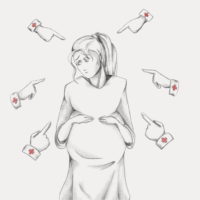

Chapter I: First Came the Quarrels
They met by chance, through social media. He said he had fallen in love with her kindness, while she… had not fallen in love, no — not then, not later. He was different from the men she knew — in what seemed to her to be his open-mindedness, his boldness.
One day he told her how, when he came from Syria to Armenia to study at the age of twenty, he had not known that shops closed for the New Year holidays, and for four whole days had scraped by on some flour he had managed to find, making himself unleavened bread. She felt something between pity and maternal tenderness for him.
Then they met in person. Soon they were living together. Sirarpi’s family disapproved of their living together without being officially married (they only registered the marriage a year later), but did not stand in the way of their union.
— I knew I didn’t love him. But I was a little over 30, and I constantly felt pressure from relatives, neighbors, people I knew. I was so fed up with the endless “You’re already 30, your biological clock is ticking” that I just wanted everyone to be quiet. And he was good-looking, and he’d latched onto me with a death grip, too”.
She was an accountant. He worked as a programmer at a small company. Neither earned much. They rented a tiny two-room apartment.
Then he left his job and started his own business — developing Facebook apps. Sirarpi helped him — finding photographs, promoting ads. The couple began making money.
Sirarpi says that, being gentle and accommodating by nature herself, she admired her husband’s ability to take risks and get ahead. She thought she saw in him traits of her father, whom she had lost at 18.
The first quarrels began after six months of living together. Any little household thing could set them off. His shouting and all the swear words frightened Sirarpi. In her parents’ home, where three generations with different worldviews lived together, no one raised their voice and everyone always made concessions to one another.
At first she answered back, then she learned to keep quiet, but neither helped. Each scene went on for hours, and Sirarpi could find no way to calm her husband down.
Then the physical violence began. One day Sirarpi was sitting after hours of work, close to tears with exhaustion. Her husband was making her carry on. When his wife said, “I can’t do any more,” he took off his flip-flop and began hitting her painfully on the shins. She started crying from the pain and hurt, and he said: “My mom used to hit me with a slipper when I was little, too, so what? I love her anyway.”
For several days Sirarpi wore pants in the summer heat to hide the bruises. After that she tried to do everything the way he wanted, met his shouting with silence, tried not to upset him unnecessarily. Gradually, they began buying food he liked for the house, going where he wanted, seeing people he enjoyed being with; Sirarpi wore clothes he picked out.
— He made me wear very revealing clothes, tore and shortened my clothes. Once he demanded I wear the very short shorts and top I’d bought for the beach to the supermarket. I was terribly embarrassed, I felt like everyone was staring at me, I just wanted to disappear. But if I’d disobeyed, he would have beaten me.
The more money her husband earned, the more irritable he became. He bought an apartment, added two more cars to the one he had. Opened an office, hired employees. All he knew was working and eating, Sirarpi says. Socializing, resting, going for walks — none of it interested him. He kept the money they earned for himself, even though Sirarpi worked just as much as he did. When her husband moved into the office, Sirarpi took professional development courses and went back to working as an accountant.

Chapter II: Then She Began Leaving — and Coming Back
The scenes and beatings did not stop. He never missed a chance to reproach her for earning much less than he did, and also demanded that she spend her entire salary on the household. If Sirarpi tried to object, he hit her. When, after yet another beating, Sirarpi ventured to mention divorce, her husband fell to the floor from his two-meter height, clutched his heart, and began writhing on the floor, gasping for breath.
— He did that many times afterward. It took me a long time to realize he was pretending. Back then I’d get scared, rush to pick him up, help him. He would cry, ask for forgiveness, say he wouldn’t do it again, that if I left him he’d be all alone. His family had stayed in Beirut.
And even after she saw through the pretense, fear kept Sirarpi from divorcing him — fear both of her husband and of the very same public opinion that had pushed her into an ill-considered marriage. Sirarpi feared both that her family would not understand her and that the burden of condemnation would fall on them as well.
Once, when her husband’s parents came from Beirut to visit them, Sirarpi complained to her father-in-law that her husband beat her. He advised them to settle their family affairs between themselves.
Now, looking back on that time, Sirarpi admits that she cannot shake the feeling that she is talking about someone else. As though she had been hypnotized back then, stripped of her will.
The wish that he would not hit her or swear at her gave way to the wish that her husband would at least not do it in front of other people. Brought up to believe that you should not air your family’s dirty laundry, Sirarpi suffered more from his making scenes in public places — in the street, in a shop, a café — than from the scenes themselves.
One day, after yet another nighttime scene, she ran away from home. Threw a few things into a bag and went to the bus station. For some reason she thought that if she left Yerevan, he would not find her, and everything in her life would work out.
— I was trying to decide where exactly to go when my husband called. I don’t understand how myself, but he talked me into coming back. On the landing, sleepless and tear-stained, I ran into a neighbor — she’d recently got married. And she says to me: “We couldn’t sleep all night because of your shouting. I feel so sorry for you, I want so much to help you. Please don’t fight.” That pity from a woman who was a stranger to me was like a slap in the face.

For a while she tried to “keep up appearances.” Then she could not take it again, and one day, while her husband was at work, Sirarpi went to her mother (their apartments were in neighboring buildings) and told her about the scenes and beatings and her intention to leave her husband. Stunned by the news, her mother supported her decision. They went to Sirarpi’s home together and packed her things. Sirarpi left her wedding ring on the table.
Her husband came for her that very day. He cried, swore he would never lay a finger on her again, if only she would come back.
— An inner voice was telling me — don’t go back. But… there was another “but.” I wanted a child so much. And I began thinking — if I divorce him now, there’s no knowing how long I’ll have to wait before I meet someone, get married, and I’m already over 30. Our mentality put pressure on me here, too — having a child without a husband was out of the question.
Then other thoughts came — but how could I have a child with him? He’s so cruel, what would happen to me and the child afterward?
Nevertheless, Sirarpi went back. Her husband did stop beating her — well, twisting her ear or jabbing her painfully in the forehead with his palm doesn’t count, does it? But the endless scenes, with swearing, continued.
Sirarpi developed insomnia. A feeling of hopelessness set in; thoughts of suicide came. For a while she seemed to live out of habit. And then she learned she was pregnant.
Her husband received the news without enthusiasm. According to Sirarpi, he had never wanted children; it was his parents who were eagerly awaiting a grandson.
During her pregnancy, her husband once went to Tbilisi on business for a couple of days. Sorting through his clothes when he came back, Sirarpi found a woman’s tank top among them, and women’s hair in her husband’s car. Her husband began making excuses — apparently the tank top had been in the wardrobe at the hotel, someone had left it there.
— Of course I didn’t fall for it. He never put his things in a wardrobe when he traveled. Did it hurt me? No, not at all. She wasn’t the first; during our marriage he might bring a mistress to our home for lunch, for instance. Want the truth? I was glad every time one appeared, hoping he’d leave me for her. Being a coward myself, I was shifting that responsibility onto someone else.
— But why would he leave? Life with me was so convenient. This girl lasted much longer than the others. I remember, after I found out she existed, every day on my way home from work I’d listen to Led Zeppelin’s “I’m gonna leave you, baby,” cry and silently beg — let him leave me for her, let him leave me.
Chapter III: Then She Threw Herself into Motherhood
Sirarpi went to work right up to the last day of her pregnancy. After giving birth, she immediately went back part-time. A neighbor babysat her son while she was away.
After work Sirarpi would rush home. The most ordinary things she did with her child — bathing, walks, feeding — brought her enormous joy. Her husband showed no interest in the child, refused even to hold him.
Though living in the same home, the couple barely spoke to each other. Sirarpi got up at six every morning and carried the still-sleeping child to her mother’s home so that his crying would not wake his father — who demanded that the child be given medication so he would sleep all night and not disturb him.

But the scenes continued even in the rare hours when their paths crossed. When their son was almost a year and a half old, they went to Beirut — to have the boy baptized.
— His parents are Arabs, only one of his grandmothers is Armenian. They didn’t know Armenian, we spoke English and a little Arabic, as much as I’d learned. Sometimes we’d all be sitting in his parents’ living room, and he’d say to me in a calm voice: “How about we go to the hotel and I beat you up.” I was so scared that I found out how to call a taxi, how to call the police if he tried to do anything.
Once her husband hit her in the face in front of his parents so hard that she fell. His parents reproached him halfheartedly, and when Sirarpi later complained to his mother about how hard life with her son was, she remarked: “So what, he bought you a home, a car, takes you to the seaside.”
When she returned home, Sirarpi went to a psychologist.
— The psychologist asked questions, I answered them, and it felt as though I was understanding many things for the first time. As if my subconscious had been protecting me from going completely mad — pretending to forget, but actually shoving unpleasant events into dark corners, and now I was pulling them out. I realized that in almost seven years of marriage I’d completely lost my sense of self — more than that, I’d lost the ability to think, to decide. During the scenes I just wanted them to stop. And in between them I lived by inertia.
Chapter IV: At Last They Divorced
That night the quarrel started over money. Sirarpi no longer remembers the details, but the way her husband shouted for hours on end while the child clung to his mother — “like little monkeys in films” — and trembled with fear is burned into her memory forever. Toward morning, her husband, exhausted, went to bed, and Sirarpi made a decision — perhaps she had put up with it for seven years and would put up with it for as many more, but she would shield her child from that kind of life.
At six in the morning, wearing only her pajamas, she wrapped her son in a blanket and left the apartment. Taking only the car keys with her. The plan was this — she would go to her mother in the next building, then the following day leave for her aunt’s — in the village.
— I press the elevator button, the elevator is coming up, and I hear him (my husband) turning the key in the door. And I realize that if he opens it and sees me on the landing, I’m done for. I covered my child’s mouth with my palm and ran down the stairs. Made it to my mother’s apartment. I felt as though I’d got out of prison.

A couple of hours later her husband came. Demanded the car keys and told his wife: “Don’t come back.” A few days later he sent word through her brother that he agreed to a divorce and would find a lawyer soon. Sirarpi did not understand why a lawyer was needed if they both agreed. At first she wanted to leave all the property to him, but her family talked her out of it — you worked just as much as he did, they said, and the property was acquired jointly. So she got a lawyer, too. Now Sirarpi thinks perhaps she should not have listened to them and angered her husband, who loves money more than anything.
Despite her lawyer’s urging, Sirarpi decided not to stand in the way of her child seeing his father. And she was very surprised when she received a piece of paper from the court of cassation — her husband’s lawyer had filed a claim to prohibit the child from being taken out of the country. She then insisted that her lawyer draw up a similar document concerning her husband.
They divorced through the courts, the child stayed with his mother, and the court set visitation days for the father and ordered him to pay child support.
— My son was very attached to me. Often he didn’t want to go to his father. When he came back, you could see that my husband, my mother-in-law — if she was visiting him — had worn him out with their prohibitions and reprimands, whereas with me the child grew up freely. If I did forbid him something, I always explained why.
Sirarpi persuaded her son to go to the visits. She was afraid that otherwise the conflicts would start again. Besides, she did not want to turn the boy against his father — yes, she had problems with him, but he was his father.
But soon Sirarpi and her now ex-husband established a relationship unlike anything they had had while living together. He sent polite messages to let her know when he would visit, asked her to dress the child nicely if he was taking him to visit someone; they worked around each other’s schedules.
A couple of years later he married again. She met his wife; sometimes the woman would come to pick up the child on her own, and Sirarpi was glad that she treated the boy well.
Chapter V: Then the Nightmare Began
When kindergartens in Armenia closed for the COVID lockdown, the question arose of who would look after the child on days when both Sirarpi and her mother were at work. Her husband dismissed the suggestion of hiring a nanny and volunteered to take his son every other day. A few months later Sirarpi began working from home and told her husband that there was no longer any need to pick up the child on “extra” days.
— He suddenly got angry and began shouting that he wasn’t a nanny I could call whenever I needed one. We had a row, but I smoothed it over. After that, one day I was taking my son to his place, my son was being difficult, I got angry, he cried. When my ex-husband opened the door and saw our son’s tear-stained face, he snapped at me: “This won’t be forgiven.” I didn’t attach any importance to it then — well, he’d seen the child crying, said it in the heat of the moment.
But gradually Sirarpi began to notice her always cheerful, sociable child becoming irritable, having bouts of aggression. The boy who used to spend hours playing all sorts of games with her now refused even the tempting games on her phone.
She decided that the child, who was already going to school, was behaving this way because of his enforced isolation from his peers (schools had switched to remote learning, too). She even exchanged messages with the mother of her son’s school friend, suggesting they arrange for the children to meet at least over Skype. She sought advice from a child psychologist. She went through different reasons why she no longer felt warmth from her son, but it never occurred to her to connect the boy’s state with his visits to his father.

Sirarpi was so glad that she and her ex-husband had more or less found common ground, and that the scenes and beatings in her life had stopped, that she missed the first warning bells — for instance, the father’s demand that his son talk to him on the phone with headphones on or locked in his room (well, apparently father and son had secrets of their own, what was wrong with that?). Until one day it became impossible to turn a blind eye to the father’s troubling influence.
— My child made me angry, I gave him a light smack on the bottom (for the first time in my life, I’d never raised a hand to my child), he got upset and told his father about it on the phone. The next morning his father picked him up, and police officers knocked on my door. The man who had beaten me for years had complained to the police that I was beating my child. No one was interested in my arguments. I was told I’d been put on the guardianship authorities’ register.
A few days later the child’s father came to pick up the boy again on his allotted day, and right after them the same police officers appeared at the door, asserting that Sirarpi had beaten the child again.
— I went to their supervisor, explained that I hadn’t laid a finger on my son. She told me the child himself had pointed out where I’d supposedly hit him. I say to her: “My child’s skin is such that if you squeeze his arm even slightly, it leaves a red mark. Where is the forensic medical examiner’s report?”.
And she replies: “The child’s father said there was no need for a forensic medical examination!” (Is that for the child’s father to decide?). And she announced that I was being deprived of the right to see my child for ten days.
Upset, Sirarpi went home. Her relatives found her a new lawyer, with whom she filed a claim in court the very next day, asking for an expedited hearing. Within a couple of days the court invalidated the police decision depriving Sirarpi of the right to see her child, for lack of evidence that the boy had been beaten.
Chapter VI: The Nightmare, Like the Court Cases, Continued
Sirarpi’s husband, however, did not bring the boy back to his mother, and himself went to the court of cassation — demanding that the child stay with him. The case has been dragging on for more than a year. The boy lives with his father.
While the court has yet to reach a final decision, Sirarpi has been granted three days of visits, six hours each.
At first the visits took place in the children’s room at the court of cassation. Sirarpi says that this room, with its dirty floor and foul-smelling toys, was the only place where she could be alone with her child.
During the visits, however, her ex-husband kept calling the child on his mobile phone and telling him how to speak to his mother and what to say. Then he stopped bringing the boy at all, demanding that the visits take place at his home. But when Sirarpi went to his apartment, he would not let her cross the threshold, allowing her only to exchange a few words with her son at the door; a couple of other times he brought the boy down to the courtyard, never moving a step away from him.
The Investigative Committee eventually opened a criminal case against him for obstructing visits between mother and child. However, this case has also been dragging on for almost a year and a half. Sirarpi has been recognized as the victim, but her husband has still not been named as the accused. Who, then, she was the victim of is unclear.

The bailiff who supervised the mother and child’s visits in the children’s room at the court of cassation and saw that the father was manipulating the six-year-old child nevertheless testified that it was not in fact the ex-husband who was preventing their contact — the child simply did not want to see his mother.
— When this case first began a year and a half ago, the judge summoned my five-year-old child to testify, even though under our law that’s only allowed from the age of 10, and asked leading questions. My ex-husband showed the court videos in which the child sits in a stuffy apartment in a jacket and hat and “tells” how I didn’t feed him, beat him. His father says to him, for example: “Tell them how you were pulled by the arm, this and that happened, right?” and the child nods, looking frightened.
— My ex-husband has cameras everywhere at home, in the child’s room, too. And this man also went to court demanding that a psychological examination be ordered for me, because I’m mentally ill!
The court ordered the examination a year ago — for both parents. They are still waiting for it to be carried out.
As the court cases drag on and the examination is planned, the child continues to live with his father. His mother manages to see him at the school gates, on the threshold of her husband’s apartment, fleetingly in the courtyard. The child is growing ever more distant from her, while the former spouses’ court case sprouts new, absurd offshoots.
One morning, when she woke up, Sirarpi saw a missed call from her son. She called both him and her ex-husband back, but neither answered. Just as she was, in her house clothes and flip-flops, she rushed to his home, imagining every kind of horror that might have happened to her child. On the way she called the police, asking them to help her find out what was happening.
— In their courtyard I saw my child, my ex-husband’s wife and their dog. I rushed to my child, scooped him up, happy that he was all right. And that woman snatched the child out of my arms and began shouting. Her shouting brought my husband down, he made such a scene that people gathered, broke my car door and took the child away.
The police never showed up. Instead, a new criminal case was opened against Sirarpi for… biting her ex-husband’s wife on the arm. Sirarpi tried to explain that the boy had bitten the woman when she was holding him by force, and that the mark on her arm made it easy to tell that these were a child’s teeth, not an adult’s. But to no avail.
A few days later her ex-husband called Sirarpi and invited her over — to see her child. Opening the door, he held back with his hand the child standing beside him, who had started toward his mother, and began pouring out insults and swear words.

Sirarpi was accompanied by her husband (she had begun a new relationship shortly before), who was waiting for her at the end of the long corridor, by the elevator. Sirarpi says he came over to them and calmly asked her ex-husband not to swear.
— He (my ex-husband) went inside, came back and, covering the child’s face with his hand, sprayed us with pepper spray. It felt as if some kind of acid had hit my face and was burning my skin away. My husband got more of it. We couldn’t see anything. Supporting each other, we went down one floor, began knocking on doors, but no one opened. We felt our way to the elevator, went down, called an ambulance, called the police.
It later turned out that Sirarpi’s ex-husband had called the police before they did and promptly testified that Sirarpi’s companion had attacked him with a knife and he had been forced to defend himself with pepper spray.
No case was opened against Sirarpi’s husband, no evidence of the use of a knife was found, but Sirarpi was nevertheless also refused a criminal case against her ex-husband. Neighbors living on the same landing, who had looked out of their doors to find out what had happened, testified that there had been something in the air that made them feel ill, and also made a child who was coming up in the elevator at the time feel ill.
But after a preliminary investigation, the investigator concluded that Sirarpi’s ex-husband’s actions did not constitute a crime, since the pepper spray had not caused even minor bodily harm to the victims.
The investigator did not take into account Sirarpi’s testimony that an ambulance had taken her and her husband first to the Malayan Ophthalmological Center, then to the National Burn Center, where they were given first aid and prescribed treatment, or that the following day Sirarpi had gone to a hospital complaining of nausea and weakness and received treatment for poisoning.
Chapter VII: She Asked for Help
After the pepper spray incident, Sirarpi decided to write to all the NGOs that help women who have experienced violence.
— Before that I’d tried to hide my story, felt ashamed, didn’t want people talking about me. Now I want as many women as possible to tell their stories, for violence to be punished, and for former spouses fighting over a child to understand that the only person they’re hurting by doing it is the child.
Almost all the organizations replied and offered help. The Helsinki Citizens’ Assembly provided her with a criminal lawyer.

Lawyer Ara Karagyozyan, together with human rights defender Zaruhi Hovhannisyan, a representative of the Coalition Against Violence Against Women, organized an online press conference, which Sirarpi also attended, raising the issue of inaction by the police and judicial system.
Ara Karagyozyan believes that the police and the prosecutor’s office are openly siding with the abuser (who has still not been recognized as such), even though there is a psychologist’s report on the father’s harmful influence on the child and the various ways in which he is manipulating the child’s psyche. Karagyozyan promised that if he failed to obtain justice here, he would turn to the European Court of Human Rights and the international organizations funding police reforms that have, in reality, never taken place.
When Sirarpi and her husband had just divorced and the court had ordered him to pay child support, he came out of the courthouse and kicked his now ex-wife’s car door as she was getting in so hard that, had she not managed to move her leg, it would probably have been broken. Sirarpi went to the police. The young man on duty there heard her out and said: “Well, that definitely wouldn’t have happened to my sister.”
Sirarpi repeatedly hears from people working in law enforcement and the judicial system: “If you’d found yourself a decent husband, this wouldn’t have happened,” or “You should have thought about it earlier, when you were getting married.” Another telling thing, she says, is that Sirarpi’s well-groomed appearance leaves the system’s employees somewhat at a loss: in their minds, a victim of violence should be pitiful, cowed and unkempt.
— I want this accusatory, stereotyped attitude toward women to change in our country, especially in institutions like these. People need to understand — this can happen to anyone. And many women keep quiet precisely because they know: they’ll be blamed anyway. And then, having waited in vain for protection from the state, they try to solve their problems themselves.
Sirarpi says that after the press conference the investigator, who had previously ignored the appeals she and her lawyer made, at least began answering calls.
Lawyer Ara Karagyozyan appealed the investigator’s refusal to open a criminal case to the prosecutor’s office, and after the prosecutor upheld the investigator’s decision, he went to court. At the time this article was published, the court proceedings were still ongoing.
Chapter IX: Then Support Came
Sirarpi says she used to want her ex-husband to be tried and the child to stay with her. But now she wants to find common ground with him, realizing that endless quarrels between parents only traumatize the child.
She did not reach this decision at once.
— One day I went to my son’s school just to see him, even from a distance. Another mother saw me and wrote to me on Instagram saying she really wanted to help and inviting me to “their group.” I thought it was some kind of sect, but I felt so bad that it didn’t matter where I went.

The “sect” turned out to be a mutual aid group. There she met women in situations similar to hers; there she was understood and not judged. Sirarpi says that throughout the judicial nightmare, she had been unable to cry even in moments of great distress, even when she was home alone. But in the group she sat down on a chair and the tears flowed of their own accord.
Sirarpi has been attending the mutual aid group for several months now. She has a peer counselor (someone who has been in a similar situation, overcome trauma and now helps others free of charge) — a woman from Russia who also fought for custody of her child. Sirarpi talks with her over Skype, following a special program.
The program involves several stages with homework assignments.
— For example, one assignment is to write down everyone in your life who has caused you pain or hurt you so badly you can’t forget it. My list began with school. I’d been hurt by a girl who said something to me back then, and I’d carried that burden for years — even later, as an adult, I found her on Facebook and blocked her.
I told my counselor about everyone I’d written down, we went through each case, I understood the reasons and finally let them go.
Another assignment was to write about what had hurt Sirarpi most in her relationship with her ex-husband. Sirarpi filled nine pages. Here are some of her hurts:
- “He quarreled with my friend and her husband when they were visiting us, and forbade me to see them. I hated myself for not being able to stand up for myself. I made up with my friend after the divorce; her husband never forgave me”.
- “He poured beer over me on our balcony because I refused to call his mother, I was very tired”.
- “Once he called me to his office, beat me and broke my favorite umbrella. My friend and I wanted to start a business together. He didn’t like the fact that I hadn’t asked his opinion before agreeing”.

— When I sorted through my feelings, talked through the hurts connected with my ex-husband, I understood a lot. I’m not forgetting or excusing my ex-husband, but for as long as I keep fighting him in court, I’ll be hurting my child and myself.
Sirarpi says that before, she had been determined to try to mend their relationship, but as soon as she saw her ex-husband, the pain and sense of injustice would rise up inside her with renewed force and she would lose her temper.
But after several months of work in the mutual aid group, Sirarpi went to see him one day, and he made another scene, shouting and demanding that she now pay child support — but she did not raise her voice once. A calm had settled inside her.
Sirarpi’s offers to discuss the situation and reach an agreement nevertheless meet with refusal from her ex-husband. Where Sirarpi once explained his anger by his excessive love of money and the fact that he was hurt by her filing for division of property, now he no longer has even that reason.
The court left the apartment and two cars to her husband, declared the third — Sirarpi’s car — joint property, and also ordered her to pay the court costs and her ex-husband’s lawyer’s fee.
She recalls how, during the divorce, her husband demanded her brother’s word that his sister would never marry again. “Maybe what made him angry was that I have a life of my own, that I have a man now,” she suggests.
Epilogue
When we tell stories about domestic violence, people (of both sexes, but more often women) frequently say: “It’s not that clear-cut. I wish we could hear the other side, too.” We “heard” the other side, that is, the ex-husband, in two recordings Sirarpi provided to Kalemon.
The first recording (audio) was made in 2012, after three years of living together. Sirarpi came home tired from work, put the pizza her husband had prepared in the oven, did not keep an eye on it, and the dough burned. Her husband made a scene and beat her. At some point Sirarpi managed to press the record button on her phone.
She says she was already afraid of him, was seriously thinking of running away, and pressed the button instinctively, without thinking about which authority might find the video useful as evidence or what it might protect her from.
On the eight-minute recording you can hear a crash, then the sounds of blows to the face and body and Sirarpi crying. And her ex-husband’s voice, with a slight foreign accent. He is forcing Sirarpi to eat the burned pizza. She cries that she cannot, begs him to have pity on her (in those very words). The man’s voice, at first shouting (with swear words), becomes calm and monotonous, even slow, as if he is enjoying the humiliation and the sense of his own power and the powerlessness of the person crying in front of him.
The following exchange takes place.
He: “Were you going to throw it (the pizza) off the balcony? No, you wouldn’t have. Because you knew that if you did, I’d kick you to death.”
She (through tears): “And what are you doing now?”.
He: “I’m not kicking you now. Yet. Eat. Have some more tea, too.”
She: “What have I done to you, why are you tormenting me?”.
He (unperturbed): “Here. I added water so it wouldn’t be too strong.”
“I make the decisions in this house, you’re the weak link here” — in another excerpt his voice becomes soft, almost velvety. As if he is explaining a simple math problem to a not-too-bright pupil. He goes on telling her that she is always wrong, relishing the repeated reminders that he alone makes the decisions here and “if you hadn’t made me angry, you wouldn’t have got it.”
This audio recording seems an invaluable find for psychologists, including those who will carry out the examination, for the police, but the latter refused to accept it “because the statute of limitations had expired.”
The second recording (video) was made in December 2021. She made the video to submit it to the court, though she fears it, too, will be rejected on some pretext.

In the video Sirarpi approaches the door of her ex-husband’s apartment, knocks, calls tenderly to her child, asks him to let her in. The door stays closed for a long time, then a key is heard turning, her son appears in the doorway, shouts “G-o a-w-a-y!” and slams the door. Through the door Sirarpi asks him to come back and tell her why he has red patches on his cheeks. The door opens again, and the child’s father appears on the threshold.
He says they all have the flu, she should leave, and he will take the child to the doctor soon. Sirarpi asks him to give her the clinic’s address so she can go, too. “You’re not going, and stop filming on your phone,” the man breaks into a shout. He demands that she leave and not show up without a bailiff.
— “I came to see my child,” Sirarpi insists.
— “Vakh, I swear by my father… Do you want — to see ‘this one’?” The man turns to his son, who is standing farther down the corridor.
— “No, go away!” the child screams hysterically. “Leave me alone!”
— “I’m not ‘this one.’ I’m his mother!”
— “You are ‘this one’! ‘This one’ wants me to throw her down at my feet,” he says to his current wife, who is standing behind him.
— “She’s provoking you, and you’re falling for it,” his wife soothes him. “Go and finish eating. Goodbye,” the woman says dismissively to Sirarpi.
— “My sweetheart, I love you so much, what’s happened?” Sirarpi goes on.
— “Go awa-a-ay! You disgust me!” The child’s shouting becomes hysterical.
— “The child is ill, and you’re making him shout,” her husband yells. “Go away!”
— “We’ll take him to the doctor today,” says his wife, who has also taken out her phone and is filming Sirarpi in turn. “As soon as we find out what’s wrong with him, we’ll write to you.”
The door slams shut.
A few seconds later her husband opens it again, steps outside, shouts: “Get out of here, don’t come back!” and bears down on his wife; she backs away toward the elevator, and he picks up a large box and throws it at her. Then he comes over, picks up the box and says: “An empty box!” apparently for those who will watch the video. He returns to the front door, where his wife is waiting for him, and shouts toward the elevator once more: “Only with a bailiff, understand? Only with a bailiff, don’t you show up here again, you mentally ill woman!”.
— “Weren’t you scared to go alone?” I ask after watching the video, thinking about the pepper spray. “Why didn’t your husband go with you?”
— Because both law enforcement and my lawyer said it was better if my husband didn’t come with me, because it irritates him (my ex-husband), makes him tense. It’s fine for him to have a wife, it’s me who isn’t allowed a personal life.

Why does the law enforcement system so often tacitly side with the person who has committed domestic violence, advocate “preserving the family” — whatever kind of family it may be — while protecting the victim of violence and the child’s interests are nowhere near its first priority?
Human rights defender Zaruhi Hovhannisyan points to several factors that explain this attitude within the system.
Internal solidarity plays a major role here — law enforcement and legal institutions are staffed mainly by men, many of whom see nothing wrong with a husband using violence against his wife (and often do the same in their own families) and instead reproach the woman for bringing a purely family matter into public discussion — even when the family as such no longer exists.
It would seem that at least the guardianship authorities, staffed mostly by women, ought to side with the wife rather than support the husband. Zaruhi suggests that the bias of this service’s employees can be explained by corruption — when a man either bribes officials or has connections in higher places — as well as fear that the abuser might find a way to harm them.
In Zaruhi’s view, the inadequately developed law on domestic violence, adopted in 2017, plays no small part here. Initially, parliament developed the law on the basis of a draft prepared by the Coalition Against Violence Against Women and numerous consultations with representatives of civil society.
But the final version of the law was heavily influenced by nationalist organizations and individuals, as well as many members of parliament sympathetic to them, who worried that the law “could undermine family values.”
As a result, before the final adoption of the law on preventing domestic violence, the focus shifted from protecting human rights to protecting the institution of the family. The law’s title is: “Law of the Republic of Armenia on the Prevention of Domestic Violence, Protection of Persons Subjected to Violence in the Family and Restoration of Peace in the Family.”
The last part, the human rights defender points out, contradicts all legal and international norms: it calls on two people — the abuser and the victim — who are by definition in unequal positions, to reconcile, which means preserving an unequal relationship and increases the risk of repeated violence.
The entire system calls for reconciliation, starting with the police officers who, after a complaint by a victim of violence, come to the home to warn the abuser. During this visit they often urge the man who has used violence and the woman who has been subjected to it to “forget everything, make peace, settle family affairs between yourselves.”
Moreover, the text of the law mentions protection of the “traditional family,” which was, again, a concession to nationalist-minded organizations intent on ensuring that the law did not inadvertently extend protection to people in same-sex unions. Thus the word “partner” did not make it into the law, and domestic violence can be considered domestic violence only if a man and a woman are legally married.
Human rights organizations have repeatedly organized training sessions for police employees. But if the short sessions changed anything, it was only at the level of individuals, not the system, Zaruhi says. For sweeping change, the state needs to become genuinely involved in the process, and reforms must encompass the entire education system, starting with schools.
In this regard Zaruhi emphasizes the importance of the media’s work. Our media often cover domestic violence when there is a news hook, especially one as high-profile as a husband killing his wife, for example, when the news can be presented as a scandal.
Media workers often lack sensitivity toward the victim of violence. For example, one of the questions most frequently put to a woman is: “Why did he beat you? What did you do?” — a question that seems to seek a justification for violence and victimizes the victim again, rather than adhering to the principle: violence is a crime; the reason does not matter, what matters is that he hit her.
And until all the institutions described above work impartially and sensitively, stories like Sirarpi’s case will sit in court for years — or never reach it at all.
***
This article was produced with financial support from the Council of Europe Office in Armenia.The Council of Europe has published a special brochure about how the media can contribute to spreading stereotypes about women and gender-based violence against them, and how to avoid this, in the English and Armenian languages.
Domestic violence is, first and foremost, a gross violation of human rights. The EU Convention on Preventing and Combating Violence against Women and Domestic Violence is intended to protect women from all forms of violence and to provide mechanisms for prevention. The Convention guarantees a multifaceted professional response and support mechanisms.
The Council of Europe Convention on Preventing and Combating Violence against Women and Domestic Violence aims to prevent violence, protect those subjected to violence and punish those who commit it. You can read more here (in Russian).
In this respect, the Republic of Armenia’s legislation on domestic and gender-based violence still needs reform to comply with internationally accepted standards.
The 4 pillars of the Convention are available in Armenian here.
Details of European Court of Human Rights judgments concerning cases of domestic violence in different countries (in Armenian) are available here and here.