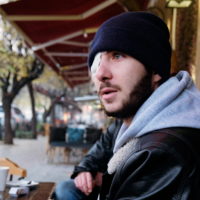
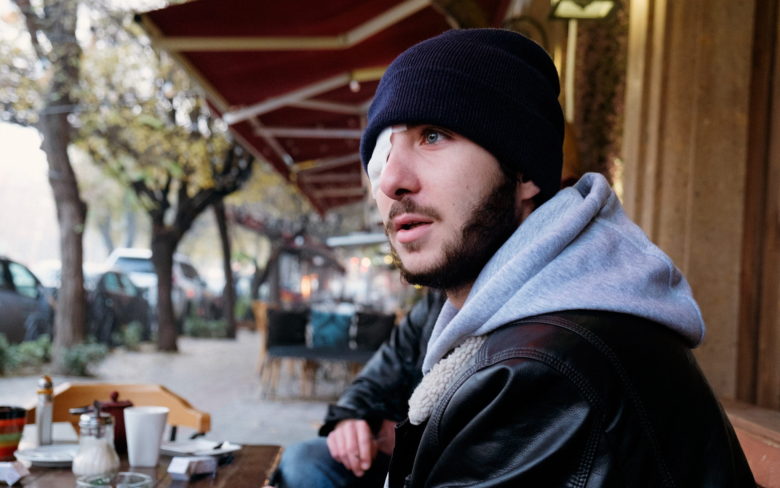
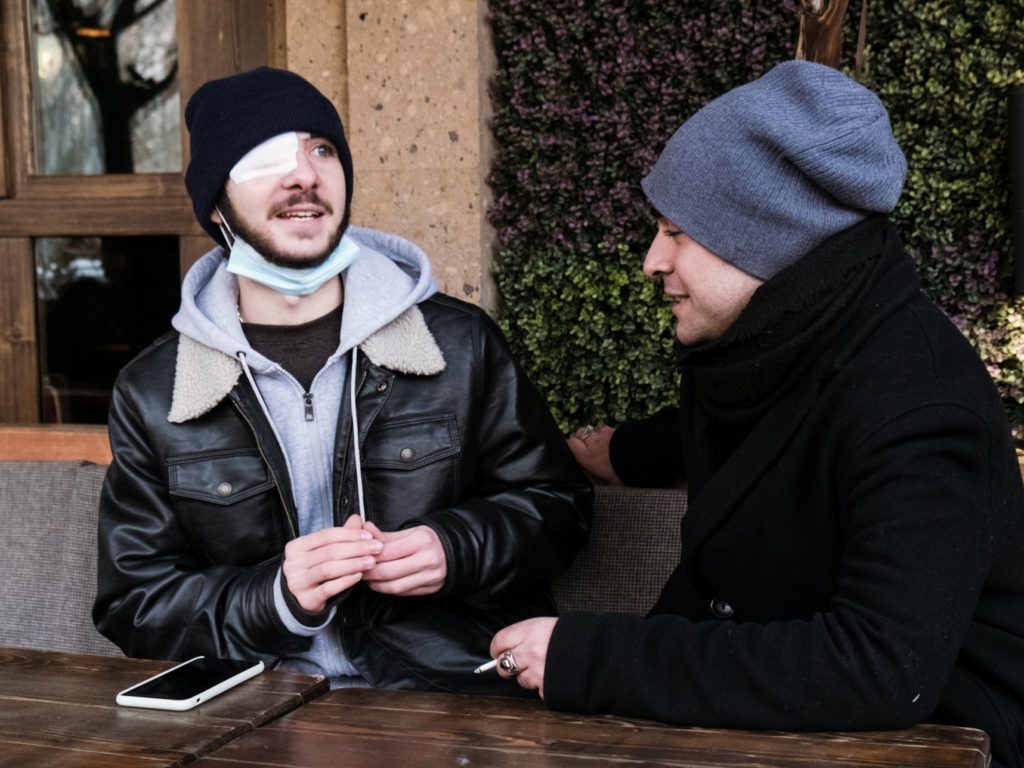
— Hello. No, this is Vahagn. I feel all right. I lost an eye and had part of my skull removed. I have an operation coming up to fit a prosthetic eye and reconstruct my forehead. You want to know what help I need, have I understood you correctly? I’ll need money for medication and postoperative rehabilitation, but I can’t give you a specific amount yet. Thank you very much.
— Wow, that was the municipality calling, — Vahagn says in surprise, hanging up.
I imagine the woman whose voice is at the other end — a woman of about 40 — calling twenty-year-old guys and, probably a little embarrassed, checking their addresses, sometimes mixing up their names, cautiously asking about their wounds. Relieved that the hardest part is over, she asks exactly what help they need.
I wonder whether anyone else has answered her in the same matter-of-fact tone, setting out his sentences as precisely as shots in a minimalist film?
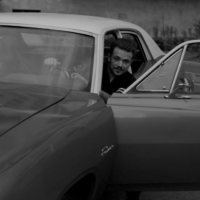
Vahagn is a stage and film actor. He played Lensky in “Onegin” at the Stanislavsky Russian Theatre. Ever since childhood, I have adored the easygoing Vladimir, who doesn’t get too hung up on things, as opposed to Onegin, who is too profound, too introspective, and therefore keeps losing his sense of life’s meaning. Vahagn resembles the cheerful Lensky.
— What do you like about working as an actor?
— That you can stop being yourself and become someone else for a while.
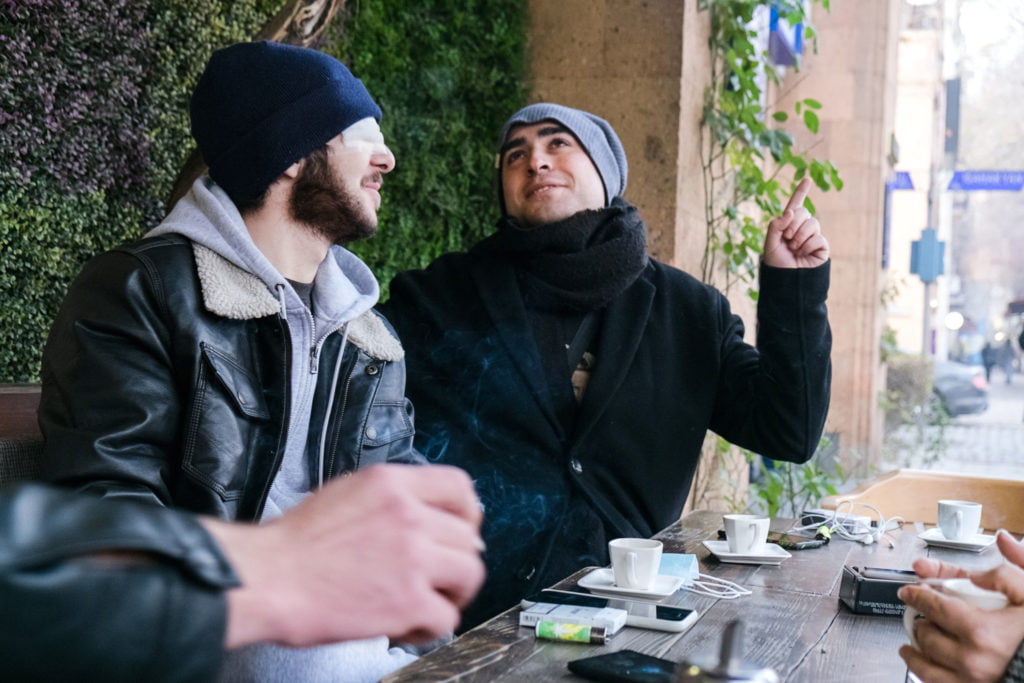
Fyodor asks Vahagn about his plans now that he has come back from the war. Vahagn expects to be medically discharged soon and assigned a disability classification.
— After that, I want to go to Petersburg, to grow. At least the theatre is good there.
— For good?
— No, I don’t want to go anywhere forever. I want to work and live in Armenia. Develop myself, come back and develop [the industry] here.
— And why can’t you develop here? What even is the film industry in Armenia right now?
— A mockery. A sort of swamp where, once you get in, you can earn a steady living. On soap operas.
— But we do have good directors and actors, don’t we? Why can’t they get together and make a good film or stage production?
— There’s no room to move forward here. We had good teachers (at the Institute of Theatre and Cinema). But even they never fully realised their potential. There’s nowhere to grow. You definitely won’t become DiCaprio here.
— Well, DiCaprio didn’t start out with the best films either.
— A lot of famous actors actually started out in porn films, — Fyodor says.
— So that’s our problem, it turns out, — Vahagn laughs. — There’s no porn industry in Armenia to get us going.
The Middle Ages and Tomatoes
Vahagn was drafted on the fifth of August. He served in the tenth regiment of the Seventh Defensive Corps, “Yeghnikner”. The military unit stands apart in the forest; the road to it is like a roller coaster, and rain washes it out so badly that not every vehicle can get through.
The commander of “Yeghnikner”, Colonel Karen Jalavyan, created a mini-village at the unit. The soldiers kept pigs and took them scraps after meals. Vegetables were grown by the posts. This way, “Yeghnikner” supplies itself from its own resources if food deliveries suddenly stop. For this, the Azerbaijanis nicknamed the colonel Kyokh — “village headman”.
— The natural surroundings — it’s like you’ve landed in the Middle Ages. The food isn’t very good; you peel the potatoes yourself. The toilet is this wooden box on the river. For cigarettes, a platoon of 116 men gets one carton of “Garni” — only enough for a couple of smoke breaks; the rest are sent from home. But it’s precisely the hardships that make the guys there more sincere, closer-knit. They don’t nick each other’s cigarettes there; they ask.
It Began
— On September 27, at 7.20 in the morning, I was standing in the smoking area. I took a sip of coffee, put my mug on a stump, lit a cigarette and heard an explosion beyond the mountain. At first, we thought there were exercises going on. Then we heard another explosion, and the order came to get body armour, helmets and weapons, go into the barracks and lie under the beds.
— Did you realise right away that the war had started?
— Yes. But we thought it would be a lite version of the April War.
— Did it feel like a film?
— At first, yes. A few other soldiers and sergeants and I rushed into the armoury, grabbed body armour, each put three helmets on his head and took as many weapons as he could carry in his arms. We handed them out — then went back. We ran past the door quickly, because they could fire a shell and a fragment could hit the door.
Not everyone knew how to load magazines. Three or four people loaded them for everyone. My thumb was covered in blisters. Then we herded everyone under the beds, two people under each, because they were bunk beds and there wouldn’t have been room for everyone otherwise. It was exciting. And then, once everyone had everything, everyone calmed down and the film was over.
— How long did you lie there like that?
— At 11.20, the firing stopped. We formed up and went into the forest. On the way, they started bombing again, and we hid beneath a rock face. A “Bukhanka” ambulance drove past us up to the front line and came back down with its windows blown out. The second time, it drove past with its rear end riddled with holes. And on and on like that — until nightfall it carried the wounded to the medical post, and from there a ZIL took them to hospitals. The unit had four KAMAZ trucks, but they had all broken down and the drivers never got around to fixing them.
KAMAZ trucks. I remember how, at the Aragatsotn regional administration, they answered my offer of help: “We need KAMAZ trucks. Everywhere. Can you get any? Even one. But a working one.”
Ordinary Things
— At night, we went down to the unit. We spent the night in the barracks. The building wasn’t damaged, but the shells had left enormous craters in the parade ground. They hit the little church, next to which stood memorials to the guys who had died in the April War. The electricity and communications went out after the second shell — they hit the tower.
The next morning, we took our things and food, went into the forest, pitched tents and covered them with leaves, though that didn’t help much against kamikaze drones.
We’re lying low against the ground, and a kamikaze is flying around. A “bang” echoes over to us, and we think — there, someone’s died. And you don’t know who, because there are no radios.
— Why?
— The batteries ran out.
— Were there no spare batteries?
— They ran out too.
Boom and Kaboom
September 28, around four in the afternoon. A fine, sunny day.
— I was just sitting on the third line, and suddenly — kaboom. And here we are, — Vahagn says.
— Actually kaboom, not boom? — Grig asks.
— Brother, the booms were 40 metres away. What we had was a kaboom.
Boom is when the artillery fires a single shell. Kaboom is a salvo from “Grads”.
— It’s better to be on the first line. At least you’re shooting there, there’s close combat. On the third line, you stand like an idiot and wait for the kaboom.
So, I opened a tin of stewed meat. Ate half and held out the rest to a mate. Turned around. An explosion. The assault rifles piled up a few metres away from me flew apart, everything around me turned orange, and I went flying into the river.
He remained conscious for another minute or so. He felt no pain and began frantically moving his arms. He couldn’t feel his arms either, but managed to see that they were intact, working. Then the orange turned to white. The last thing he saw before blacking out was blood in the water.
Vahagn doesn’t remember being pulled out of the river and loaded into a vehicle. He drifted in and out of consciousness in the vehicle. He remembered his mother’s number, asked for a phone and called her, first asking how she was feeling, then cheerfully telling her that he was wounded, but “nothing serious, we’ll have some plastic surgery, it’ll be fine”.
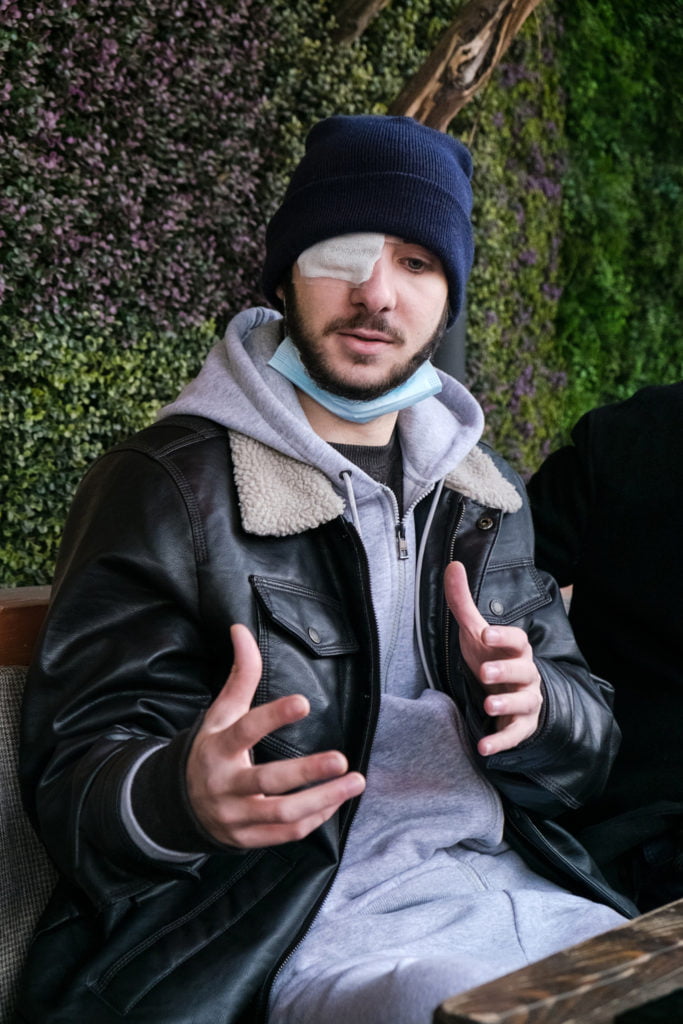
It’s Nina who tells us about the plastic surgery. Vahagn protests that he never said the words “plastic surgery”. In fact, he doesn’t remember the call either. He has to trust the people who were around him that day and during the next 11 days, which he spent in an induced coma.
— They put me in a coma because my consciousness kept switching on and off, and the terrible pain could have damaged my brain, — Vahagn explains. — They shut down the programme so it wouldn’t overload. I fell asleep at one point and woke up at another. In between — there was nothing.
Off Camera
During the 11 days Vahagn spent in oblivion, a great deal happened “off camera”. Nina tells us about it.
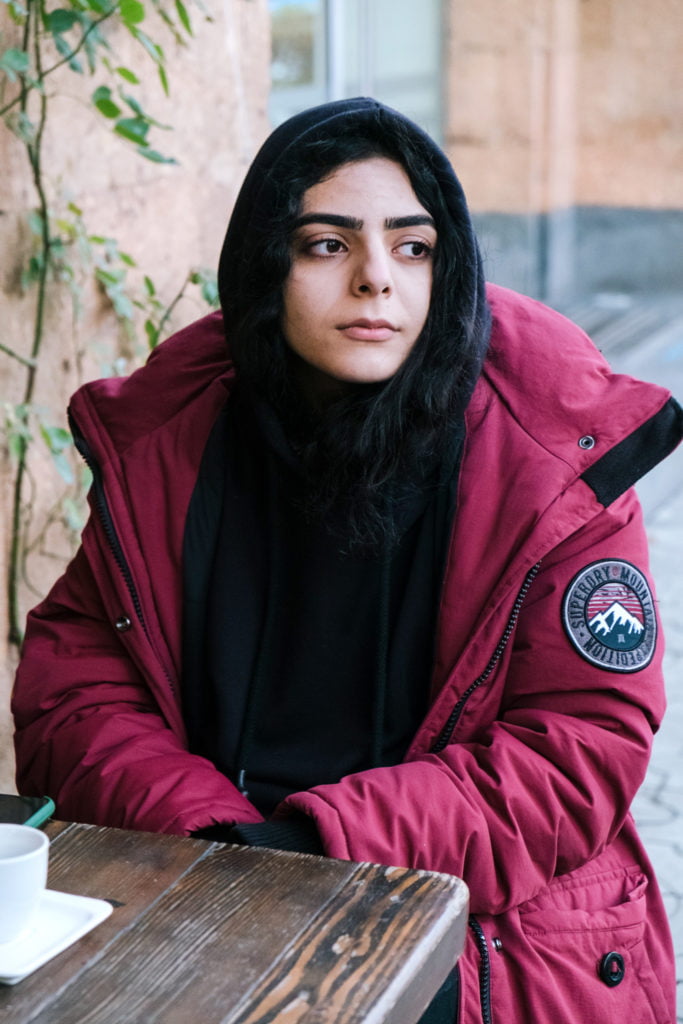
She and Grig — Vahagn’s friends — kept watch outside the hospital. Relatives of the wounded crowded around the hospital entrance. They weren’t allowed inside — Covid. From time to time, someone would come out of the hospital and shout the first and last name of a wounded serviceman. That was how the family received information. In Vahagn’s case, the doctors warned his family to prepare for the worst.
On October 3, Nina returned her ticket. She was supposed to fly to America the next day.
— Vahagn and I are very emotionally attached to each other, — she says. — For a long time, we had this ritual — every evening, it was as though we put the good and bad energies we’d accumulated during the day on the table and passed them back and forth until our energies were cleansed. That was how my grandfather cooled his tea, pouring it from one glass into another. I felt that if I left now, he definitely wouldn’t pull through.
Nina and her friend sat outside the hospital from 7 in the morning until 10 at night. An ambulance carrying wounded people pulled up every two minutes. The policeman standing at the hospital entrance shouted at the cars not to park, not to block the ambulances’ way in. The next day, he was almost crying, begging them to drive through more quickly and not create a traffic jam.
On one of those days of waiting, the friends moved to the steps of the school opposite.
— The guards would come out to us, offer food and water. Someone took the back seats out of his car so we could sit more comfortably. When it started to rain, the driver of one of the buses (the terminus was there) opened the doors for us. Some drivers were already helping the policeman move the cars along.
On the first day, when my dad said Vahagn’s condition was serious, I couldn’t hold it in — I walked away and cried. A tiny, tiny child came up to me, hugged my leg and asked — are you feeling bad? Shall I bring you a tissue?
I saw real unity in those days.
Blue Eyes
— Why am I tied to the bed?
— So you don’t hurt yourself. You’re in Yerevan, in hospital.
— No, you’ve got something mixed up, I’m in Karabakh.
That was how Vahagn woke up. They told him he had lost an eye. A shell fragment had also struck his frontal bone. He would need an operation.
— What did you feel when you found out you’d lost an eye?
— I made a mental note of the fact. Thought, the other eye is still there — good, I can see. When I could finally walk to the toilet on my own two feet, I looked in the mirror. I was curious to see what was left of the eye. I like anatomy in general, the structure of the body.
— Did you really never ask, “Why me? Why did this happen to me?”
— No. In the first few days, there was a very strong sense of frustration — as if everything was only half done. You haven’t even had time to take part, and you’re already lying there wounded. As for “Why me?”, the way we thought in the hospital was — you’re in hospital, that means you made it out, you’re alive. That means God has kept you here for something else, that means there are still things in this world you need to finish.
I was very lucky, too. There were six of us in the ward, sometimes seven; there weren’t enough beds. Most of the people on our floor had shrapnel wounds. There was a guy in my ward whose spine had been pierced by a fragment; he was in terrible pain, his arms were paralysed. He was a cellist.
Vahagn will soon be fitted with a prosthetic eye, have a titanium plate put in his head, and “get a normal face back”. We agree that eye operations are done well here.
I had a fellow student whose one eye was brown and the other blue, made of glass. Vahagn has very beautiful blue eyes. A beautiful blue eye. The other, artificial one will look the same.
We’re glad there’s something we do well. We need to cling to the little grains of good, gather them up and hold on to them.
Talking
— When were you most afraid?
— When they put a needle in my eye — to numb it so they could stitch it up.
— Was that the greatest fear you’d felt since the war began?
— Probably the only one.
I catch myself thinking that I’m unwittingly playing psychotherapist — hunting for trauma.
— There’s no need to look for it. I don’t have any trauma. A psychologist used to come to see us in hospital. She would sit by a bed and talk quietly with the patient. I turned down her services. That’s the kind of person I am — I’m mentally stable, I recover quickly.
It was strange at first, when I left hospital. The army, the uniform, discipline, regulations, hospital, and suddenly — you’re sitting at the Cascade drinking coffee. But I readjusted quickly. For a few days, I startled at loud noises. It passed. I didn’t have time to see much horror; no one knows what would have happened if I’d stayed in the war longer.
— How were psychologists treated in the hospital?
— Generally, they weren’t taken seriously. They were called head-shrinkers. Well, that’s how it is in our society. I think you don’t have to be a psychologist, you can just come and talk to someone and they’ll feel better. Like we’re talking now.
A Generation
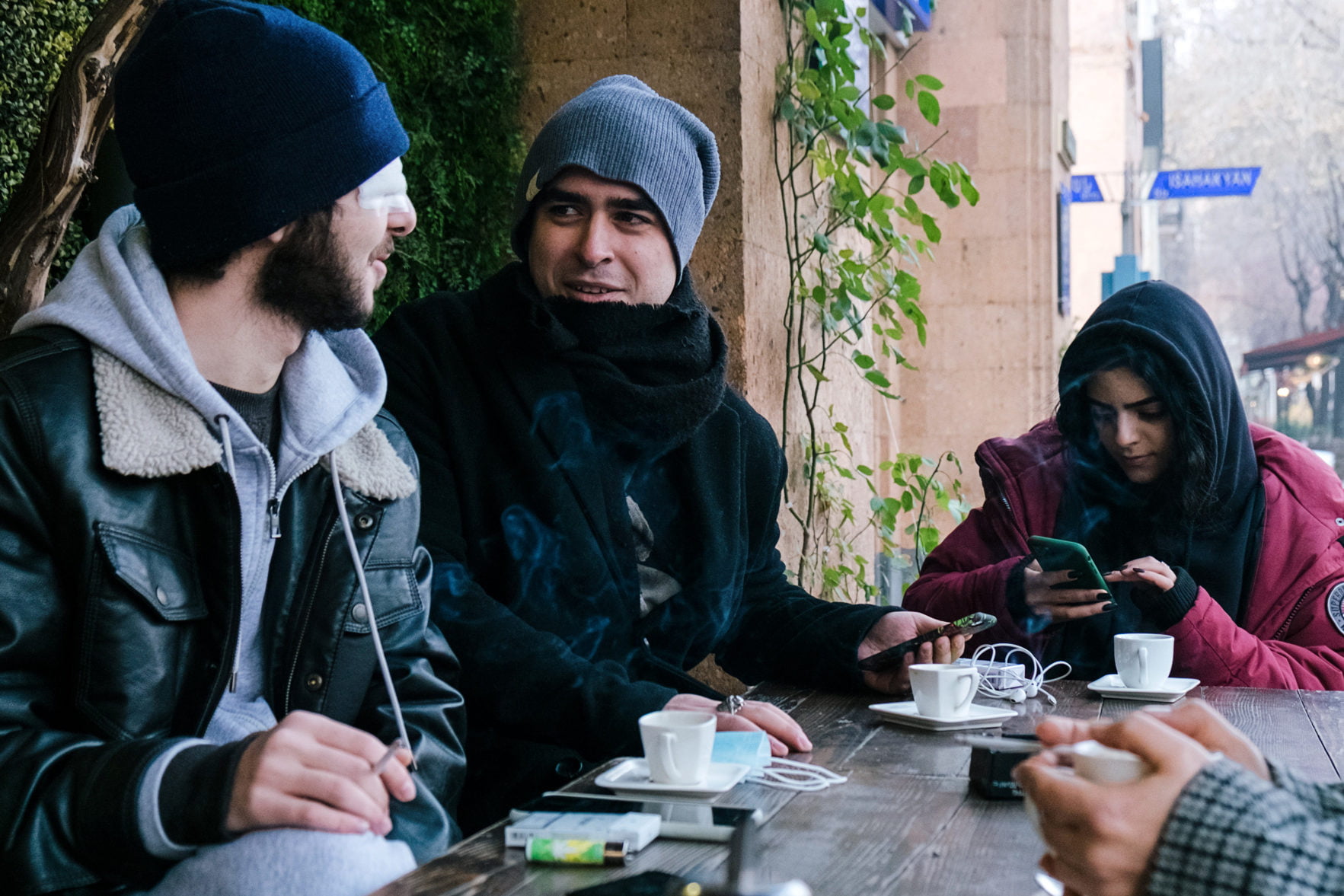
— I really like your generation, — I say animatedly. — Quick, pragmatic, without unnecessary romanticism, knowing what it wants. I believe your generation will manage to build a wonderful country.
I feel my eyes light up. I’m glad to register the feeling, as I am every rare sign of life in my almost three months of lifelessness. I really do like these young people — the generation as a whole, and the three sitting in front of me in particular: Vahagn — 21, Grig — 23, Nina — 19.
— But our whole generation’s been slaughtered, — Vahagn says simply, as though composing a shot.
The words hit me like the blunt edge of an axe, bringing me back to the horrifying reality I slip out of several times a day. His generation already lies in Yerablur, beneath a heap of flowers, beneath tears and stony silence, beneath the tramping of demonstrations. Lies there, having deprived the next generation of the chance to be born.
A Hero
— Do you often hear the word “hero” used about you?
— Yes, and I don’t like it. I don’t consider myself a hero. I was just there. I didn’t do anything heroic.
— Who is a hero, then?
— There was a guy in hospital with me who pulled his wounded mate out under a sniper’s sights. He knowingly faced possible death to pull his friend out. That’s heroism.
Or when you know no one is covering you, the enemy is advancing with tanks, and you’ve got a grenade launcher with three rounds and that’s it. You have a choice — to run away, but you stand your ground. A hero. There were plenty who ran away, too.
— And if someone ran away because they were afraid, do you judge them?
— I can’t judge them. I wasn’t in their place, and I don’t know what I would have done myself. I know guys whose minds were damaged by seeing their mates die, by realising that five minutes later they themselves could be lying there.
No one knew in practice what kind of war this was. We’d known about drones since the April War. But few people had any practical idea of what a drone actually was. And our weapons were like chasing a grasshopper with a machine gun.
Justice
— I’m tormented by the thought of how unjust it is that some people’s lives have to be protected at the cost of other people’s lives. As though your life matters less than mine.
— But there’s no justice in the world. Say my grandfather stole a lot in his day and got me out of the army. Yours couldn’t, or mine stole it from him in particular. I dodged the draft, you go into the army. That’s how it turned out.
When you stop thinking about justice, the need for expectations and illusions goes away. You expect things only of yourself. It’s easier to live that way.
I realised there was no justice back in kindergarten, when another child stole my toy and the teachers didn’t intervene. Though they should have. Then I had a choice — take the toy back by force or leave it with him. I decided to leave it. I chose to give up the toy; I won’t give up Armenia.
— Did you ever feel angry at those who were here, in comfort and safety?
— I’m not angry at anyone at all. Not even the Azerbaijani who fired the shell at me. Neither he nor I am to blame. Each of us was following orders.
Not Just About
— Where were you on November 9? How did you find out the war was over?
— At home. Mum read it online. At first, I didn’t understand — how, why, what for? Then I thought there could have been more dead. It could have been worse. Somehow I accepted that this was how things were now.
— What do we need to do?
— Strengthen the army. Domestic production. Try to become self-sufficient. We’re in a survival phase now, but people don’t want to accept that, they want to live in comfort without thinking about anything. Without taking account of what’s happening beyond Yerevan, beyond Armenia.
— Do you keep in touch with the men you served with?
— With some of them — yes.
— What do you talk about?
— For now, unfortunately, only the war. But if we keep in touch, we’ll talk about other things too. Someday. Right now, everyone is in a state of genocide, but it will pass. It will definitely pass.