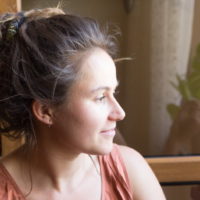

Armen Akhmeyan is 21. He lives in the village of Yeraskhahun in Armavir. Armen is the youngest member of the first volunteer detachment formed by Yazidis to defend Artsakh. Armen and his comrades spent half a month at the front and returned on October 15, handing over to a second detachment for the next 15 days. In a few days, it is back to the front line.
Armen reflects on war, love of his homeland, things intimate and funny, fears and heroes.
We thank the Yazidi Center for Human Rights NGO for its cooperation and help in creating this piece.
On Deciding to Go to the Front
My friend was killed on the very first day of the war. We were the same age. He lived in Europe but decided to return to his homeland and join the army. He had been serving for two months when the war began. On September 27, I was reading the list of the dead, and there was his name — Sargsyan Sarkis Armenovich. A shell hit him, and he burned to death.
I immediately decided to sign up as a volunteer. I had been exempted from military service twice: I have polydactyly — 6 toes on my feet. The second time, I decided to turn down the deferment and enlist on a three-year contract. They offered me a choice: either have the “extra” toes cut off, which I did not want, or go into the army as I was, to “peel potatoes.”
I turned it down then, but this time I thought that if they would not take me to fight, I would go and cook or dress wounds — any help is needed now. But they took me. When I put on army boots, they were uncomfortable, admittedly, but it was all right, I got used to them.
-

Photo: personal archive -

In the photo: militiamen hold the Armenian flag and the flag of the Yazidi people
On My Parents’ Reaction
When I learned that the Yazidis were forming a volunteer detachment, I called our MP, Rustam Bakoyan, and said I was ready too. I got my things together and went to the assembly point by our Yazidi temple in the village of Aknalich (“Tause Malak and the Seven Angels” is the largest Yazidi temple in the world — Kalemon).
At home, they did not take my decision seriously at first. When I got to Aknalich, the older men started asking, “Does your father know? Come on, call him, let us talk to him.” I called Dad and asked him not to break my resolve. Dad did not let me down; he said calmly, “Well done, son, I will be there soon too, to sign up.” But when I came home, he asked, “You are not serious, are you?”
I am a Ukrainian citizen. My father offered to send me there and then to my uncles in Europe, but I refused, and he seemed to accept it.
But early in the morning before we were due to leave, Mum and Dad started trying to talk me out of it again; they seemed on the verge of tears — well, of course, they are parents. I told them, “All right, I will think about it some more, I am just going out for a little while.” I took my small hand-held bag and went out. A little later, they called and asked, “Where are you?” And I was already on the bus with the guys.
They certainly did their share of worrying over those 15 days. Our commander, Rzgan, took our phones away and did not allow many calls, so that drones would not pick up our location. I would sometimes call my parents, say, “Everything is fine,” and hang up. Then the Turks (in Armenia, Azerbaijanis are often called Turks — Kalemon) hit the cell tower, communications went down for five days, and a rumour reached our parents from who knows where that Rzgan’s entire detachment had been killed. Luckily, friends got through to MP Bakoyan, and he reassured everyone.

On Determination
Our commander called me “the artist.” Because I am an actor. I studied at the Abel Abelyan School of Arts. I got in on my own and paid for my studies myself.
I am the youngest in the family; I have two older sisters (they are married), but I was never fussed over as the youngest. I have made my own decisions since childhood. For example, my family did not know I had enrolled at “Abelyan.” I had already been going to Yerevan for classes for two months when my father asked where I was going so often. I said I was studying.
Before studying, I did street workouts, gymnastics on a horizontal bar. Once, I broke one wrist and dislocated the other. While I waited for my hands to heal, I saved up for my studies; I did not even spend money on cigarettes.
I knew from childhood that I wanted to be an actor. After my studies, I acted at the Sos Sargsyan Theatre and was filming a feature film, “Against My Will.” Filming stopped when COVID began. I hope we will resume when the war is over.
I also write screenplays. People in America were interested in my screenplay about priests; they said it was so good they did not believe I had written it. The producers wanted to come to Armenia, but then quarantine began. Though I do criticise priests in it (smiles).

On the Reality of War
I had read a lot about war and watched films. But the reality is completely different. On our way to the front, I imagined we would sit in trenches and shoot at the Turks. But this is not a “human” war. Their infantry never did appear. Instead, all kinds of military hardware came at us — artillery, drones.
A drone is a terrible weapon; even at a distance of 50 metres, a fragment can be driven into a person by the blast wave, and even if it does not kill, it causes horrific wounds.
You hear a sound, terribly loud, and realise it is a drone, but you do not know which of the three kinds — a reconnaissance drone that films the terrain to direct artillery fire, a combat drone that fires shells, or a kamikaze that will fall and explode. You do not know exactly where it will explode, but you understand that in the next second one of your comrades, or you yourself, may be gone.
In a month of this war, I lost another one — a friend from the next village; his name was Tigran Sahakyan.
We had no internet for 15 days, and no one noticed. In the city, we are all on our phones — how many likes your photo got, whether it was shared, which of your friends posted what. Here, the people in uniform beside you become your friends.
Instead of will he like it or not — will he survive or not.

On Fear
I was not afraid for myself. Somehow there was no time for it. People you did not even know yesterday become family today. You start worrying about each of them, fearing for his life. You worry about the guy bringing you food. If he is even a little late, you start wondering — has something happened to him, has he come under fire? That happened, and 18-19-year-old boys were killed. You just wait in agony for him to make it there alive.
Or you see someone who has been killed and start imagining his family. What are they feeling, do they know yet, or are they waiting hopefully for a call? Who was he? Perhaps an only son? Perhaps his parents brought him up denying themselves everything.
Your heart aches for them so much that you think — let me die even right now, as long as no one else does, as long as the war stops.
Drones, artillery salvos… Somehow I got used to them quickly and felt no fear. Only once did I think — why the hell did I come here? Heavy rain started at night, and we were soaked down to our undershirts, but we did not light fires so as not to attract drones. Our commander would not even let us light a cigarette at night. We did not gather all together or go into the dugout — they mainly targeted shelters and military hardware. But rain was something I was not used to — not having done military service made itself felt (laughs).
A lot depends on commanders in a war, and ours in the army are just what we need. Our commander, Rzgan, is a special person. He fought in the first Karabakh war. There were 42 men (four Armenians, the rest Yazidis), plus Dilbar, a nurse, all aged 25 to 60, and we would all have followed him wherever he ordered.

On Heroes
There was a guy with us, about 26 — small, skinny, not the “fighting” sort at all; I kept wondering why he had come here in the first place. Half our detachment split off and spent several days on the front line, helping to hold back the offensive. After the battle, we had three dead and one wounded man from another detachment.
With the Azerbaijanis, if there are two of them and one gets shot in the leg, the other turns and runs away — anything to save his own life. But our guys, including this one, decided to carry out both the wounded man and the bodies. The area was under Azerbaijani fire; they could easily have been killed, the bodies were already dead anyway, but no — even our dead must not be left to the enemy. They have parents, after all; they did not get them back alive, so let them at least give them a decent burial.
Those guys are heroes to me.

On the Homeland
There are people who say — give up the lands, let our blood stop being shed. But anyone who says that does not understand that it is not Artsakh they want. If we lose Artsakh, we will lose Armenia, we will cease to exist.
So many people have died defending these lands. How can we give the enemy land that holds their blood?
When I think about defending the homeland, what I see before me first of all are our temples, our churches, our holy places that they have destroyed. How can we let them destroy temples where every lit candle is someone’s dream?
On the first day, when we went up to the posts, there was a ZIL truck there with military equipment. A shell hit it, and it burned out. We came over and saw someone’s leg in the burned-out vehicle. We have to move forward so that we never have to see these corpses again. Everyone who died was a light in someone’s home, someone’s hope. We have to move forward until the war stops for good, not so that in two years we see on television that the Azerbaijanis have attacked us again.
We all want peace. But I think wars will not end until they stop instilling in a three-year-old child that he must grow up to be a killer. We do not nurture hatred in our children. We kill only when we are attacked.
But once we do take up arms, we have such fighting spirit and mutual support that they get more than they bargained for. In our rare moments of rest, we would sing songs, talk about our homes, miss our family and friends, and think how we wished we could get home soon. Now we are back, and we cannot settle, we are desperate to go back.
You keep thinking — how are our guys doing there? Maybe the infantry has already advanced? If so, it would be good if we were there. The more, the better.

On Funny Things
One morning it was very cold, and I decided to put on a second pair of trousers. I had pulled on one trouser leg when suddenly — bang, a shell landed nearby. We took off running, and I was holding up the trouser leg with one hand; it was terribly awkward and probably looked very funny.
***
The Azerbaijanis wrote on Twitter that Syrian mercenaries were fighting on the Armenian side, and posted a photo of our detachment as proof. I have had my hair cut and shaved now, but when I look at my own and my comrades’ long hair and beards in the photo — the spitting image of mujahideen.
***
I took cigarettes, a comb, perfume and antiperspirant with me. The guys laughed at me — what, have you come here to be in a film? Or do you think a Turk will come over, sniff and say, “What a fragrance! I will not kill this one”?
***
There was a guy with us who had problems with his eyesight. And one night was gloomy and dark, you could not see anything in front of you. You approach the sentry and exchange passwords. If he does not give the password, he is the enemy — shoot.
So our friend is on watch and hears footsteps. He demands the password, but there is silence in response. He repeats the challenge, silence again. He raises his assault rifle and fires. And in the light of the muzzle flash, he sees a bull standing in front of him. Well, how would a bull know the password?
We jumped up at his shot. There was a man among us who had received a call-up notice; he came, but he was still terribly afraid. That is normal, it happens too. When we heard the shot, he cried out in despair, “I knew there would be trouble!” Everyone started laughing and could not move from the spot — what did you expect in a war?
And the bull walked away unharmed. It was big, well fed. There was a lot of livestock wandering around there — sheep, cows, chickens, horses. They just went about their business, some chewing grass, some pecking at grain. I worried about them a lot. I kept thinking, I hope a shell does not hit them. Many people had taken out loans to buy them; I felt sorry for the people. Let them be alive and well when their owners return. And they will definitely return.