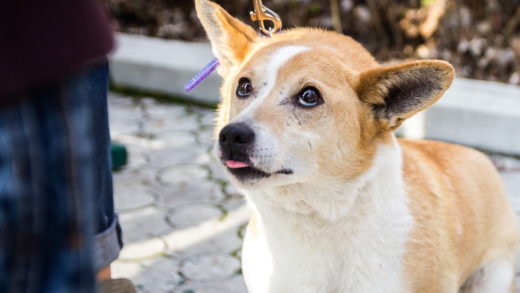
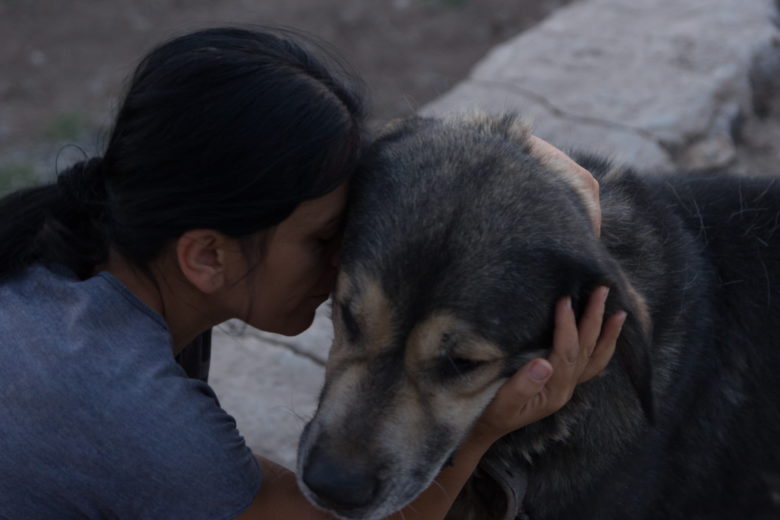
During training in Poland, I visited a shelter—spacious, beautiful, full of volunteers and dogs looking for homes. They did not put dogs to sleep for being old, but tried to find them homes to the very end. But if a pregnant dog came to them, they let her give birth, then killed the puppies. Because, the director explained in response to my eyes wide with horror, puppies are more readily adopted, and they take a chance away from adult dogs. And when you run a shelter, your professional qualities must sometimes prevail over your personal feelings, and you have to make decisions for the greater good of all dogs.
Bassit is a succession of agonizing choices, all-in gambles and big wins. Saving Bassit time and again often came at the expense of the other residents of Centaur: we poured effort and money into him that could have saved several dozen other, younger dogs. By every law of shelter life, he should have been put to sleep at least twice.
It turns out Basit kept surviving and lived so long thanks to our wonderful lack of professionalism as shelter managers.

Eight years ago
I take a horse home
It all began when I ran into Tika in the street. Golf and I were having a rare day off from rescue work. I had even put on a short skirt instead of my “dog” jeans, and Golf had had a wash. So that all the dogs and cats would understand at once: today, no throwing yourselves under cars, and no dragging yourselves in front of us with clouded eyes or terrible wounds.
Leaving the car to rest in the parking lot, I walked down the street, smiling at the sunny February frost and the passersby. Suddenly my smile stumbled over Tika’s face. It was sad. My smile froze. A sad Tika always concealed a threat in the shape of a sick, dying, unhappy dog that needed saving immediately.
My fears were justified. An enormous wolfhound, emaciated, constantly shaking his head. Not a single taxi driver would take him, and all he needed was a ride to one particular vet. The vet had agreed to examine the dog and keep him at the clinic for a few days while somewhere could be found for him.
“Such a shame, but I’m in a hurry,” I opened my mouth to say. “Well, if it’s only to the vet…,” my tongue got ahead of my brain.
It was already dark when we parked in the courtyard of Edita’s house, the girl who had found the dog. I got out of the car, and a little horse jumped up on me and joyfully rubbed its muzzle against my face. It turned out to be an enormous dog.
“I saw her and was done for,” Vysotsky sang.
“I’ll drive him to the vet and leave straight away,” I reminded them in the car. Twice. To be certain absolutely everyone understood. Including me.
Skinny Tika presses herself into the seat, making herself even smaller, and nods obediently. Her eyes, however, cannot hide a pleased smile. She takes out a cigarette, misinterprets the stern look I throw her, and hastily puts it away again.
The dog barely fits into the Volkswagen’s spacious trunk. His tongue is out, and he shakes his head like a Chinese nodding doll. His loud, snotty breathing makes the car rock slightly.
I look at him in the rearview mirror and think that I have never seen such an enormous dog. Or such a perfect one. And that we have too many dogs, and a new one is o-u-t-o-f-t-h-e-q-u-e-s-t-i-o-n. There is nowhere to put him, either—all the enclosures are occupied.
“Neurological distemper, it’s obvious even without a test,” the vet diagnosed, still in the corridor. And refused to keep the dog at the clinic not for a few days, not even for a few minutes. The dog was about eight, contact with him was dangerous for other dogs, his condition was advanced, and his chances of survival were small—unlike the medication bills—and everyone would be better off if he were put to sleep.
“I’ll spend the night outside with him, and in the morning we’ll think of something,” Tika said quietly.
I had no doubt she would do exactly that. In February. She could not take him home: Tika had Blackie, a Shar Pei allergic to absolutely everything.
“No. I’m taking him,” my tongue spoke up again, just as I was getting ready to think about who I could palm the dangerous dog off on.

Anna is justifiably outraged
Anna Zhamkharyan and I came up with the dog’s name together. If you are wondering how we ended up with so many dogs at Centaur, well, this is exactly how.
“Has, hi, are you busy?” Anna’s voice would come down the phone, and I would swallow nervously. “There’s a dog that needs taking from point A to point B, and I can’t find a car. Can you help? Just drive it there, that’s all.”
And although four out of five of those dogs somehow, in a way beyond my understanding, ended up in Ushi instead of point B—and I was the one who suggested it!—I never once managed to say no to that woman. In fairness, I should mention that I never had to worry about food or medical expenses for all those “temporary” residents—Anna had a rare gift for finding money anywhere.
Once, for example, we paid for surgery for a dog with a broken leg by clearing Anna’s balcony and returning the beer bottles she and her husband had emptied over the previous few years. Another time, Anna’s faithful retinue—myself, Anna Vardanyan and Tika—stood dejectedly at the vet’s table with four one-paw-already-in-the-grave puppies with enteritis. We hung our heads under the weight of the sum the vet had quoted, and at least one of us secretly hoped Anna would put at least these ones to sleep, but no such luck. With a regal gesture, she unclasped a thin gold bracelet from her wrist and told us to run to the nearest pawnshop.
But today Anna was furious at my “careless and irresponsible” act. Sitting at her place, drinking my sixth mug of tea, I meekly waited for the right moment to ask what she thought of the name Wabi-Manido (White Spirit). I very much wanted to give the dog a Native American name.
“Do you understand,” Anna thundered meanwhile, lighting one cigarette after another, “you’ve got about a hundred dogs” (“Only ten,” I corrected her, but Ostap was already on a roll). “Where will you keep this one so he has no contact with the others? What if you lose all of them because of this one dog? What were you thinking—both you and Tika? You have to rescue sensibly, not at others’ expense!”
Essentially, she was right. Distemper is one of the most dangerous viral diseases, and damage to the central nervous system is its most severe form. The virus passes from dog to dog through direct contact with urine, blood or saliva, which means a dog can catch it from practically anything. The likelihood of a fatal outcome—especially for unvaccinated dogs—is very high.
Our dogs were not vaccinated. They had already developed fairly strong natural immunity, and there were no puppies among them, but distemper was still distemper. On the other hand, even if the dog survived, there could be complications: loss of sight or hearing, impaired coordination, behavioral changes, epileptic seizures. Of course, we should have weighed all the arguments for and against and considered the possible consequences. But it was easy for Anna to talk: she had not seen the dog.
“So what do you suggest?” I asked. “No one else will take him.”
“Put him to sleep,” Anna snapped.
I pretended to believe her and became extremely indignant. You had to take great care to conceal from Anna that you knew about her immense kindness and sensitivity. Anna had all but demanded that the vet resurrect a dog that had been dead for several hours; never mind making the decision to put one to sleep herself.
By midnight she had calmed down, and the dog had a name. Not Native American, but Aramaic (Anna’s husband is Assyrian, and she speaks Aramaic)—Bassit. It meant trusting and easy. So that the treatment would be easy and the dog would get better soon.

An elephant moves into the china shop
All ten of our dogs ran free during the day, and at night were shut into three stalls standing empty without horses.
We ourselves—the therapists and trainers—spent our nights in a trailer, or rather the trailer of a Red Cross vehicle, measuring 2.5 x 1.5 meters. Narrow couches were nailed along two walls clad in sheet metal and painted pale lilac, and between them, cabinets stretched the full length of the third wall.
This “little room” was to be Bassit’s home for the next few… no one knew whether weeks or months. There was no guarantee Bassit would pull through at all.
All day, his lanky, skinny body lay sprawled on a couch, half asleep. He came alive only at feeding time and for the countless injections. In one movement, Bassit would swing the front half of his body down to the floor, where a bowl of meat and rice was set—his hind legs stayed on the couch—and gulp his food greedily.
When Bassit grew tired of lying down and “moved around” his tiny home, glasses fell from shelves and clothes flew off hooks. But Bassit would not turn around even at the sound of a cup breaking—self-control and composure worthy of a guardsman of the British queen.
The walls of our trailer had no insulation whatsoever. At night, for safety, we turned off the electric hotplate with a heating coil that warmed the place, and sometimes by morning the water in the glass jug had frozen, and your head sticking out from under the blanket ached with cold. Now, though, you could squeeze in beside Bassit on the couch, put your arms around him and sleep in warmth. The main thing was to hold on to the wall so as not to fall off the narrow couch.
Twice a day—morning and evening—we shut all the dogs away, carried the meter-and-a-half-long dog some distance from our grounds, and walked him on a leash. Bassit moved slowly, swayed and constantly shook his head.
The snow in the village of Ushi was knee-deep. Noisily and curiously, Bassit inhaled the unfamiliar smell of horses, savoring it—his nostrils flaring and his upper lip sliding comically up and down—getting used to it, then breathing out just as noisily. He tumbled about, caught snow in his mouth, swallowing some and spitting some out, tried to catch his tail and fell from weakness. At times his left hind leg twitched, or he vomited all day. And he shook his head all the time.
One day Bassit fell. He was running about, scooping snow into his mouth as usual, but suddenly stopped, swayed and fell. For a few seconds he convulsed, then got unsteadily to his feet and looked in bewilderment at us, standing frozen.
An hour later, Bassit was lying on the clinic floor, and the vet was trying to draw blood. Which was not so easy. Bassit’s veins “hid” at the sight of a needle, while he himself, lethargic just half an hour before, fought off the vet with strength that had come from nowhere.
At last, they managed to collect the blood in a tube. The vet sighed with relief and picked up the cap, but just then the tube leapt out of his hands, and Bassit’s blood sprayed in every direction. We had to repeat the whole procedure. We needed to hurry: the lab was closing.
Ten minutes before closing time, I burst into reception and shouted breathlessly:
“Will you take blood?”
The two women at reception stared at me in horror. Only then did I notice that my light-colored blouse was splattered all over with Bassit’s blood.

Bassit decides to live
The next examination showed that distemper had, after all, rewarded Bassit with anemia, a damaged liver and heart, one completely destroyed lung, and another working at half capacity.
The number of pills and ampoules grew. At set times, strictly according to the instructions. At the sight of a syringe filled with yellowish or scarlet liquid, Bassit impersonated an enormous grasshopper jumping in the grass. He gave us plenty of practice throwing darts; often we literally had to throw the syringe into the upper part of his bony thigh.
Bassit had a catheter in his leg, through which medication was infused into a vein. Bassit would chew one out, and every other day he had to be taken to the clinic for a new one. Each time, overcoming his aversion to the car with every conceivable form of persuasion and threat. Leaving our little elephant at the clinic was out of the question: there would not have been enough room.
At night, we listened intently to his breathing. Counted his pulse, stared tensely at his closed eyes until the poor fellow woke up from our intrusive attention. Rushed to him whenever Bassit began rolling in the grass, ate too fast or, on the contrary, too slowly, seemed far too calm or suspiciously restless. The collapses recurred every three days. Each night could bring another day of life—or be the last.
We did not breathe out until six months later: the vet declared the fight for Bassit’s life over; neurological distemper had surrendered. He would need a full examination every year from then on, but his life was no longer in danger. Bassit moved out of the little house and into the stable.

Basit meets the love of his life
Bassit got along with all the dogs. More precisely, he was indifferent to them. Our elderly lapdog, Ketty, who was not particularly fond of dogs herself, fell passionately in love with Bassit: she followed on his heels everywhere and bounced on her chubby little legs, trying to lick his face. Bassit accepted the adoration with dignity and even showed affection for Ketty himself: sometimes he spent a long time sniffing her. But things never went any further between them.
Maggie came to us on a snowy winter day just like the one Bassit had arrived on a year earlier. The Caucasian Shepherd had a prolapsed uterus: she was operated on with money raised by volunteers, and her owner was warned that from now on she would only be able to give birth by cesarean section. After considering that he had two other healthy bitches producing puppies for him to sell, and calculating the cost of a cesarean, the owner gave her up.
Anna and I went to collect Maggie. Because “The dog is big, and there’s no one else. Let her stay in Ushi, and we’ll find her a home in no time.”
We were descending into a gorge along a narrow, icy road. Anna had her feet up on the glove compartment, as she liked to do, smoking and cursing Maggie’s owner. The car slid above the gorge; the tires were winter tires, but past their best. I was frightened, and I hated them all—Maggie, her owner and Anna.
“The brakes aren’t holding,” I said through clenched teeth, my voice trembling.
“You’ll manage,” Anna said calmly without even looking my way, lighting her next cigarette from the last. And I did manage. What else could I do?
The dog’s name was actually Mega. Her owner put her on the back seat, set a piece of rag beside her, and said feelingly that the rag was from her enclosure, so the dog would not be too nervous. He told us to take good care of her, because she was a wonderful dog. Luckily for him, Anna had already got into the car and did not hear those words.
Reversing to turn around, I saw Mega’s eyes in the rearview mirror—the longing with which she watched the man walk away made my heart ache. We’ll find you the very best owner, girl.
While we were still on the road, I changed her name to Maggie. After the heroine of The Thorn Birds. A few days later, Bassit offered Maggie his paw and heart, as our trainer put it, and she accepted. Maggie forgot her owner; naturally, no one even thought of finding her a new one anymore.
Maggie was shorter but broader than Bassit. The herdsman who drove cows past our stable to pasture every day spread a rumor around the village that we had got ourselves a lion out of boredom. Maggie really did resemble a lioness: in her fawn coloring, her powerful chest, even her gait. There was something independently fearless in her eyes that sometimes made you uneasy.
When Bassit lay exhausted, recovering after a collapse, Maggie silently lay down beside him and licked his leg with its catheter marks. They were always together. If Bassit moved even a little way off, Maggie began anxiously looking around for him.
Once, a yellow gampr that appeared out of nowhere attacked Bassit while he was recovering from another seizure. The young, strong dog knocked Bassit down and began tearing at him with his teeth. In one leap Maggie landed on the gampr, knocked him to the ground and bore down on his throat with her full weight. By the time we ran over to them, the gampr was no longer breathing. In Maggie’s amber eyes there was a readiness to obey her owner, but also a complete absence of remorse, and an absolute determination to go on protecting Bassit.
When Bassit grew stronger, Maggie stopped protecting him; on the contrary, it was as though she tucked herself under his shoulder and sighed with relief that she could be a doe of a woman—capricious and tender. If one of the dogs annoyed her too much, she would growl softly without getting up, and Bassit would immediately come running to deal with the importunate quadruped.

Bassit becomes a therapist
The child could not see and could barely walk. We had to make the diagnosis—cerebral palsy and autistic symptoms—ourselves: the family, deeply religious and absolutely without faith in medicine, had never taken him to doctors. Every Sunday, they took the child to church and prayed for his miraculous recovery, and for the past four years his mother had washed his eyes with honey water “so they would be able to see.” His mother did, however, agree to try therapy with horses.
Bassit was as indifferent to people as he was to dogs. He patiently allowed people to stroke him, coo over him and admire him, but did not seek out company himself. We were building a new stable and dog enclosures, and in the meantime, at night and during therapy sessions, we tied Bassit and Maggie under an enormous truck.
During the child’s first session with a horse, Bassit, dozing under the truck, woke up and looked at him intently. Came out from under the vehicle, something he never did in the heat. After the session, he began straining toward the boy and whimpering like a puppy.
The mother asked if the boy could pet the dog. The child felt for Bassit’s head, stroked it, gave it a little squeeze, and laughed. With sound. A lack of speech skills is one of the main symptoms of autism. Sometimes it takes the form of a complete absence of vocal expression of emotion. Even laughter is silent. That day, the nine-year-old child laughed an “audible” laugh for the first time.
Bassit waited patiently while the child stroked him, then lifted his head and… licked him in the eye. Taken by surprise, I grabbed Bassit’s collar with both hands.
“Let him lick.” The boy’s mother stopped my attempt to pull Bassit away. “I’ve heard about the healing properties of dog saliva. What if…”
As though he had only been waiting for approval, Bassit began diligently licking the boy’s eyes. Every time after hippotherapy, the child got off the horse and asked to go to Bassit. The ritual stayed the same day after day: he stroked Bassit’s head, then Bassit licked his eyes.
After two months of sessions on horseback, the child began to walk holding someone’s hand; another month later, he took his first independent steps. To build muscle memory, he needed to practice walking as much as possible. Still unsure of his own abilities, the boy complied reluctantly: he took a couple of steps and fell into waiting arms. But at the magic words “and now let’s go to Bassit,” his face broke into a broad smile, he leaned slightly forward to keep his balance, and walked slowly but steadily toward the sound of impatient whimpering.
The miracle happened after four and a half months. After therapy, we went to the stable as usual to feed the horses apples and carrots. It was overcast, the stable was rather dark, and I turned on the light. The child startled and backed away. He was frightened of the dog that had run into the stable behind him, we decided; his mother and I took his hands and began describing who and what was around him.
His mother gave me an odd look, and that evening she called to say that he had startled in exactly the same way when she turned on the bathroom light to wash his hands. And when the chandelier was switched on in the living room that evening.
“He behaved as though he was frightened of the light,” she said.
It did not take long to persuade his mother to take the boy to an eye doctor. The doctor confirmed our tentative hopes. The child had begun to distinguish light and shadow.
That was the very moment when the equine therapy center began to think that dogs should be involved in rehabilitation too. Dog therapy in Armenia was born with Bassit.
A few months later, the child could already make out the outlines of objects at a certain angle. And he was terribly afraid of this new, previously unknown ability to see. He would go to Bassit, lay his head on his back and become still. Bassit went through all his fears alongside the child.
After the boy, Bassit became warmer toward children; at least he noticed them now, but he never had an attachment like that with anyone else.

Bassit meets his past
The child’s father, mother, grandmother and two of his father’s friends got out of an enormous jeep. The mother gently set a little boy down on the ground, his parents took his hands, and the child hobbled toward us, barely dragging his weak, trembling legs.
Cerebral palsy. His parents had come to sign up for hippotherapy.
“I need my son to walk. I’ll spare nothing for it; we’ll come every day if we have to,” the father said, shifting his thick neck with its thick gold chain.
At the sound of his voice, Bassit crawled out from under the truck.
“That’s my brother’s dog!” the man exclaimed. “What’s he doing here?”
“We found him in the street,” I said.
“Good for you, taking him in,” the man said approvingly. “I thought he was dead by now. He caught something and could barely walk. My brother drove him to the outskirts and let him out. He was always defective. His father and brothers are all champions, they take first place in dogfights, but this one was always afraid to fight. Flops onto his side and lies there.”
“But that was a long time ago, it must be a good two years,” he added.
“Yes, I was pregnant then,” his wife confirmed.
I listened to the guy and tried not to think about how the sweet little child in front of me had legs that trembled just as Bassit’s had when I first saw him.
I told the parents honestly that I could give them no guarantee that the child would walk. We needed to try for at least a month and see how the child’s muscles responded to the work of the horse’s muscles. The father was disappointed. Said they would think about it and call. We never saw them again.
About dogfights and Bassit’s cowardice. I have never seen such a noble dog in my life. Bassit never fought other dogs for no reason. His attitude toward them was very consistent.
At the sight of a new girl, Bassit pokes his nose into her rear in a businesslike way. If there is the slightest hint of an approaching heat, Bassit courts her gallantly, invites her to share his enclosure, gives her his food. A spayed dog, meanwhile, earns a look of puzzled annoyance from the Caucasian count: madam, do you really not understand that you are wasting my time?
Bassit approaches large males menacingly and looks at them. Usually his look is enough for the newcomer to understand who is in charge. Bassit does not notice the little boys. If a stranger gets onto our grounds and Bassit senses a threat from him, he attacks instantly. But even then his nobility does not desert him. As soon as the other dog shows his teeth in defeat to signal surrender, Bassit lets him go.
After we had moved to the new land with its enclosures, when the wolves came down in winter, our dogs would cry with fear like little children. Only Bassit answered with a wolf’s howl and tore at the bars of his enclosure—let me out, I’ll rip their throats out.
When the man mentioned Bassit lying down on the ground and refusing to get up, I could barely suppress a smile. What his owners took for cowardice was actually Bassit’s cunning trick. At the command “place,” all our dogs run into their enclosures. Bassit, however, looks around in genuine astonishment every time, as though saying: “Surely you’re not talking to me?”
If Bassit does not want to go into his enclosure—and he never does—he flops onto the ground and pretends he has just urgently died. Even closes his eyes. A few seconds later, he peers from under his brows: did they believe it, will they leave? You walk away, he immediately jumps up and runs off. You chase him, catch him, grab his collar; Bassit falls flat again and turns into a little corpse. Until you run out of breath and leave him alone.

Maggie runs through the forest
It was a hot July day. We were waiting for a child to arrive for hippotherapy. Maggie and Bassit looked out expectantly from under their truck. I began dreaming about how, at the new place, Bassit and Maggie would have enormous enclosures and fields to run in to their hearts’ content. A phone call brought me out of my dreams: the child’s mother apologized, the little one was being fussy, and they would be an hour late.
In such heat, you wanted to lie down and die, but other children would come after this child, and there would be no energy left to walk the gamprs. Better to use the hour that had opened up.
Out in the field, away from people, I let them off their leashes. Bassit and Maggie raced joyfully ahead, with the rest of our dogs tagging along. There was an enormous puddle on the road: apparently someone watering their vegetable garden had forgotten to turn off the water, and it had formed a little lake. The dogs, languid from the heat, plopped into the water. I looked at them enviously, went past the puddle and whistled for them.
We did not last long in the field. The heat really was incredible. On the way back, the little dogs unexpectedly went around the water. I trudged along behind with Maggie and Bassit. As usual, Bassit was pooping on every enormous stone. Getting himself into the most improbable poses, the envy of mountain goats. That is how he marks his territory. With poop.
Beside the puddle, I hesitated for a second between dipping my feet in the dirty water and dying on my feet from the heat, and decided: I’ll get in and wash my feet at home.
My foot rose into the air, ready to land in the puddle a second later. From four meters away, Maggie hurled herself at me in one leap, knocked me to the ground and jumped into the water herself.
A second later she shot out like a bullet, took two unsteady steps and fell. “The heat,” I thought stupidly. Went to her, walked past her, called her. It sank in. That she had fallen. That she was not getting up. That she was barely breathing.
While I called the others and screamed for them to bring the car, while the car raced toward us, battering itself over the rough ground, Bassit stood silently beside her, looking bewildered.
Then we were driving Maggie, already dead, to the clinic. Injecting adrenaline into an already dead heart, trying to bring her back. There was an autopsy, and a cause of death: snakebite. Darevsky’s viper. Kills almost instantly.
We buried Maggie in an out-of-the-way spot. The next day Bassit refused food, and on the second and third days too. That night I heard Maggie bark. There was no mistaking her lion’s roar for anything else. I came out of the little house. Bassit was standing by the truck, staring intently at something. Eyes wide open, fur on end. The next morning he ate, listlessly, but he ate.
In the evening, I took him for a walk. Bassit turned off the road, unerringly found the place where we had buried Maggie, trudged over and lay down on her grave. An hour later he got up and walked slowly home. And so it went every day.
After Maggie, Bassit became aggressive and withdrawn. He would lunge at everyone, then sit motionless for hours. Sometimes he was gripped by such longing that I did not dare approach him. Maggie had died saving me. The guilt and pain made me just as aggressive as Bassit for many months.
But one day I had a dream. We were running through ears of wheat: Bassit, Maggie and I. The dream was in riotous autumn colors; our happiness echoed across the fields. Suddenly the field ended and the forest began. Maggie ran in among the trees; Bassit started to follow her, but Maggie stopped, looked at him, and Bassit stood still. Maggie looked for a long time at him, at me, at the fields, and disappeared into the forest. A second later, as if in slow motion, I saw Maggie running through the forest—lightly, as though she did not touch the ground. Joy suffused the air in sunny yellow.
I woke with a double feeling—aching and bright at once. Sat on the grass beside Bassit, put my arms around his big child’s head, and told him about the dream for a long time; about how Maggie was all right, about souls that need to be let go so they can soar into the sky, into absolute freedom. I spoke hurriedly, so I would not have time to doubt what I was saying. My salty tears fell onto his muzzle, but Bassit did not move away. Listened intently. The next day he let Kety approach him and even sniffed her.
Ahead of him lay Sunny, an enormous shaggy girl who brought Basit back to life, and little Acherik, who moved into his enclosure and lived with him until the end of his life. Sunny came to stay with us for a few days so she could be active and lose weight. Bassit ran with her for hours and seemed to grow younger. When she left, Bassit began sniffing other girls again and chose Acherik—spayed and much younger than him though she was—as his “enclosuremate.” But Maggie forever remained Bassit’s one great love.

Almost two years ago
Bassit refuses to get up
Our worker had the day off, so on Saturday morning I fed the dogs. Bassit did not look at his food. Did not run out through the open enclosure door. Tried to get up when I pulled his collar, but his hind legs would not obey.
While Fyodor and Hans carried him to the car, I changed my clothes. Chose which earring to put in my ear. Decided whether to wear boots or sneakers. Invented things to do, stretching out a time in which it was as though the disaster had not happened yet and there was no need to think what to do about it.
We had to wait at the veterinary clinic: our vet, Mihran, was performing a complicated operation. Bassit stretched out in the reception passageway, demanding just one thing—to be left alone. People with their animals carefully stepped over him.
A clipped poodle was waiting for his owner at the clinic. And kept trying to run out to meet Bassit. For some unknown reason, male poodles were the only dogs the peaceable Bassit always attacked. He did not even look at the poodle.
When the operation was over, Bassit had an X-ray and received his diagnosis. Discospondylitis is when an intervertebral disc undergoes destructive changes due to infection. Bassit had developed granulation tissue that led to compression of the spinal cord and nerve roots.
On the X-ray, a second, “artificial” spine could clearly be seen beneath the natural one. This meant pain that would grow worse. Legs that would fail more and more, all the way to complete paralysis. No chance of surgery. There is no way to give dogs an MRI in Armenia. Nor is there experience of such operations.
The poodle was collected. New emergency patients arrived. The vet disappeared into the clinic with them. Fyodor and I sat in reception. I looked at a little spot of dirt on my sneaker and took great pleasure in feeling irritated. As though a dirty sneaker were the biggest problem that had happened to me. There was nothing else in my head: only the spot and irritation.
Then came fear. And despair. Mixed in with them came the first blurred constructive thoughts. Find a hospital with an MRI scanner and persuade them to let a dog in. A compelling argument for a conversation with the head doctor took shape in my mind: “He’s a therapy dog, he helps children.” A few years earlier, when veterinary clinics did not yet have X-ray machines, we secretly carried dogs into human hospitals in large gym bags and paid five times as much for an X-ray. You could not sneak Bassit in. Not even in an enormous suitcase.
Perhaps an MRI would show that surgery was possible, even though Bassit was fourteen? And then find a human surgeon who would agree to operate alongside our vet.
Bassit was given a painkiller injection and snored softly, still stretched out in the passageway. Our vet did not risk saying “put him to sleep,” but hinted that there should be no hysterics. Wolfhounds do not usually live this long. Bassit had lived a life many dogs could not even dream of. There was no point tormenting him with treatments and operations.
It takes a minute to put a dog to sleep, but euthanasia is irreversible. How do you know which decision is more right—to lose Bassit forever or leave him with legs shattered by paralysis?
The painkiller would let Bassit live without pain until the following evening, and let us think over the decision.
I could not sleep that night. I sat down at my laptop and wrote Mihran a long, emotional message about how much Bassit meant to me and how important it was to think of a treatment for him. All right, a whole bunch of messages. Fyodor researched the illness and possible therapies online. By three in the morning, he could easily have defended a short dissertation on discospondylitis, while I had received word from Mihran of a miracle—the nonsteroidal anti-inflammatory drug Previcox. Mihran admitted that he was very reluctant to prescribe “cox,” as I soon began affectionately calling our salvation, which would relieve the pain but could wreck Bassit’s kidneys, already not in the best condition. The drug was not available in Armenia; we would have to order it from Moscow, and it would cost us sixty-two dollars a month. Not a small sum for us.

Bassit sticks out his tongue
The next day Bassit refused food again. Received another dose of pain relief. Got up only to pee, then straight back to his enclosure. He peed like a girl, without lifting a leg, barely staying upright on his trembling hind legs. I wanted to become very, very small, run away somewhere and hide. And not make decisions.
The line between genuine care and a selfish unwillingness to feel the pain of loss is so thin. You burst into a dog’s life, take responsibility for it and make choices. How can you know they are right? Discospondylitis and kidney failure sounded equally frightening.
A few years ago, the girls from a volunteer animal rescue group found a dog in the street with a broken spine. They kept her in one of their basements and tried to persuade our vet to put her broken spine back together. I went there to persuade them not to torment the dog and to put her to sleep.
I walked into the basement and saw an exact copy of Bassit. A girl. Her body was paralyzed, and she could only move her head. Bassit and I had only just won our battle with a terrible disease. Everyone had advised putting him to sleep, but we had won. Bassit was eight, his female double was ten.
Apparently my mind clouded over, and I thought that putting this dog to sleep meant denying her the chance Bassit had been given for six months, and was almost the same as deciding to put Bassit himself to sleep. I joined in the pleas to try. We chipped in for enormous absorbent pads and expensive medicines. Took turns staying with her. At the sight of us, the dog joyfully lifted her head and pounced on her food just like Bassit. Putting a dog with such an appetite for life to sleep was horrifying.
Not only did we inject the dog with an enormous quantity of medicines, we also made the vet come and assess our little successes: yesterday she turned her head more strongly; today she showed us with her eyes that just a little longer and she would definitely get up.
“Even if by some miracle her front legs start working in six months, which will not happen, it isn’t worth it,” the vet said on the day he announced that this was his last visit and that he refused to take part in our inquisitorial torture of an old dog. “You can explain to a person that they have to suffer for six months and then things may be all right. An animal has only one tense—the present. A dog doesn’t understand ‘putting up with it.’”
Those words sank into my soul. So deeply that, without asking the others, I took the dog to be put to sleep.
I pictured Bassit dragging his legs along the ground. No, that would never happen. We would only try. If it did not work, I would take him for euthanasia myself.
Making at least some kind of decision made it easier. I wrote a post on our page asking for help with Bassit’s treatment.
I was nervous. It is easy to raise money for a young dog that is bleeding to death, dying of starvation or needs surgery. A couple of “apologies-in-advance-to-your-nervous-system” photographs, an emotional text, and you are done. Quite another matter: “Help us buy a medicine for a fourteen-year-old dog that he will take every day for months, which will save him from paralysis but may shut down his kidneys.”
I removed the word “therapy” from the text. It made it sound as though spending so much on Bassit was justified by his usefulness, rather than by the fact that he was a member of the family, and we needed to fight for him just as we would for a person.
There were many responses to the post, from different countries. Offers of financial help, advice and consultations with vets abroad.
But there were others too: indignant demands that we stop tormenting an old dog under the guise of false kindness and put him to sleep immediately. Or think about whether it made sense to spend a sum on one dog every month that would feed all thirty-five dogs for several days.
Our friends brought Previcox from Moscow. The symptoms disappeared within three days.
Within three days, Bassit began eating, walking, running, peeing with his leg lifted.
A few months passed. Bassit ran and jumped like a puppy. Pulled the leash out of your hand like a horse. His kidneys were fine. I did, however, keep the habit of approaching his enclosure slowly every day, my heart standing still. And breathing out in relief when he lifted his head and sprang to his feet—wa-a-alk! And mentally sticking my tongue out at the old woman with the scythe. Not yet. Not today.
Bassit is fourteen. No treatment will make him younger. Or make his bone tissue knit back together. We do not know the end of this road. We do not even know the next stretch. But we are not keeping him on painkillers, not giving him endless injections. He swallows just one pill a day.
More and more people write to me asking where to get Previcox. More and more vets prescribe this wonderful drug, which became popular in Armenia thanks to Bassit.
Going to the vet, writing posts, finding money, arranging delivery of medicine from another country—all of it takes time and effort. But when this enormous eternal child comes running and slams his head into your ribs, then waits patiently for you to regain the ability to breathe, turn to him and scratch his neck, you realize it is worth it.

Bassit runs ahead
Bassit died on the fifteenth of February. That day was irritatingly windy, and the night gently cold. We were not there; we had gone with Mikki Muk to give therapy at an orphanage, and I hope he went peacefully, or better still—in his sleep. The thought of an autopsy flickered for only a second and went away: Bassit could not stand riding in a car; it may sound silly, but it seemed to me that putting him in a car now would be deeply disrespectful.
Bassit was 16. Wolfhounds do not live that long, especially with diagnoses like those—we had been hearing that since he was ten. Thanks to Previcox, he lived actively and without pain. But one day even this wonderful medicine would have stopped helping him; Bassit would have suffered severe pain or lost the use of his legs, and we would have had to put him to sleep. And if there is someone above us, I am grateful to them that Bassit went on his own.
“Not today,” I said every time another “fatal illness” befell Bassit. He will not die, not today, we will pull through. And we did pull through.
“Not today,” I say even now. Not today will I sit down, talk to myself and accept his death. Not today. I cannot yet. Life without Bassit is as though a person lived, say, in Japan, beside the sea, and then suddenly a tsunami came, destroying their house and the whole town. They were evacuated, say, to Paris. Years pass, and the person has an apartment in the center, a good job, friends, perhaps a family. They like living in Paris. But always, always, on their heels follows the knowledge that they can never get back that Japanese house beside the sea, never get back that important part of themselves.
“Bassit runs ahead, behind him a horse’s lunge line unreeled to five meters, a breathless me, and the phone bouncing in my free hand, lighting our way. Sometimes Bassit turns his head as he runs and looks at me like a governess—the eighth this week—who, to his deepest regret, will have to be dismissed as well. He slows from a gallop to a trot, gets into position and empties his bowels right onto the lunge line.
A piece of polystyrene lies alone on the road. Cursing quietly, I try to clean the line with it. It seems to work. Bassit is already galloping again. Inconveniently, the wind rises, and the polystyrene decides to skip after us, scraping horribly through the silent night field. Bassit stops, slowly turns and surveys the polystyrene: ‘Dismiss this negligent employee too.’
We come back. I sit on a stone in the dogs’ yard, catching my breath. Bassit is completely unbothered. As though he were not the one who is fourteen. The enormous wolfhound darts toward Arianur’s enclosure at the speed of a tiny dog and tries to claw the dog in heat out through a little square of mesh. Bassit cannot shrink Arianur through sheer force of desire. He lies down beside her enclosure, looks at her longingly and sighs as though his heart is about to break.
Mine does break—with tenderness. With the palpable miracle that he is running, sighing, breathing again.”
This is something I wrote a year and a half ago. We gathered in the comments beneath it—people who had known one another back in the “Zhamkharyan days,” when Anna had not yet left Armenia; people who had scattered all over the world, who had not spoken in a long time or only talked online, and those who met later. Bassit is like a bridge between two eras.
The most unbearable thing about death is looking at laughing photographs taken during life, and speaking of the dead in the past tense. Let Bassit remain in your memory in that present where he races through the fields with me and pulls funny faces in our selfies together.

Become a Patron
We are building a community of caring, free and unbiased people. If you want to support our work exploring deep social problems through the personal stories of ordinary people, the best way to do so is to become our Patron.
The text is finished, the story continues
Our mission is to help bring about change in society by breaking taboos and freely discussing important subjects such as violence, poverty, discrimination, parental and medical ethics—and so on.
The stories told here will always remain honest and unbiased—in part thanks to our Patrons. You can join too by clicking the button and choosing the amount of your support.
Every subscription, starting at 2 dollars a month, will help authors create new work. Thank you!


The creation of this article was supported by the Armenian civil society development program of the NGO NESEHNUTÍ (TRANSITION Program of the Czech Ministry of Foreign Affairs)