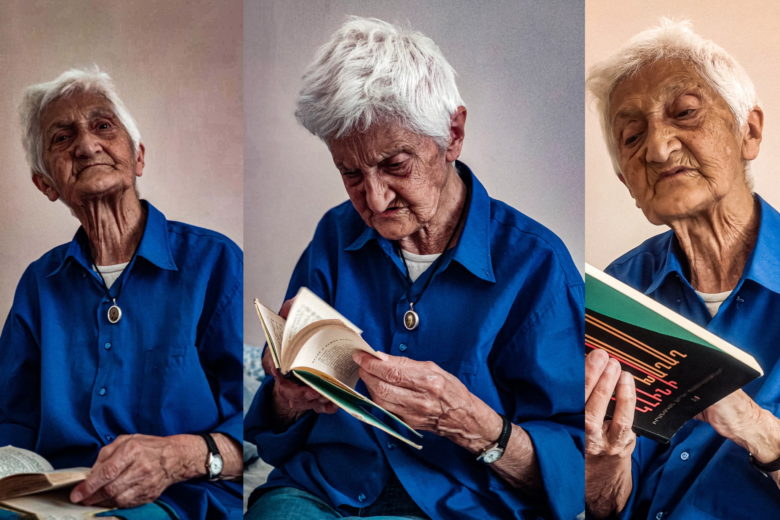
I tell Kima that I have been dreaming of meeting her for two years now — ever since the day I first saw her piercing eyes. In various social media posts by director Anzhela Frangyan and producer Sona Margaryan. In a music video by the rapper Lyoka, who lost his home twice, in the first and the last Artsakh wars.
“Oh, they’re my friends!” Kima exclaims joyfully. “Lyoka, yes, he filmed me in his video ‘I Still Exist.’ Well, here I am, I still exist. I’m 91, and I’m still alive. For some reason all my women friends have died off, but I haven’t got time for that, my granddaughter is due to give birth soon, I’m going to have a great-granddaughter!”
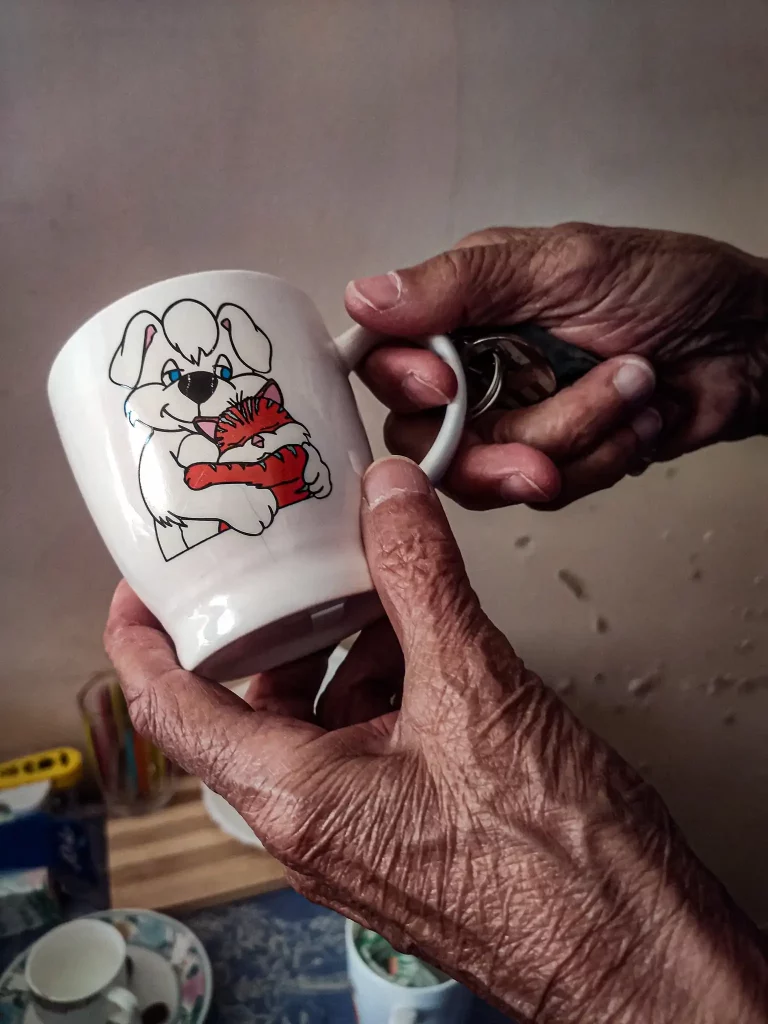
A white dog painted on the mug is hugging a red cat. The mug has tea stains and a chipped rim.
“It’s high time this cup was smashed,” Kima says. “But I can’t bring myself to do it. After all, the sworn enemies on it chose to be friends.”
“Settled”—she raises her index finger—“I won’t drink from it, I don’t like broken things, but I will brew tea in it.”
***
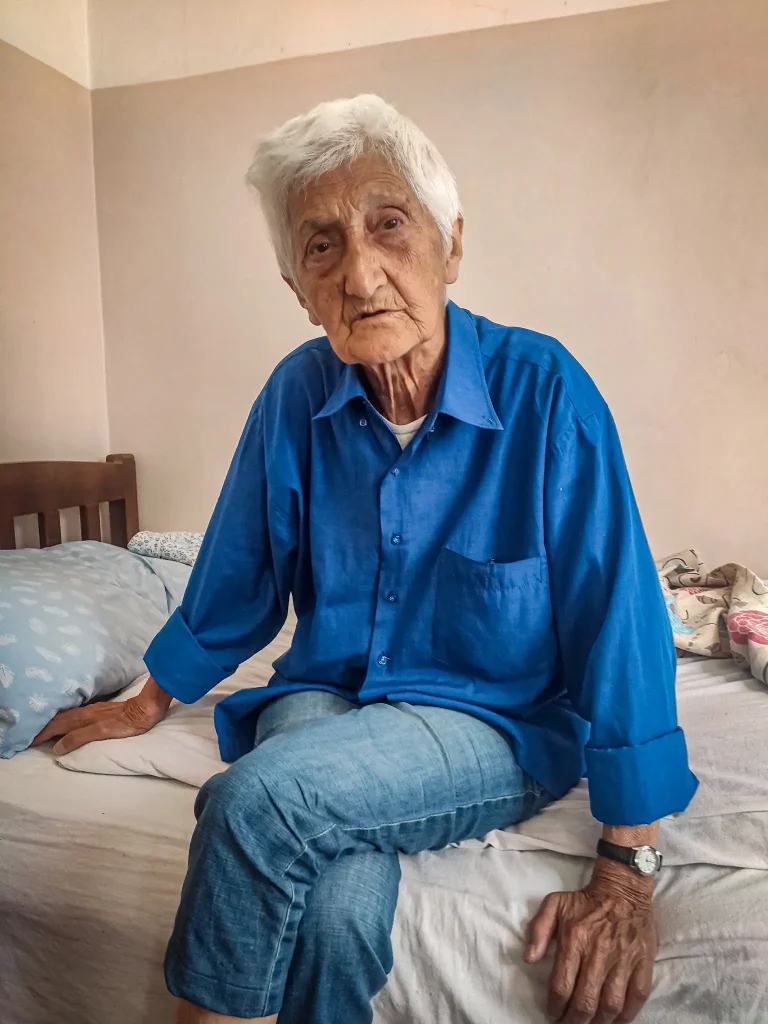
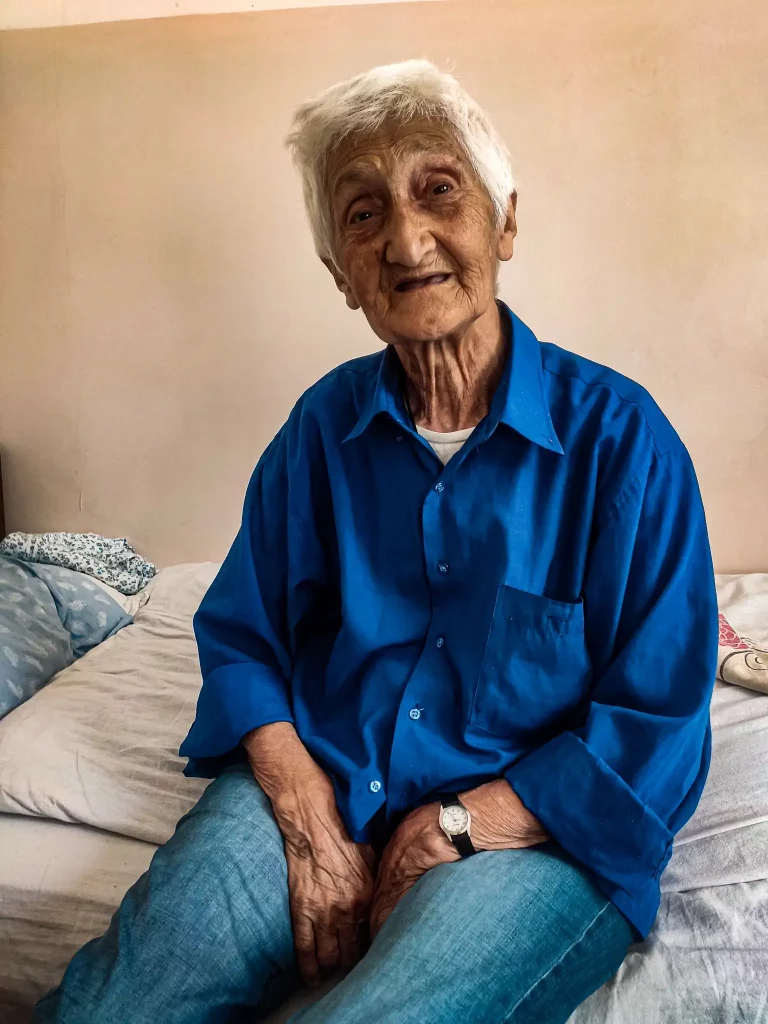
Kima is sitting on her as yet unmade bed. In an hour she will go to breakfast, and the care home staff will neatly make the bed and tidy the room. Many residents do their own cleaning, but Kima is entitled to help on account of her age.
There are potted flowers on the windowsill. Kima tends them because “you must create beauty wherever you can.” This one — Kima points to the pot on the right; the sweep of her hand is like an invisible bow touching violin strings — will soon bloom with red flowers.
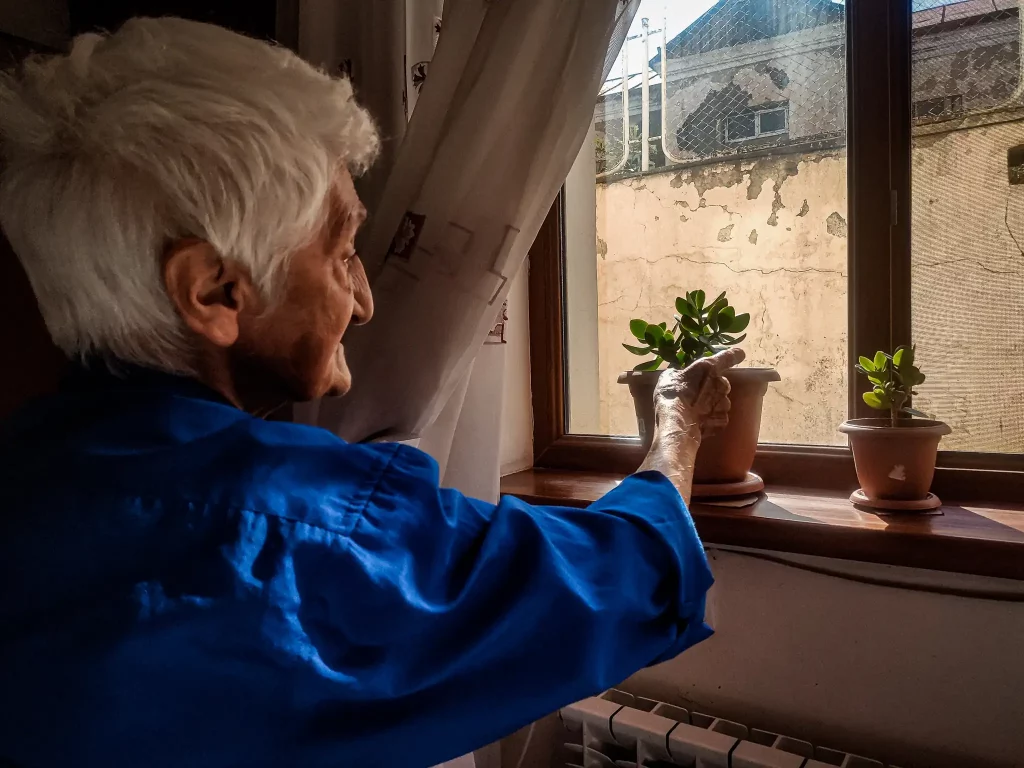
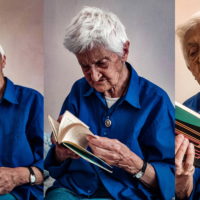
Kima is slender, silver-haired, in jeans and a blue shirt with a man’s cut. The sun-filled room, the spare red furniture — it seems like a noblewoman’s boudoir. On Thursdays, literary circles and music-making. High society considers it an honor to be on the guest list.
“My pupils from Shushi came to see me the day before yesterday, my golden boys,” Kima says. “That’s what I call them because they won gold at a music competition. Two are in the military, another is an architect, a third is studying at the conservatory. Good lads. My television isn’t working, something needs installing — they said they would come round in the next few days and fix it.”
“But I”—the slender fingers fly up again—“told them not to worry, the [care home] staff will see to it.”
“They treat me very well here, the director is a good man, and he’s put together a decent staff. I have my own bathroom, the food is quite good, everyone’s put on weight. It makes no difference to me, I don’t eat much. I even have a nickname: ‘Little-Little.’”
The care home is designed for 20–30 people, but 129 live here — people displaced from the towns and villages that passed to Azerbaijan after the 2020 war.
“So many villagers have been moved here, I have no idea what to talk to them about.” Kima spreads her hands. “They say the displaced will be given apartments. Many came here on that pretext, but I don’t care — whether they give me one or not. Even if they do, it won’t be mine anymore. My home is back in Shushi.”
***
Kima has three sons. The eldest lives in Ukraine, “in the part they aren’t bombing so much yet,” the youngest in Yerevan.
“And the middle one, my Gorik,” Kima falls silent, lowers her eyes to her folded hands, then, slightly tightening her fingers, goes on, “he was special. We understood each other without having to finish a sentence.”
When the war began, Kima says, Gor left his mother a note saying “I’ve gone” and volunteered for reconnaissance.
“When the first Karabakh war began,” I specify to myself and shrink inwardly: somehow we have taken to saying it easily, without a falter — the first, the second, the April one… But Kima does not specify: they are all one endless war.
Kima followed her son. Settled in Stepanakert. Nursed her son back to health all three times he was wounded — once in the arm, which they almost amputated. When our men took Shushi — her son was among those who liberated the town — Kima says she suggested that he sell the apartment in central Yerevan and move to Shushi. Her mother’s ancestors came from there.
“I bought a magnificent four-room apartment on the fourth floor, beside the forest. I had pupils all over Karabakh, I was earning money, we started living well…”
April 17, 1992, Kima says, was Gor’s last battle. He was wounded in the neck. “As though someone had lifted me up and slammed me into the ground with all their might,” was how her son described what he had felt.
Years later, the wound made itself felt. Terrible pain set in, his voice began to change. Kima spent a long time trying to persuade her son to go to the hospital for tests.
The doctor in Yerevan told her bluntly: “Cancer, stage four. A month to live.”
“They wanted to keep him in the hospital, but I brought him to Shushi. He lived a month and another year. Morphine eased the pain somewhat. He had a girlfriend, she came to him from Yalta. She wanted to have his child. But he said, ‘I must raise my child myself,’ and sent her back. He knew he wouldn’t have time.”
“He never complained — he had a strong will, just like me. I sat beside him and held his hand. In his final moments he said, ‘Mama, leave the room.’ And I left.
“He was 55. I buried him in Shushi. I forbade everyone to cry. He had been a calm, intelligent man in life, we had to bury him properly.”
After a silence, Kima adds:
“They [the Azerbaijanis] broke the monument on his grave. I asked the lads to bring a handful of earth from the grave, to bury it in Yerevan, beside his father, but it didn’t work out.”
***
During the war, Kima was one of the last to leave Shushi.
“I wasn’t planning to leave at all. I had my son’s knife with me, and if the Turks had come, I would have slit my wrists. What is death? Just a moment.”
After a silence, Kima recalls visiting her son’s grave on one of the last days of the war — not suspecting that she would never see it again.
“Our soldiers came up to me — tired, bearded men — and said I had better leave. Then I understood at once what was happening. My legs gave way. The lads caught me, someone said to bring a box — there was a big box lying there. They sat me in that box — luckily I’m small, I fitted — and began dragging me down the hill from the cemetery.
“At the bottom they whispered among themselves and left me. I rolled onto my stomach and crawled. I ordered myself: ‘Kima, get up. What if the Azeris come [right now]?’ That spurred me on. Then they shoved me into a car and took me to a bus with people from Karintak. They put me on the bus, and we went to Yerevan. The Azerbaijanis were already coming up from Karintak.”
***
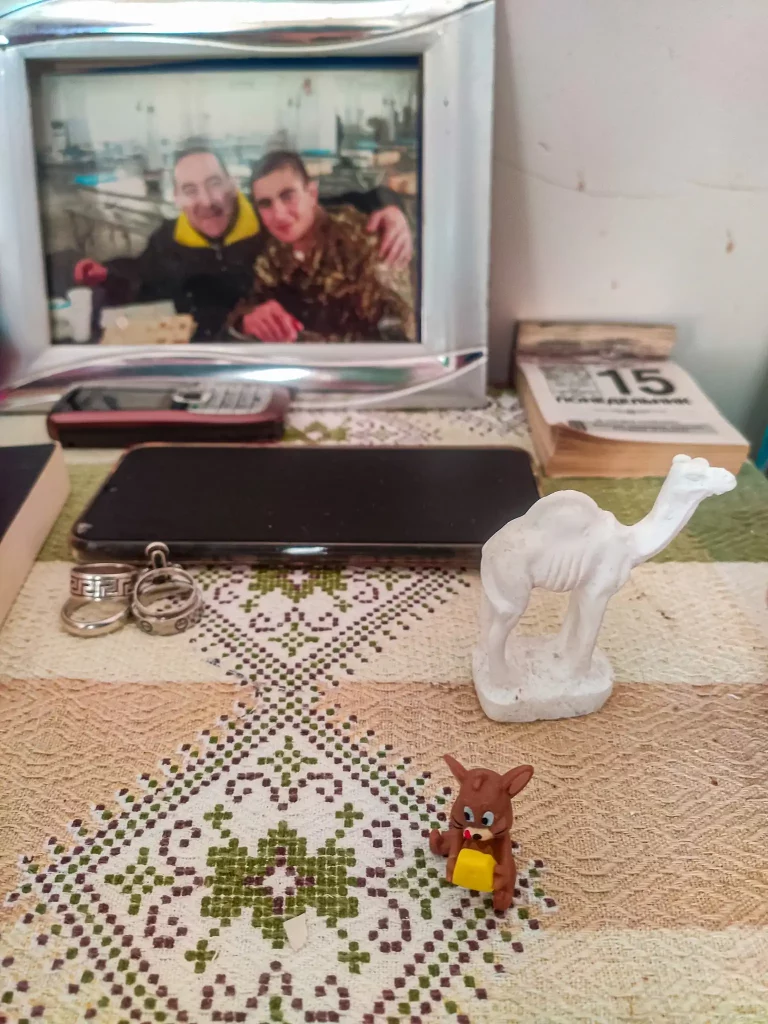
Kima’s treasures lie on the bedside table. In a photograph, a man has his arm lightly around a young man’s shoulders.
“This is my youngest son. And this boy is his friend’s son, he’s a hero, he died in Jabrayil. His name is Adam.”
2000, 2001, 2002… the numbers on the gravestones surface in my mind.
“And this little mouse I found in the street and took in. What would he do out there all alone? Let him live with me for a while.”
Behind the little mouse and the camel that Kima’s granddaughter brought her from Egypt sits a fifty-year-old keepsake box with a pack of cards. I dabble sometimes, Kima laughs.
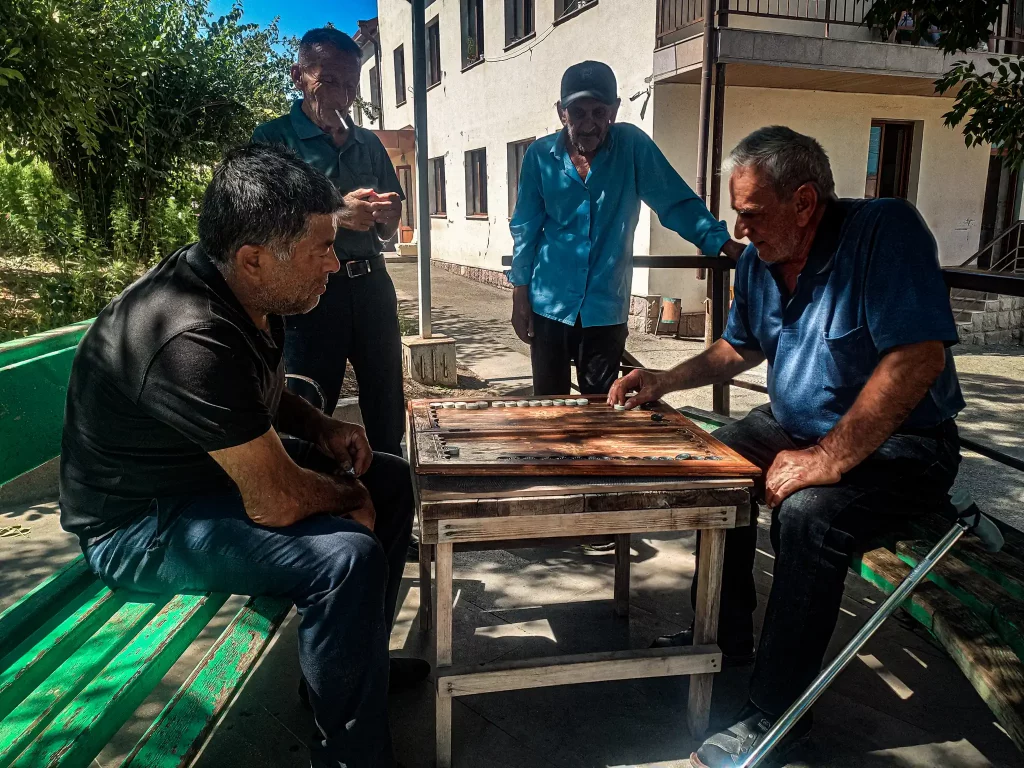
She also goes down to the garden when the men sit down to play backgammon, and joins them. In hot weather, Kima goes out in nothing but white, “look, even my sun hat is white.” She plays backgammon well and often wins. Behind her back, the home’s residents whisper: “Always keeping company with the men.”
“Like I said — uneducated, from the villages, what can you expect?” Kima shrugs. “It’s mostly the women who gossip. The men line up before me like tin soldiers. I told them straight away: I may be a cultured person, but if need be, I can slap someone’s face too.”
“I tell [the residents] this is Ward No. 6, but no one understands what I mean, people here don’t read,” she laughs.
***
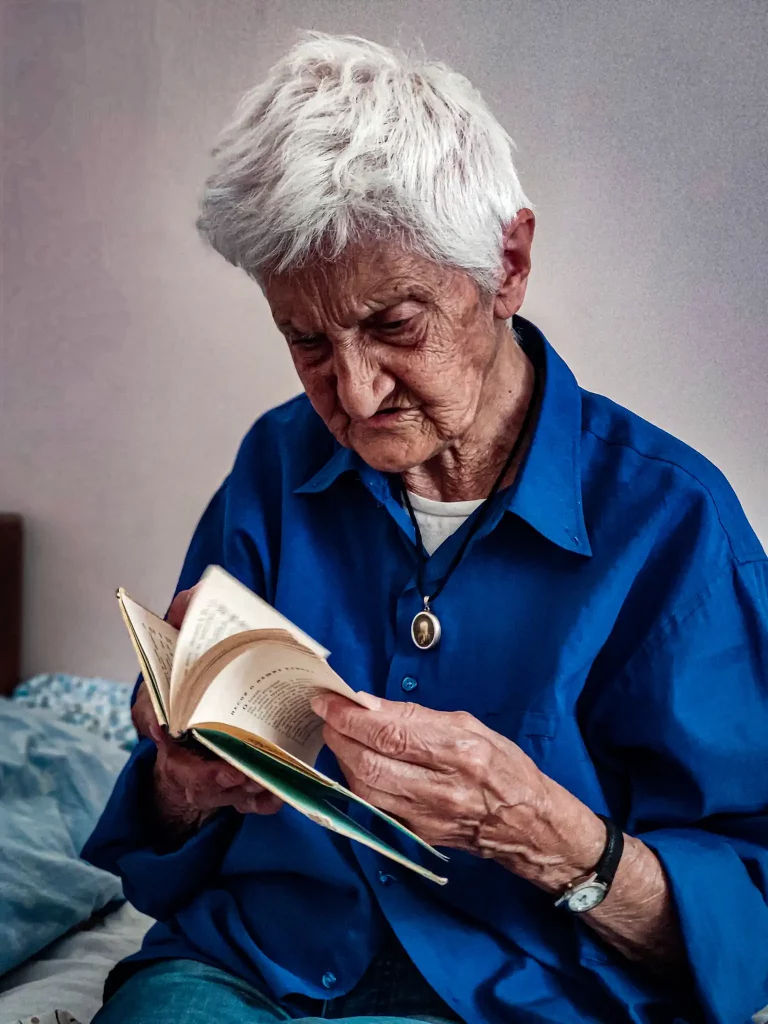
Kima picks up from the bedside table a collection of poems by the Armenian poet Silva Kaputikyan, translated by Okudzhava and Mandelstam. It was a gift from the care home staff.
Kaputikyan is too fixated on her dramatic love, Kima thinks, but writes rather good poems.
“Here, listen to one of my favorites,” she offers:
In a foreign land, in the fields of foreign soil
He vanished without a name, without a grave,
If only they had brought his shirt back home,
So his mother could wash its blood away with tears…
But a memorial spring stands in the village,
In the shade of a green-curled hazel tree.
There are many on this stony land —
Since the war, this wise custom has been ours.
The gray-haired mother has a place to weep.
She comes here early in the morning,
Mingles her tears with the flowing water,
Caresses the scarlet stone as though it were wounds.
So every day they meet —
Son and mother, comforting each other.
Water runs — day follows day,
Easing grief that has no way out.
Kima peers at the lines, her eyes slightly narrowed, but reads without glasses.
***
People often wonder why Kima does not move to Yerevan to live with her son.
“But I don’t want to. I’m going to celebrate my hundredth birthday here. You’re invited, my dear child.
“I can’t leave here, because Gor’s soul is here, I can feel it. Gorik comes to me in my dreams, invariably asks how I am and always says: ‘Mama, everything will be all right, everything will still be all right.’ And disappears.
“But once, two years ago, the dream was different. Gorik was coming out of a cave, leading a horse. I call him, and he says — Mama, I can’t come, I’m holding the horse. I ask him — why are you living in a cave? And he answers — the horse wants it that way.
“The next day the war began.”
***
About once a month Kima goes to Yerevan — to visit her son and granddaughter. When the bus passes Shushi, Kima asks the driver, Mher, to slow down. She rises a little and quietly says: “Hello.”
***
Kima skips from one subject to another. Mixes up dates, but remembers the names of her very first violin teachers, neighbors, the important people of her childhood. For instance, Roza Lvovna, a Jewish woman and a friend of her mother’s, who taught German at the medical institute. Kima’s mother had graduated from medical school too, but her husband would not let her work — “she was so very beautiful, he was jealous.”
It was Roza Lvovna who spotted a talent in the lively little girl and persuaded her parents to send her to music school.
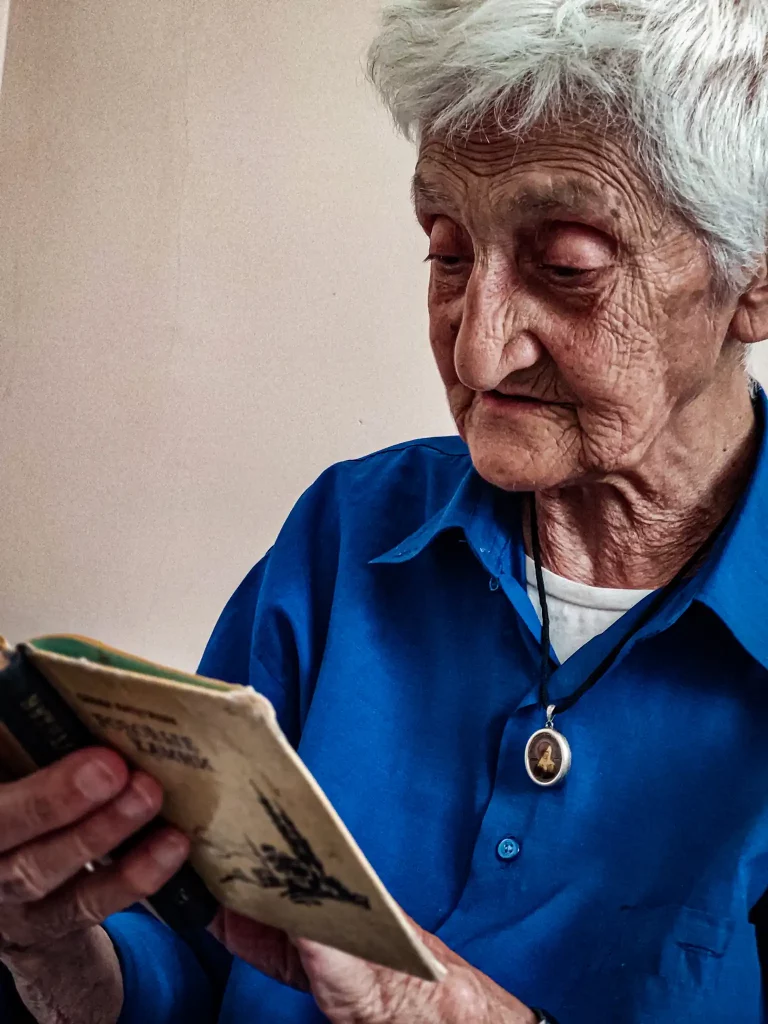
“I remember what I sang before the panel: ‘We’re going, going, going to faraway lands…’ The panel decided: ‘The girl is a violin girl.’ I dug my heels in: I didn’t want the violin, I wanted to play the piano.
“They objected: you don’t even have a piano. We really couldn’t afford a piano. There were five of us girls — I was the youngest — and Father could barely keep up in those war years (the Great Patriotic War, I continue keeping the chronology. How many wars there have been in her life). But I drew keys on a big sheet of paper and said: we do have a piano, I’ll learn like this!
“Eventually they persuaded me to take up the violin. I went to the music school attached to the conservatory, which had only just opened then. The cleaners came at seven in the morning. I slipped into the school with them and practiced on the piano while no one was there. That went on for several years, until Papa could buy me an instrument.”
***
Kima recalls her violin teachers and her “communion” with the stage.
“My first violin teacher was taken off to war. It was 1941. A Jewish lad, his surname was Gordon — he taught, and was himself in his final year at the Conservatory. The second, Atik Saakovich, came back wounded and could no longer teach. The third was Khorozyan, he was first violin at the opera. My Janik. He died during the war, of pneumonia. My papa blamed himself for a long time for not knowing he was ill.
“Khorozyan talked to me about Paganini. Gave me a photograph of the great composer. And did a clever thing — sent me to perform in a concert, though I had started learning relatively recently.
“I was 10, we had prepared a program. And there I am on stage. In old clothes, darned socks — I wore my sisters’ hand-me-downs, but later learned to alter them so no one guessed they were old. A woman called Ashkhen accompanied me. The professors are sitting there, looking at me. I give Ashkhenchik a solemn nod — we can begin. I played without embarrassment, bowed and left. Everyone laughed — this girl will go far.
“That was how I tasted the stage, and I liked it. I fell in love with the violin. I had my own way of naming each of the four strings, I talked to it. And the violin talked to me.
“When I entered the conservatory, I still had my school violin, which should have been replaced long before. I got excellent grades and a scholarship 25% higher than everyone else’s. By chance I met a man who had brought a violin from Leningrad. A wonderful violin. I arranged to pay him gradually out of my scholarship and bought the instrument from him.
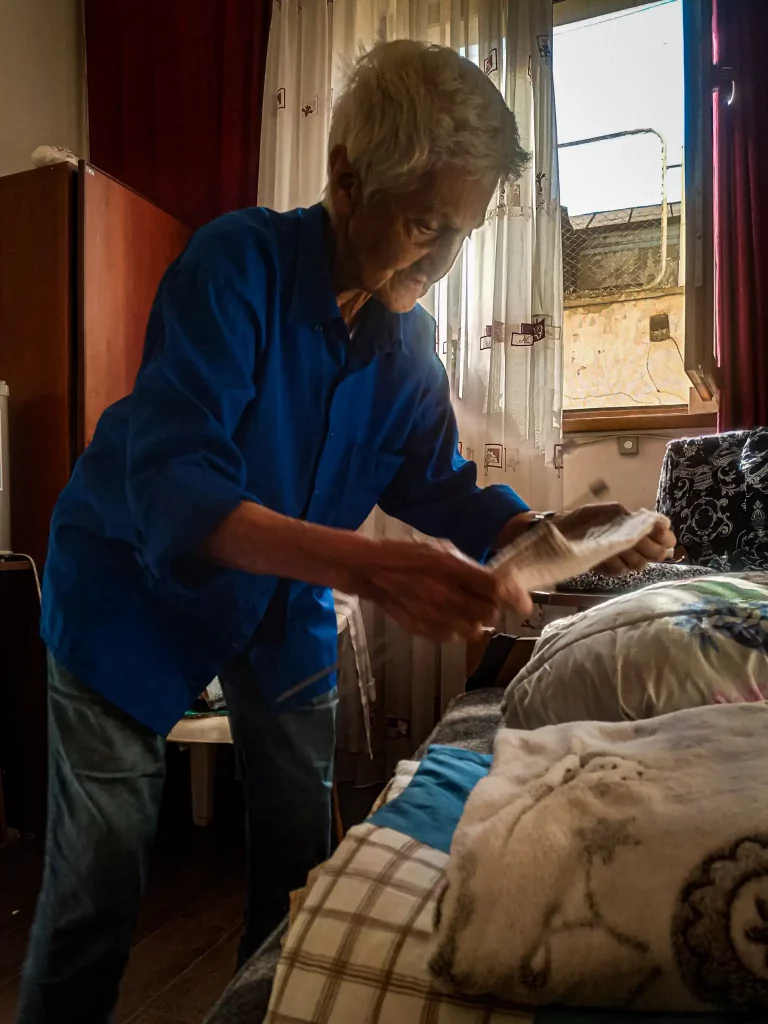
“That violin was with me all these years. After the war (the last one, I note mechanically again) I gave it to the Stepanakert music college — in gratitude. Once, when I had only just moved here, they gave me teaching hours, gave me pupils, so I could earn a living.
“Sometimes I miss my little violin terribly. So much that I want to demand it back. But it soon passes, let them play it to their hearts’ content.”
***
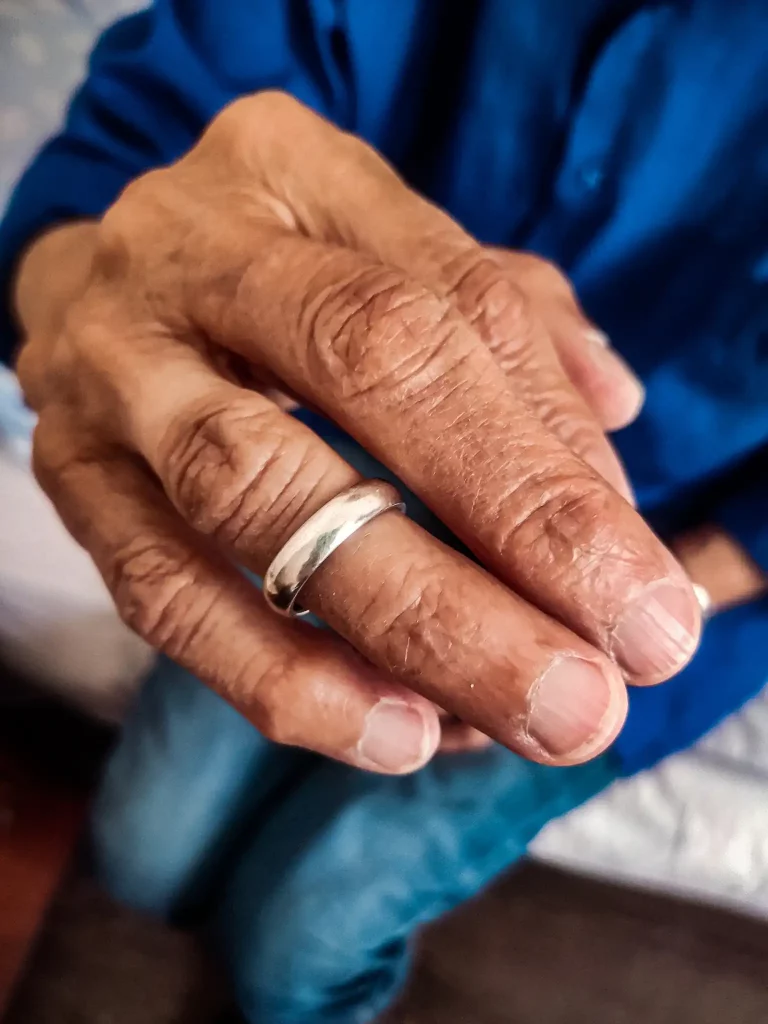
In a sense, Kima met her husband thanks to the violin too. Fingering the silver rings — one her husband gave her before their wedding, another she had made for Gor in Stepanakert — Kima says:
“I met my husband in a truck. One of my favorite teachers at the college had died. We pupils got together and went to the funeral. For some reason we came back in a truck.
“On the road, the side of the truck broke, and we flew out. I lost consciousness, an ambulance came. I went to my Conservatory entrance exams covered in bandages.
“Spartak, the young man who had been sitting beside the driver in the truck, began coming to the Conservatory to meet me. Made friends there, found out everything about me. But I was haughty and turned up my nose at him, because he was three years older and had no higher education.
“Then he was drafted into the army, to the Ukrainian town of Mukachevo. And his friends ‘kept an eye’ on me.
“When he came back, we met. I asked him very sternly — why aren’t you studying anywhere? And he said — Mama works as a cleaner, I have no father, and my sister has tuberculosis. I need to work to pay for her medicine.
“You know, my dear child, that admission was what broke down my resistance. Besides, he was a very handsome young man, why pretend otherwise?”
***
Kima was happy in her marriage. Her husband, a long-haul truck driver, adored her and chose the longest, well-paid routes so his wife would want for nothing.
“He told me: you’ll keep having babies until we get a girl. I got scared — I can’t go on having babies forever, can I? My husband took pity on me and decided — all right, you’ll have ten and that’s enough. If the tenth is a boy too, we’ll take a girl from an orphanage.
“We had three sons, and I was pregnant with our fourth child when my husband was murdered. Some drug addict, out of envy. He was sentenced to death by shooting at first, then his relatives pulled some strings and the sentence was changed to ten years in prison.
“I don’t know what sex my baby was. I had a miscarriage and lost it.”
***
“Let me read you another favorite by Kaputikyan,” Kima offers.
By day and night — fresh and light —
Water runs from the spring.
When plowmen go out to the fields —
They drink, quenching their thirst.
A mountain girl goes to fetch water —
Casts a glance at a young man.
In the hazel’s shade since morning
Barefoot children make a din,
The children run about in a crowd,
Splashing water on each other.
The water flows and weaves its babble
Into the living clamor of life.
In it are the hearts of fallen warriors,
And like life, it has no end…
***
At the care home, Kima has taken to knitting. She knits little blankets for chairs. “Here, I’ve made one for my son. When I go to Yerevan I’ll give it to him, let him put it on the car seat, under his bottom.”
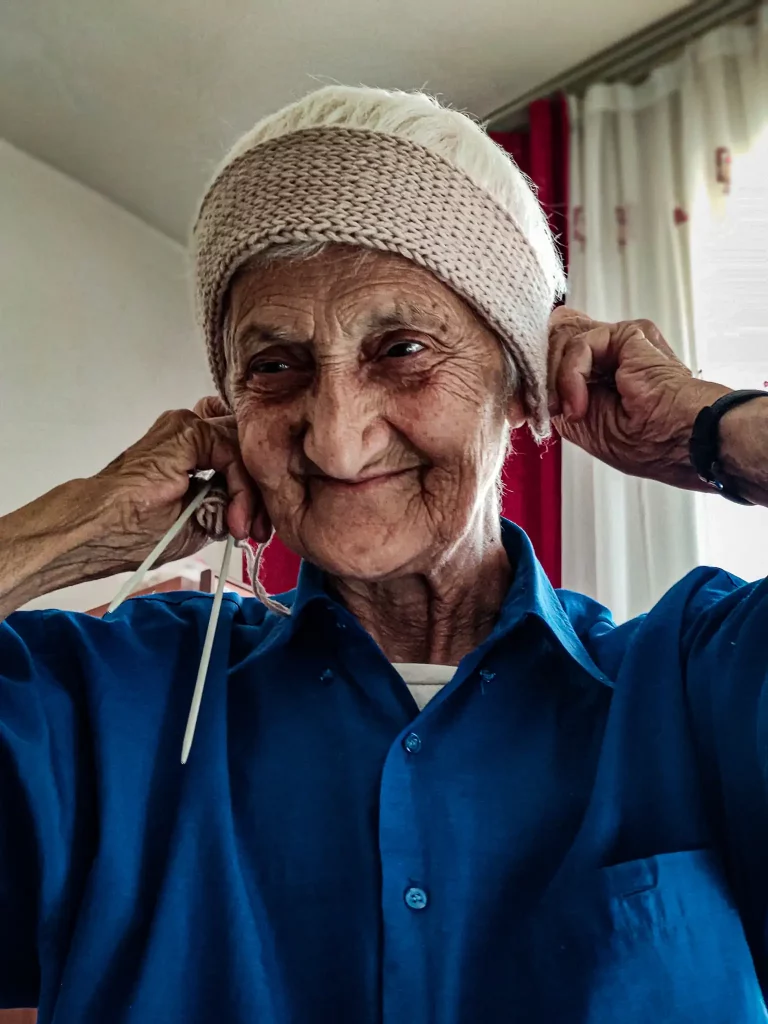
She tries on a headband, which she knitted too. Tilts her head to one side, smiles coquettishly:
“I’m a funny woman, aren’t I?”
Kima has a hundred facial expressions a minute.
***
“I can’t live without books,” Kima says. “The staff find books for me everywhere. Not long ago they brought me my very favorite. You’re young, my dear child, perhaps you don’t know it. It’s called ‘The Gadfly.’”
I leap to my feet. It has been the most important book in my life for 30 years! And I use those very same words to tell other people about it — “You probably don’t know this book”… And indeed, few people know it, especially from my generation and younger.
Kima’s eyes shine just like mine. Talking over each other, completing each other’s thoughts, we begin discussing the book we know by heart.
“And I always cry when the Gadfly and Montanelli…”
“See each other for the last time.”
“I’ve reread it a hundred times, but it’s extraordinary, every time, holding my breath, I pray…”
“That he’ll have time to saw through the window bars.”
“Dear Jim…”
“If I am fated to die,
I shall greet death as a bride…”
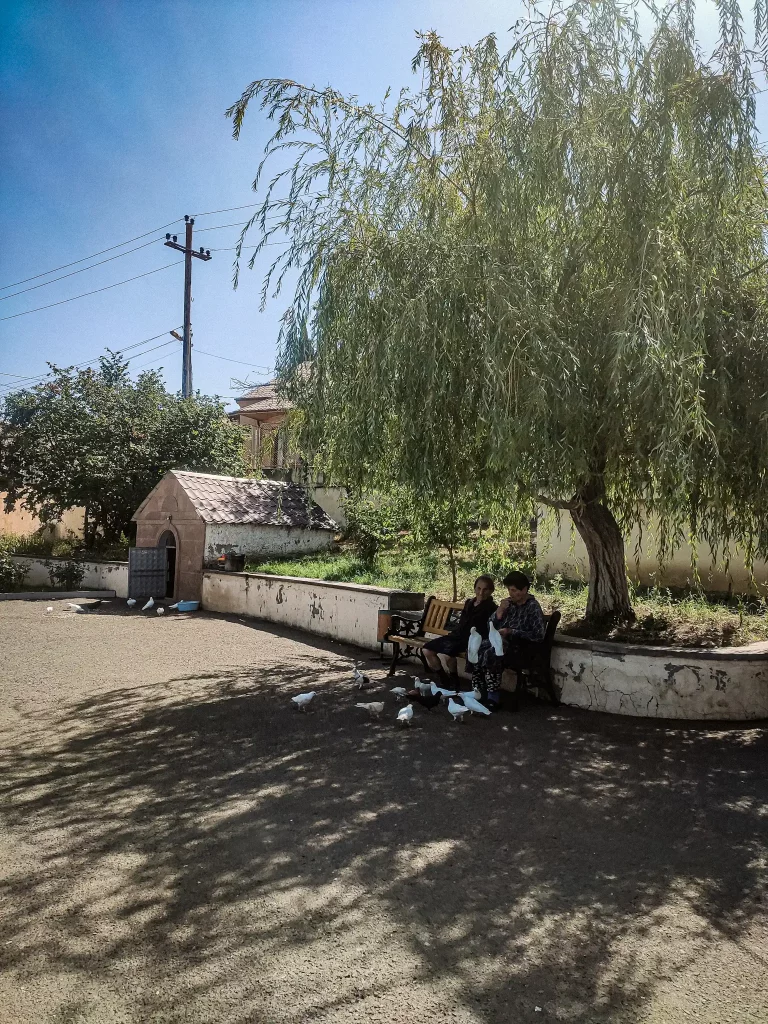
A light breeze holds back the advancing heat for now. In the corridor, a nurse is trading good-natured barbs with a resident. Two women sit on a bench in the courtyard. One is cracking sunflower seeds, the light-black husks fall onto her skirt, the pigeons bustling at her feet fly onto her lap, hurriedly pecking up the husks while the woman unhurriedly shoos them away. A kitten lurking behind a large stone crouches to make a hunting leap, then changes its mind and starts licking itself.
“Montanelli went on with his interrupted work. Somewhere beyond the window a cockchafer buzzed monotonously, and from the street came the long, mournful cry of a fruit seller: ‘Fragola! Fragola!’ (‘Strawberry’ in Italian)” comes back to me from “The Gadfly.”
Kima and I are separated by five decades and five generations, and we have the same most important book in our lives.
***
It is breakfast time at the home. I walk part of the way to the dining room with Kima. Kima walks slowly, with small, slightly shuffling steps. Her legs have never fully recovered since that day at her son’s grave.
“Like a little old granny,” she laughs.
“You’re no little old granny, don’t even try,” I laugh in reply.
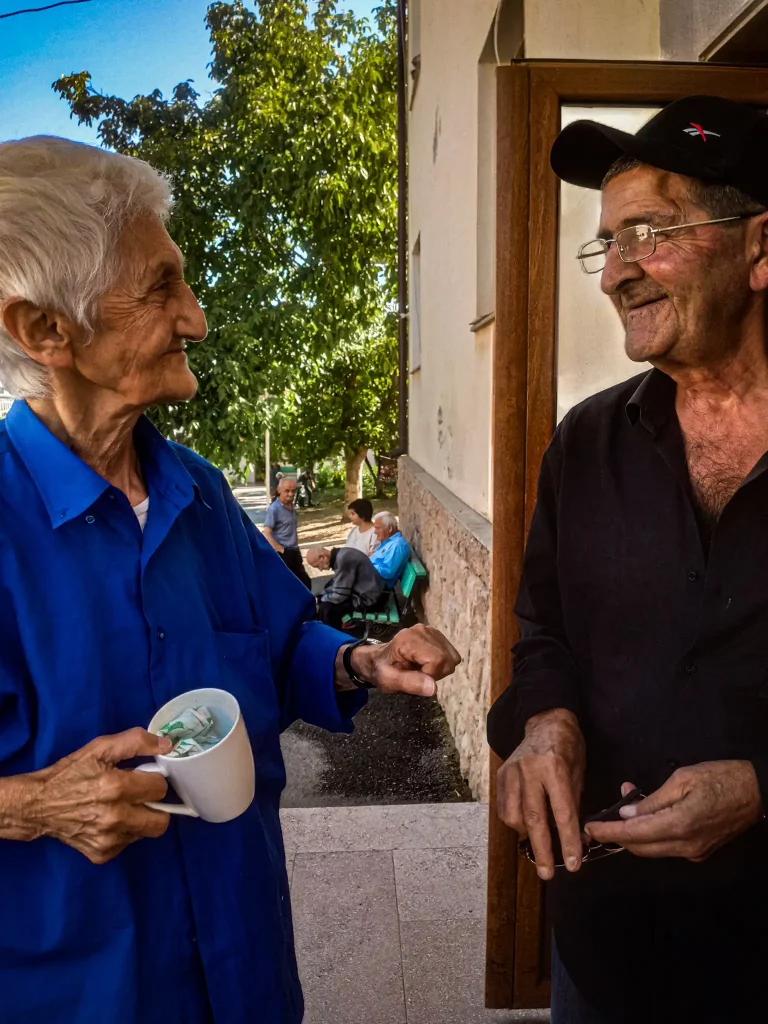
A man stands on the steps leading to the courtyard. Kima smiles warmly at him.
“This is Levon Vazgenovich,” she says. “He’s the only person you can talk to here.”
Levon Vazgenovich gives her a broad smile in return and tells me he can leave the home and come back whenever he pleases, because he doesn’t drink and they trust him. And that in his time he traveled all over the Soviet Union and “met such people, there are hardly any people like that now, well, people like Kima.”
“Now listen,” Kima says as we say goodbye and I promise to come back soon and bring her books. “I know you’ll understand. If anything happens to me — I am 91, after all — none of that sobbing and wailing. I don’t like it. I’ve lived a very good life, found fulfillment as a woman and as a professional, loved and been loved. It’s a sin to sob over someone who has lived a life like that.”
I won’t sob, I promise. I’ll reread “The Gadfly” for you.