
We pass a checkpoint outside a village that suddenly found itself on the border in September*. A white Lada Six pulls out and follows us, flashing its headlights. We stop. Two uniformed men—one in military uniform, the other in police uniform—approach our car.
(*On the night leading into September 13, Azerbaijan’s armed forces launched a large-scale attack on settlements in the Republic of Armenia. Towns and villages came under fire; air defence systems and artillery were attacked. Two days of fighting left Armenia with significant territorial losses. A total of 207 people are listed as dead or missing.—Kalemon)
“Police,” the First introduces himself. “Who are you, and where are you going?”
“Journalists. We’re going to the village.”
“American?” He glances sideways at Fyodor, who has a camera in his hand.
“Russian.”
“He was photographing the checkpoint. Tell him to delete the photo.”
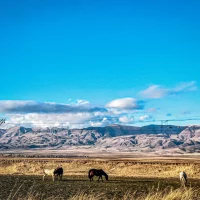
“All right. Can we photograph the horses?” I nod towards the animals grazing nearby in the burnt-yellow fields.
“The horses are fine,” the policeman agrees, and begins a long, careful examination of my documents, without checking whether Fyodor has deleted the photo.
“I need to call the general,” he says at last, “and find out whether he’ll give you permission to enter. Wait here.”
While he calls the general, his partner surveys our car disapprovingly. Our Golf—already battered by life—recently came under attack from a concrete mixer in the mechanic’s yard, which, without a second thought, started working right behind the car.
The garage workers tried to put things right by hosing the car down. Now it looks as though the concrete was mixed directly on it.
“Why doesn’t the car say ‘Press’? Why doesn’t it have government plates? And anyway, it’s time your newsroom got a new car,” the Second Policeman remarks, while the First tells someone with direct access to the general about us, having already forgotten the unfamiliar name of our publication.
I give their Lada, with no police markings, a pointed look.
The First Policeman hands back my documents and orders us to wait with them at the checkpoint for the general’s decision. Cars pass us, and nobody stops them.
“We should have hidden the camera. We’d have driven straight through,” I say in frustration.
“Exactly. What made you take the camera out right at the checkpoint?” the Second Policeman agrees, shivering and shifting from foot to foot in shoes too light for the season.
“We didn’t think there was anyone here. We couldn’t see anybody.”
“It’s freezing out here. That’s why we were sitting in the car.”

On the granite-blue mountains, lined up in a long, slightly concave wall beyond the wheat fields, are Azerbaijani positions.
“Do you ever get scared?” I ask.
The First Policeman looks at me in surprise.
“Not a bit,” he replies firmly, either puzzled or offended by such an absurd question. He slips a cigarette between his lips and cups his hands, trying with his thumb to coax a flame from a lighter that keeps going out in the wind.
After taking a drag, he asks why we are going to the village.
“A week ago I spent a little time there, and it left me terribly depressed. How can I describe it? As though the apocalypse had begun its advance from that very village. As though an earthquake, a tsunami, a hurricane and a nuclear war had all struck at once. The devastation, poverty and hopelessness overwhelmed me. I really wanted to come back—to find something bright there, to lift the oppressive weight it left behind.”
No, I hold back and don’t answer like that—what if he comes from that village and I offend him? I simply say that we write human stories.
“Do they help at all?” he asks.
“Help with what?”
“Well, so people read them and give money to the poor souls you write about. Or fix their roof, I don’t know, help with clothes for the children. Otherwise, who needs your stories?”
And he drops his cigarette butt on the ground.
Half an hour passes. Nobody is in a hurry to call back with word from the general. I can no longer feel the tips of my ears or my big toes. The sun shines brightly, but the cold wind so common here overpowers it.
A ZIL truck stops on the shoulder across the road. The driver jumps out, leaves the door open and runs over to us.
“Boys, give me some water,” he says with a smile, shaking both men’s hands as he comes up. “The damned thing’s boiled over.”
Three cows stand in the truck bed in perfect alignment, as though someone has lined them up with a ruler, against the mountains turning pink before sunset. While the driver talks to the policemen, I decide to photograph them.
I take a couple of steps towards the truck, and it begins to move, slowly.
So this man isn’t the driver. The driver must still be in the cab. No, there’s the steering wheel, visible through the open door. Well, his friend must be sitting in the passenger seat; he’ll stop it in a moment.
I don’t know why I freeze and dutifully follow these stupid conjectures as they form in my head. But following them, I lose two or three precious seconds. The truck turns hesitantly to the left, taking its eyes off another truck parked ahead, and rolls towards the gorge, gathering speed fast. On the way here I filmed that gorge and its half-dried-up river, which looked more like a wide stream.
I snap out of it and shout:
“The truck’s moving!”
The men turn at my shout. The driver drops the water bottle and runs towards the truck, loudly invoking somebody’s mother.
“Faster!” the policemen yell after him. “Get there!”
But the driver doesn’t make it. The ZIL knocks down the metal railing and shoots like an arrow into the riverbed. I think I hear the cows’ heads hitting the side of the truck.
We run towards the frame sticking out of the river. The cows are tied to the side by their necks with thin twine—the sort used for hay bales. Particularly caring owners transport cows this way. Uncaring ones simply put the animals in the truck bed.


The First Cow lies on the floor of the truck bed. The Second has fallen onto her, and both are pinning down the Third. There is blood on her nostrils; she is struggling to breathe. The twine is tightening around her neck.
“Someone, give me a knife to free the cows!” shouts the driver, who has already jumped into the truck bed.
Nobody has a knife. I offer to throw him a lighter, and then two men appear, with faces straight off a police “Wanted” board. Apparently, they were passing by. Each has a penknife. Swearing quietly and monotonously, the driver begins cutting the twine.
The First Cow lies flat, breathing infrequently and seemingly reluctantly. She seems unconscious—either she hit her head hard or the Second crushed her.
Two more cars stop. People get out and offer to help.
“Help me get the cows down,” the driver asks.
The men talk him out of it—even if the cows get up and jump down themselves, they will break their legs.
“Why didn’t you leave it in gear?” the Second Policeman chides the driver without malice. “Who leaves a vehicle in neutral on a slope?”
“Who could have thought? I was only going for a second—to get some water.”
I have lived in a village for more than ten years. Fyodor and I keep horses, and every year several trucks bring us hay. Few of the drivers leave the truck in gear. Few even turn off the engine. They usually try to park facing downhill so they can bump-start it afterwards.
Year after year these huge vehicles pass their roadworthiness tests and get the coveted piece of paper, despite all their faults that endanger both the driver and everyone around them.
A tractor comes up to the ZIL—apparently someone has called it from the neighbouring village. The driver of one of the cars that stopped hands the tractor driver a cable: a scrap of metal that looks as though it has been pulled from a rubbish bin, tied in several places like a shoelace. It slips off at the tractor’s very first tug.
“What are we going to do?” The driver clasps his head in his hands.
“First thing, cut her throat,” one of the men gathered there says, nodding at the First Cow. “She won’t live.”
I flinch inwardly, but say nothing. A few years ago I would have protested, loudly and in tears, and sworn to find a vet even if I had to dig one out of the ground, someone who would certainly save her. But years of village life have taught me to recognise signs that a cow will not survive, one of which is severe swelling of the whole body.
The jugular vein has to be cut so the meat won’t go to waste—if the cow dies on her own, her meat can no longer be sold for a good price.
The tractor driver tells the policemen they need a bigger vehicle. They spread their hands helplessly.
I dial 911. I give the location and ask them to come and pull the truck out. The operator takes my details and promises that “the boys will call soon”. A few minutes later, a “boy” calls back, and we have the following conversation.
“A tractor’s come to you,” he says. “It’ll pull it out.”
“It couldn’t. We need a heavier vehicle. And quickly. There are cows inside.”
“I understand. But we don’t have the equipment to pull out a ZIL.”
“How can the Emergency Situations Ministry not have the equipment?”
“That’s how it is. Where’s the driver? Is he all right? Anyway, are there any men there with you? Put one of them on, let them explain.”
“Are you making fun of me? I’m explaining it all to you already.”
“Put the driver on.”
“The driver’s in the truck bed, trying to get the cows up!” I begin to shout. “Why do you need a man when I’m telling you exactly what’s happening?”
“To understand what sort of vehicle it is, exactly what equipment is needed…”
“I’m telling you it’s a ZIL, with three cows in it! What other information do you need?”
“Well, if you think you know about these things,” the “boy” continues, in the relaxed tone of someone making small talk, “then tell me: our winch is rated for a maximum of one tonne. Will that do?”
“No, of course not. It’s a ZIL!” I am almost crying with anger.
“There, you see? I’m telling you we haven’t got the equipment. Now, if a human life were at risk—someone trapped in a vehicle, injured—then call us. We’ll come straight away!”
Furious, I press the button to end the call. The First Policeman comes over to me.
“You’d better take your Fyodor and go,” he says. “We’ll think of something.”
I suggest he give me a cigarette in place of advice. The “bandits” are making calls, looking for a vehicle. The men begin casting sideways looks at my cigarette, and I cross the road.
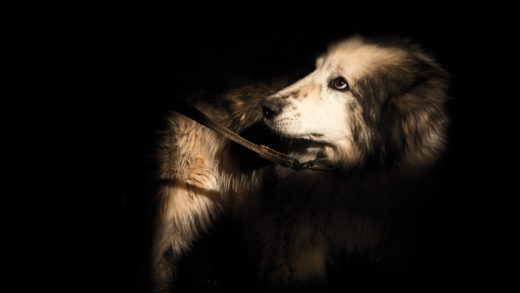
A beige dog runs up to me—the checkpoint dog, who has spent this time either sleeping or rummaging in the piles of rubbish in the local fields. She is thin and keeps squinting; pus is beginning to form in her eyes.

She’s ill with something, I note out of habit, unable to concentrate on the symptoms and what the illness might be. I squat down. The dog moves her back under my hand and leans against me, and we watch the truck across the road.
Behind us are the ochre of the wheat fields and the sunset mountains, already half pink. I think about how, whenever I come to these parts, I grow anxious and want to leave at once. There is something ominously hopeless, irretrievably abandoned in all those half-built houses, heaps of twisted metal, deserted factory buildings with their broken, clouded windows, the shards baring their teeth in dark eye sockets.
Even the sharp, cold lines of the mountains, even the ploughed earth beneath the azure clouds give me no strength; they seem indifferently removed from the people and their little houses scattered like seeds.
I stub out my cigarette on the ground and put the butt in my pocket. I cross back to the truck, where another ZIL has arrived. The dog starts to follow, then changes her mind and returns to the roadside.
The two truck drivers discuss how to move the cows from one vehicle to the other. The newly arrived driver half-heartedly suggests helping the cows jump to the ground and then lifting them into his truck. One of the men clicks his tongue, raises a finger and tells him to back up, bed to bed, so they can drag the cows across.


The villagers gathered there again insist that the First Cow must be slaughtered. Her owner looks at her sorrowfully and turns the knife over in his hand, as though hoping she will think better of dying.
The second ZIL backs right up to the first. The men climb into the truck bed and begin dragging the Second Cow across. Apart from a couple of trivial scratches, she has no visible injuries, but she refuses to get up. The men pull her by her horns, tail and legs. Her enormous pregnant belly is pushed into the second vehicle; a teat of her swollen udder catches for a moment in the narrow gap between the two trucks, then the udder too disappears behind the side of the second truck.
They manage to get the Third Cow onto her feet. She looks around uncomprehendingly, then takes a step, lowers her head and… begins chewing the dry blades of grass on the floor of the truck bed—hay laid there to keep the cows from slipping on the manure.
But getting her into the second vehicle is difficult too. She slowly steps over the First Cow, who is lying on her back. Her hind legs catch on her, and she falls onto the other animal. They haul her up by the tail and drive her on into the truck. The driver pulls forward a little, jumps out and closes the tailgate.
Passing cars, often travelling at tremendous speed—the men tending to the cows curse them through their teeth, sparing the ears of the only woman among them—no longer slow down. I cross the road to look at the beige dog, who has disappeared from view behind one of the stopped cars. She is lying in the field, licking her paw.


I stroke her and return to the truck. Only the First Cow and her owner remain there. From the joint between the floor and the side of the truck, a thin, swift stream of scarlet liquid pours into the river. The driver has cut the First Cow’s throat.
A Ural truck arrives and hooks up a cable. The ZIL’s driver leaves the cow and climbs into the cab. He manages to start the engine, which is half under water. The Ural begins to pull. The first attempt fails—the wreckage of the bridge railing is holding the undercarriage. The driver switches off the engine and jumps into the water to free the railing from the river silt. On the second attempt, the ZIL won’t start, but the Ural pulls it out on its own: slowly and laboriously at first, then suddenly the ZIL pops up onto the shoulder like a cork.
The driver of the ZIL with the cows in its bed comes over to ask the owner where to take them. The owner suggests that he help get the now dead First Cow off the truck and butcher her on the spot. The policemen are outraged and demand that he make a mess in his own yard, not at the checkpoint. The driver reluctantly complies.
We have dog food in the boot. I pour some out for the beige dog. A white puppy immediately appears from somewhere. The food is packed into a three-litre plastic bottle. I shake it furiously. The dogs—both thin, their ribs sticking out—fall upon the brown triangles.
The Second Policeman comes over, smiles approvingly at the feeding and announces:
“The general said no.”
I shrug—who needs that general now?

We get into the car and leave. I ask Fyodor to put on Grebenshchikov. He plays the first thing he finds. It is “Not Meant to Be”.
…There comes a moment
And the hands can no longer hold
The stone weight of the brow.
Our true selves were never even here
For longer than an instant…
Grebenshchikov is interrupted by a call from a woman in the neighbouring village whom we visited earlier that day. She asks whether we managed to reach the village we had planned to visit. I tell her about the cows. Poor man, she says, upset. Village life is hard enough as it is, and now he’s suffered this loss. The “poor man”, standing beside the dying First Cow, lamented in just the same way—as though he hadn’t been negligent, but “cruel fate” had intervened and killed his cow.
We drive in silence for a while. I think about how I was closest to the truck: if I hadn’t frozen but had run, I would have had time to jump in and hit the brake. And the First Cow would be alive. But perhaps I wouldn’t have made it. We will never know now—accidents, like any story, do not tolerate the subjunctive mood.
Our home is 180 km away. We cover that distance in pitch darkness: not a single streetlight on roads that stretch on endlessly, very narrow in places.