Chapter I: A Dog Appears out of Nowhere
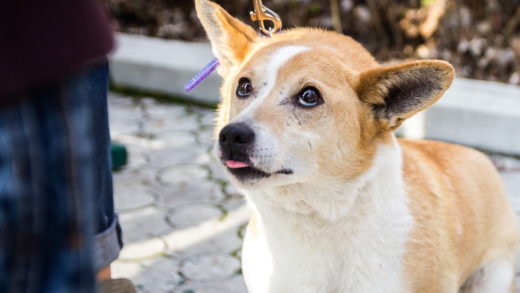
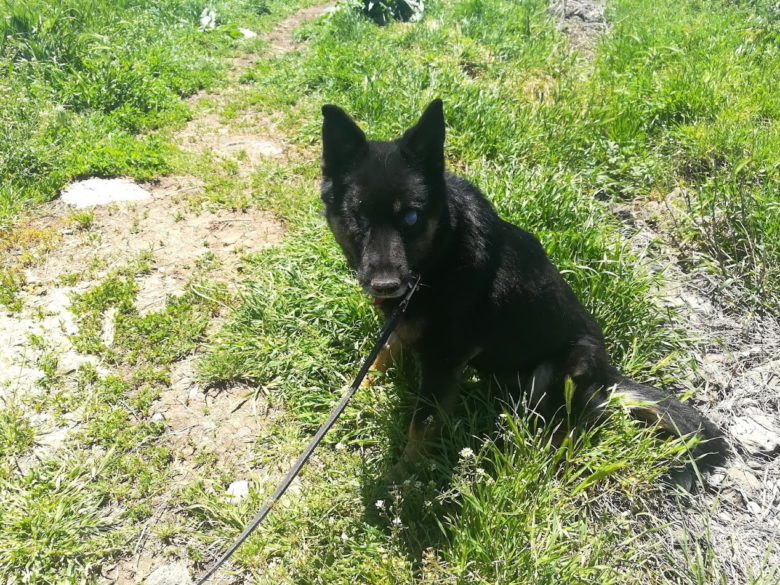
The dog has blue eyes. One eye bulges — it looks as though it is about to burst, while the other has already burst, as though it has drained out of its socket.
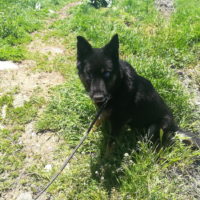
We are sitting in the car, which I am slowly rolling along a bumpy road. We have barely left home. The dog appears as if out of thin air — his back to us at first. A bushy tail, glossy black fur (could he have strayed from his owner? But no, he is too skinny and covered in burrs), upright ears. A shepherd dog. Or a cross with one.
Yes, yes, no new dogs. And we are in a hurry. The last day, three hours until the bank closes. I press the accelerator. At the same moment, the dog turns towards us. With those dreadful eyes. Startled, I slam on the brakes, forgetting to press the clutch. The car gives a surprised, offended grunt and stops.
March 2020. Armenia has just gone into COVID lockdown. There will be a huge queue at the bank as it is. And here is an eye that has fallen out of its socket.
We will make it, I plead, clasping my hands. A couple of minutes, we will catch him, put him in the car, go to the bank, then to the vet. We will get it all done.
***
Forty minutes. That is exactly how long one blind dog runs two sighted people around fields sodden after the rain. He bumps into stones, gets tangled in bushes, gets free, takes fright, stops, turns towards us, growls viciously and runs any which way. He snaps two dog leads and chews through one horse lunge line that we try to throw around his neck like a sort of lasso.
At last he happens to end up between three large stones, and in the second when he crouches, preparing for another attack, Fyodor grabs him by the scruff and pins him to the ground. And I run into the house for a crate — in boots caked with mud right to the top, and tights with a little hole already threatening to turn into a run.
“We will definitely make it,” I say, less confidently now, as we shove the crate with the now-quiet dog onto the back seat and get in ourselves, without even having had time to wash our hands.
All we have to do is go to the police, get Fyodor a social card, take the papers to the bank, open an account. An hour and a half remained.

Chapter II: The Dog Gets a Name and the Right to Live
Exactly halfway there, an ominous sound comes from beneath the car. We moor ourselves at the roadside, get out and bend down in unison to look underneath: the front right half-shaft is hanging helplessly down. The wheel was now hanging on by a promise. The garage had urged us to replace it three months ago.
But the drive shaft mercifully ends its working life on a downhill stretch, two hundred metres from the repair bays. Pushed by Fyodor, the car rolls over there. The mechanic who comes out to meet us takes in the situation at once. Without wasting words, he tells us to flag down a taxi and take the dog to the clinic, while he will get all the parts and fix the car by nightfall.
A taxi is just pulling out of the car wash next door. Clean, clean, we assure him, trying to hide behind our bodies the tail decorated with Christmas ornaments of burrs. The crate is clean too. And the lunge line we have left around the dog’s neck, relentlessly giving off the smell of the stable — that too is spotlessly, spotlessly clean.
The stink of the lunge line fills the entire car. But the taxi driver seems not to notice. Loudly, in a tone that brooks no argument, he shares his views on homosexuals, feminism and Soros, and his thoughts on how he would deal with all of them if he had his way. And when we reach the clinic, he surprises us with an unexpectedly small fare.
We leave the dog there, run to the police, get the social card, go down to the bank, spend a long time queuing, spend a long time doing the paperwork. The mechanic calls — the car is fixed. We collect it and go back to the clinic.
***
When we try to get him out of the crate, the dog growls viciously and lunges. Five people have to distract him so that the vet can plunge a needle with a sedative into his bony thigh.
After examining him, the doctor suggests putting him to sleep. The eye that has fallen out needs to be removed; perhaps, after some time, the second one will have to be too. It is a major operation and will not restore his sight, only stop the inflammation and the possibility of infection getting in.

He also has venereal sarcoma, and that means taking him for chemotherapy once a week for a month and a half, and each time keeping the aggressive dog absolutely still while vincristine slowly flows into his vein. Times are hard enough as it is, the world is slowly going mad, people have no attention to spare for animals.
I sniffle. Pretend I am going outside to think, to consult Fyodor. But my customary tears before doing something irrational fool no one. Everyone understands that the dog will live.
We leave him at the clinic overnight. So they can take samples in the morning and prepare him for surgery. I suggest calling the dog Bavakan (in the best Armenian tradition, “Enough” in Russian translation) or Laveli (also “Enough”), while Fyodor, for some reason, suggests Kobzon. But the dog becomes Ugolyok.
Chapter III: Ugolyok Growls and Lunges
Ugolyok’s eye has been removed. The retina in the other eye has detached. We have to wait and see — if it does not “explode”, there will be no need to operate.
Ugolyok spends an entire week at the clinic. In a large crate. Several times a day, Levomekol is squirted into the hole at his eye, between the dotted lines of surgical thread. Sometimes the crate door is left unlocked — Ugolyok has no intention of going beyond the bars. He does not want to be stroked, or go for walks, or live. Only a bowl of food briefly brings him to life.
We start a fundraiser. We tell the truth about Ugolyok, honestly admit that by every rule of shelter logic he ought to be put to sleep, but when have we ever followed logic? The money comes in instantly — none of the people helping us pay for treatment and food for our dogs doubts that we were right to decide to save a life.
***
A week later we take Ugolyok home. We arrive, lift the crate out of the car, put it in a horse stall and start prodding the resisting dog to make him come out. Ugolyok tumbles clumsily out of the crate and immediately huddles in a corner.
We have strict instructions from the vet. Feed him well so he gains weight and can withstand chemo. Continue treating the eye and injecting an antibiotic twice a day. Take a crash course in hypnosis to lull Ugolyok’s vigilance. That last one is not an instruction but my own speculation, because I cannot imagine how we will perform all these procedures on a dog who will not let us come anywhere near him.
We spread soft hay in one corner of the stall, leave food and water, and go.
***
In the morning I find the food eaten and the water bowl overturned. I stamp about loudly by the door to let him get used to my presence. Then I begin in a gentle voice:
“Hello, little one. Well, how are things?”
“Grrrr,” says the little one, baring his teeth.
“You’re hungry, aren’t you?”
“Grrrrr.”
“And thirsty…”
“Grrrrr. Grrrrr.”
The viciously bared teeth are very close to the bowl. I sigh and slowly march towards him so the dog can hear every step I take. Ugolyok ducks his head, darts from corner to corner, hits his head against a wall, rebounds, crashes into another wall. Stops, trembling all over. I squeeze my eyes shut — it is impossible to watch these desperate lunges.
I grab the bowl and hurriedly pour in dry food for him. Try to put it as close to him as possible. As I approach, Ugolyok springs up and starts crashing into the walls again. Having poured the water, I leave the stall and shut the door behind me. In an hour — the first treatment of his eye.
***
This is what the treatment looks like. Fyodor and I approach the stall. Ugolyok starts growling. We go in. The dog runs to the wall, presses himself against the cold black tuff, the growling grows louder.

I take hold of the end of the long lead we have left on him (in two days he will chew through another three of them), squat down and tell him in a soft voice that this is his home from now on, that he must not be afraid, and that we will not put him to sleep, however much he might want us to. So please be good enough not to make our already difficult lives any harder. My legs go numb, but I stay squatting to be on his level, hoping he will understand this from where the voice is coming from.
Once the growling has quietened a little, I reach towards his head with a thick work mitten. Ugolyok lunges at the mitten. Here you have to be quick and press the mitten onto the top of his head. Then he quietens. Trembles all over, but stops lunging. A minute later I carefully replace the mitten with my hand. Still trembling, Ugolyok lowers his head.
Now Fyodor starts stroking him. Then he takes a firm grip on his scruff, commenting on his every action in the same gentle voice. I tie his mouth shut with a bandage, squirt levomekol into the eye and inject 2 ml of antibiotic into his thigh. We untie him, let him rest and stroke his head again — first with the mitten (he snaps his teeth, bites at the air), then with a hand. The first treatment is over.
***
The number of COVID cases in the country is growing. Armenia has its first death from the new virus. People stop kissing and hugging. People stop meeting. People stop leaving the house.
In the capital. In the village of Ushi, people go on living as they always have — mostly “not believing in corona”, devising conspiracy theories and generously sharing information about various home remedies for the new illness, which is “no more dangerous than flu”.
We are torn between these two realities, not knowing which frightens us more.
We are not locked up anywhere; we have endless fields. But the shared fear reaches us through calls “from over there”, through social media, through news sites that as yet know nothing reliable about the virus.
Our principal therapy dog, Mickey Muk, is found to have lymphoma. Her spleen is removed. Now we have to take her for a blood test once a month and watch for any new tumours.
Having weighed all the pros and cons and consulted local and overseas specialists in veterinary and human medicine, we decide against chemotherapy for a dog who is no longer young. But she needs to switch to Renal — food for kidney patients. The food is not cheap, neither was the operation, it is hard enough to ask a world paralysed by terror and uncertainty for money, and now Ugolyok needs good food too and will soon have chemotherapy.
But, to be honest, it is thanks to Ugolyok, or rather to all the fuss with him, that we survive the collective fear of the pandemic and our own private fear for Mickey Muk.
Chapter IV: Ugolyok and the Other Animals Go to the Clinic
On the day checkpoints go up on the roads between regions, Ugolyok is due to have his stitches checked at the clinic, Mickey Muk is due for her first monthly blood sample, our cat Kayuk develops constipation after surgery, and a stork with a shot wing wanders into a private garden in the most COVID-dangerous village of the most COVID-dangerous region.
Or rather, the stork appears in the garden three days earlier. But no one responds to the pleas on social media to help the bird — even if you can get into the village, the officers at the checkpoints are strictly forbidden to let cars out of it.
Our three animals have evening appointments at the clinic, which means we can try to get the stork out during the day. Drive through three regions and six checkpoints — big deal.
***
We spend a long time persuading the police at the checkpoints. Tell them about Centaur, the animals, therapy with their help. They let us through. At the last COVID checkpoint, they demand a document signed by the director of our Centaur. A document? Of course, right this minute.
We return to the car, I quickly tear a sheet from a notebook and, in my barely legible handwriting, authorise the staff to find and rescue a stork, take the stamp out of my backpack, and Fyodor breathes on it and presses it hard against the sheet — the stamp has been out of ink for ages. Faintly, but still, it leaves its mark on the paper.
The officers let us through. Our joy is short-lived, however — already inside the quarantined region, the car stops on an uphill stretch: the button controlling the fuel supply breaks. Fyodor flags down lorry drivers (who else would risk stopping their vehicle in a place like this?) to ask for tools. Unscrews the panel, cuts a wire, attaches something to something, and the car works again: only you have to hold the button down with a finger. Taking turns holding it, we reach the stork.

We chase him all over the garden, drive him into a shed, grab him, install him in a box and head back. The garden’s owner shows us a roundabout, utterly roadless, car-wrecking route — but it does bypass the first checkpoint, which has orders not to let cars out of the region. We slip through. Leave the stork at the clinic and race home for our three animals.
***
At home it takes us a long time to get Ugolyok into the carrier: we chase him around the stall until he happens to run into the big blue crate. Which we carry to the car wearing thick work mittens, because the growling does not stop even inside the crate.
At the clinic we get him out of the crate in much the same way — pull on the lunge line with all our strength, throw a bandage over his muzzle and tie it shut. Because of the venereal sarcoma, bloody pus is coming from his nose; with his mouth tied shut it is hard for him to breathe, and he wheezes. The thought flashes through my mind that it would have been better to put him to sleep straight away than to torment him like this.
The vet, however, is pleased with the state of the wound and the stitches. A few more days, and they can come out.
The stork’s wing is amputated. The next day we will find him a home. Mickey Muk has blood taken. The next day the tests will come back clear. Kayuk is given an enema, and the walls shake with his outraged yowls.
At midnight, trying to keep our eyes open, we return home.
Chapter V: Ugolyok Does Not Like High Notes
With Ugolyok we need to develop rituals and follow them strictly. So he can acquire a sense of stability and safety. Always put the food and water in the same place. Tie his mouth shut with a bandage, stroke him, give the injection, treat the wound, remove the bandage, stroke him, pour out the food, stroke him.
Ugolyok presses himself into the ground, tucks his paws under him, trembles, growls when you touch a paw and leaps away as soon as you stop stroking him. But there is a small step forward — now he lunges at us us only on the first of all our visits that day. On the others he tenses up, makes threatening noises, but does not lunge.
Attempts to get him out into the fresh air inevitably fail — the dog is wildly terrified of leaving the stall. If he had his way, he would not even leave the crate.
***
The obligatory bedtime ritual is to go into the stall, sit him beside me and stroke, stroke, stroke him. Alternating between growling and silence, Ugolyok indicates the pace and the body part to stroke. Two days before we go for the blood test for chemotherapy, I timidly touch his throat. He flings his head up; I freeze: now he will bite. If he bites, I need to react. But how? I cannot punish him; if I say nothing, he will remember.
And suddenly Ugolyok lowers his head. I almost cry with joy: he has let me touch his most vulnerable spot! How defenceless he is. In complete darkness, in uncertainty. Our bond is so fragile. One wrong movement, and the shoots of trust finally appearing will vanish.
***
But a real relationship, rather than frail half-connections, begins between Ugolyok and me thanks to… music. I like singing in the resonant echo of our stable. Sitting on an armful of hay in Ugolyok’s stall and running my fingers along his back. Ugolyok responds keenly. If he does not like a song, he growls a little. If it is quite unbearable, the growling gets louder and he bares his teeth too. If a piece is to his liking, Ugolyok lowers his head and half-closes his eyes, or rather, his eye. That is how we divide the songs into “ours” and “not ours”.
Me: “Ibrahi-i-im…” (the acoustics of our stable were simply made for Freddie Mercury’s Mustafa).
Him: Don’t you dare! (loud growling, ears standing up in boundless horror).
Me: All right, all right.
“There’s no time for us
There’s no place for us…”
Him: Possibly (a short, faint growl, stops at the second verse.
Me: “When love must die!”
Him: No after all! (the growling starts again, his body tenses).
Me: Got it, got it, no expression (I sing the line almost in a whisper; he graciously lowers his ears).
Hmm, perhaps Katie Melua? Her lyricism meets with fussy Ugolyok’s approval. “Maybe I, maybe you” by Scorpions is indignantly rejected — though perhaps the fault lies in my talentless rendition. The sad song about a black-haired girl whose beloved traded her for a fair-curled one beneath rustling poplars and weeping willows — my favourite of the songs my mother sang to me as a child — Ugolyok listens to lying motionless, even forgetting to pull his front paw away when I touch it.

We go out into the field with a horse no fewer than twice. Look for the wings Butusov liked so much, send the apostle Andrew off to hang on the cross. I begin the ones about the little girl with the she-wolf’s gaze and the aces and jokers with some apprehension, because of the musical “unevenness” of Krematoriy’s songs. But Ugolyok receives them with unexpected tenderness. A hunch strikes me. I try a few more different songs, and the hunch is confirmed. It is not the unevenness of the melody that bothers Ugolyok, but its piercing quality. He is even rather fond of bravura.
Expecting no catch, I boldly move on to introspection drowned in cognac and the lack of any need for pepper and onion in a salad. Ugolyok unexpectedly growls, pinning his ears back like a horse.
“Ugolyok,” I appeal to his understanding, “where else can I sing Arbenina without fear of being heard and disgraced? Let me sing just one verse!”
But Ugolyok stands firm. On this and on the other Arbenina songs I try to smuggle past his sensitive ears.
Ugolyok’s favourite song becomes Surganova’s “My Path”. Whatever I sing, the evening stable concert has to end with this very song. Even the horses seem to stop chewing and listen closely to the beautiful lines:
“To your soul, as then, a flight of steep steps leads down,
My path is like the nakedness of a worn-out sole —
Yes, well, so be it…”.
Taught by experience, that is, by Ugolyok’s growling, I sing the drawn-out “Well, so beee it” quickly and quietly. The dog listens to the other lines with his body almost limp, his head lowered and his eye closed.
Chapter VI: Ugolyok Begins Going out into the World
A week before the blood test to start chemotherapy, we begin going for walks. They last ten minutes at most; I cannot manage any more. This is what the walks look like: after many attempts I clip a lead onto Ugolyok (we have removed the permanent lunge line) and drag him out of the stall with all my strength. Ugolyok resists — also with all the strength of his now stronger body.
With gentle coaxing interspersed with curses, I pull him out of the stall into the open air. The dogs and cats hanging about nearby run over to say hello. Ugolyok sniffs the cats with interest. He is afraid of the dogs. He flinches at the horses’ neighing, as he does at all the unfamiliar sounds of the big, noisy, incomprehensible and therefore dangerous world.
In the yard Ugolyok spins around me as though I am a Christmas tree and he is a hysterical children’s circle dance. My already weak vestibular system gives up instantly: the ground becomes the sky, the sky the ground. My head hums with the globe spinning at tremendous speed. I shorten the lead and, in a painstakingly gentle voice with metal shavings in it, urge him to stop. The spinning only gets faster.

I try to catch him by the scruff and press him to the ground. At last I manage it. Angry tears drip from my eyes. I want to hit him, yell at the top of my voice, put him to sleep immediately. Ugolyok bulges his eye and trembles in terror. I drop to my knees, lower my head to calm the nausea and dizziness, begin haphazardly stroking his head, neck, back, ask pointless questions about whether he is not tired of tormenting us, recover a little, regret having frightened him, assure him I love him, wipe away helpless tears.
This is how we walk every day. For five whole months I am torn between pity for Ugolyok, the wish to end both his suffering and mine, and the decision to keep fighting for him and with him.
***
Three days before the blood test, and two months after coming to us, Ugolyok stops growling when we enter the stall. Bares his teeth, runs away, but no longer growls. He does not welcome an outstretched hand with joy, but neither does he reject it with a vicious threat to make short work of it at once, down to the last tendon.
He refuses to leave the stall of his own accord, but no longer resists as though being led to slaughter. He lets dogs and cats sniff him, but shows no interest in them himself. Only the accelerating rotations invariably accompany our so-called walks, after which I spend an hour lying down and returning the planet to a relatively stationary state.
***
On the day of the blood test, he walks from the clinic to the car on the lead by himself. Well, what do I mean, by himself? I pull, he resists, then takes a couple of steps, stops, presses himself into the ground, I stroke and praise him, pull again, he takes another two or three steps. That is how we reach the car. With a sigh of relief that the torture is over, he climbs into his familiar carrier on the seat by himself and, exhausted by his long thirty-metre walk, falls asleep.
Chapter VII: Ugolyok Begins to Give In
Ugolyok is having chemotherapy. Once a week — strictly on a set day and at a set time.
He lies on the table, ears flattened, his blue eye with its brown edges darting anxiously from side to side. His mouth is tied shut with a bandage so he will not nip — he was horrified by a muzzle, but takes the bandage normally, only he still wheezes because his nostrils keep clogging with pus. Fortunately there has been no need for sedation — Ugolyok lies quietly while the drug flows into his vein drop by drop.
Already at the second chemo session, while we are waiting our turn, Ugolyok, held on the lead by Fyodor, comes over to me and lies down at my feet. For the first time he does not dart about, but waits quietly. I rejoice exuberantly — to the surprise and incomprehension of the other dog owners in the queue, whose pets are sprawled lazily at their owners’ feet: where else would they be?
Dogs often feel ill after chemo, may vomit, refuse food. But not Ugolyok. His appetite is excellent, and he feels great.
***
In the third week of chemotherapy I approach Ugolyok’s stall with food. The pus from his nostrils has diminished considerably; Ugolyok has begun to smell things. I no longer need to stamp my feet for him to realise I am here.
I stop at the stall door. Ugolyok springs up to run away and press himself against the wall as usual, but suddenly changes his mind. Stops and “looks” in my direction. I do not hurry to open the door. I shake the bowl a little; the flat little balls of food knock against one another. Ugolyok freezes, then shifts from foot to foot and suddenly gives a faint whine. Like a real dog! In almost three months, this is the first time I have heard a sound from him other than growling. I have never even heard him bark.
***
Our walks gradually get longer. Now we do not just walk around our yard and riding arena, but go out into the fields. There Ugolyok settles into a steady run, then, as though suddenly remembering something, starts spinning again in a frenzied ritual dance that makes sense to him alone.
I take him along familiar routes. On the path by Uncle Surik’s apple orchard there are two shallow but wide potholes. Ugolyok remembers them from the second time. On Romik’s land there are irrigation trenches and a big walnut tree. We go around the tree, but learning to jump the trenches takes time. We follow winding paths, negotiate descents and climbs, adding a new, unfamiliar stretch of road every day.

I try to give Ugolyok as much independence as possible — let him learn to sense and avoid obstacles himself. I intervene only when there is a chance he will run into glass, the sharp edge of a stone or protruding wire. Bumping into blunt stones and tree trunks is allowed. Not too hard, I hold him back a little with the lead, but squeeze my eyes shut every time. Like a mother who has read all about Montessori and is nevertheless inwardly frantic with worry.
***
No longer every day, but the evening singing continues. Piercing notes still make Ugolyok tense, but no longer terrify him — sometimes he can put up with them. And, a miracle, Arbenina is no longer out of favour. No, Ugolyok has not become a fan of her work, but now I can occasionally bellow with feeling and without a warning growl from my sole listener:
“Being with me isn’t easy. Being with me, forgive me, is unbearable”…
In August Ugolyok finishes all six courses of chemotherapy completely. The pus finally leaves his nostrils; Ugolyok breathes easily and freely.
Chapter VIII: Ugolyok Infiltrates the Pack
One hot August evening I go into the stable and find Ugolyok’s stall empty and, more inexplicably still, its door locked.
I call Fyodor to help; we begin searching. Ugolyok is found beyond the apple orchard, near the rows of prune plum trees. We chase him. How freely he runs, barely bumping into stones, trees and other obstacles, I marvel. Inwardly, quietly, to myself. Out loud I shout that if he does not like it with us, he, an ungrateful pig, can stay and live in the field.
Ugolyok runs us around the fields scorched by the summer sun for a long time. And, desperately fleeing us, runs straight towards the stable, “slams” into the door and freezes. My heart is ready to leap out of my chest — home, he ran home!
Ugolyok will escape a couple more times — until we realise he manages to push the door inwards with his body and squeeze out through an incomprehensibly narrow gap, and fix the bolt.
***
It is not that Ugolyok has become completely used to the horses’ presence in the stable and at pasture, but his fear of them has diminished considerably. On a walk we reach the grazing horses. Phoebus sniffs Ugolyok indifferently — he flattens his ears, but does not run away. Zheffa does not even notice the dog — she is busy nosing into my pockets in search of treats that might have been left there.

Only hysterical Salma, who has never shed her peasant manners, raises a front leg, gives a short snort or neigh, and lunges at Ugolyok. For Salma the world is not divided into herbivores and predators; to her, everyone passing by is necessarily out to get her grass. Ugolyok takes fright, gives an unexpectedly strong tug, and I tumble into a ditch into which irrigation water has just been released. Just the thing in the August heat.
***
An hour into a walk, I suddenly catch myself walking along lost in thought, the lead looped round my wrist like a bracelet. Which means Ugolyok is walking ahead so steadily that I have forgotten about him. For the first time in five months he is walking steadily. Inspired by such a significant change, I introduce a new exercise — several times during a walk I suddenly stop him and start stroking him. Ugolyok learns to lie still and not pull away. To feel my touches in different places (he has stopped pulling his front leg away!), the varying weight of my hand, of my embraces.
***
We have begun leaving Ugolyok in the dogs’ yard for an hour or two — at first watching from a distance, then entirely on his own. His rehabilitation is over; now he will learn to live in society. We let different enclosures out to join him — girls only. The girls race up to him, sniff him and run on about their business. Ugolyok already wants to socialise. He tries to keep up with them, bumps into the mesh, falls into the shallow holes the dogs have dug as shelters from the heat, stops helplessly.
The first boy admitted to Ugolyok is Volcha. Volcha and Mamasha — a huge son and mother — live in a spacious enclosure; Volcha is neutered, and if they get along, Ugolyok can move in with them. Mamasha shows the liveliest interest in Ugolyok. Jumps on him from every side, sniffs him furiously. Ugolyok timidly licks her nose; Mamasha graciously accepts his attentions. Volcha joins them. These are the first dogs to really play with Ugolyok.
But only in the yard. In the enclosure Ugolyok tries to approach Volcha, who growls quietly; Ugolyok presses himself into a corner and lies there for hours until we let him out. We try for several days, but no miracle happens — in Volcha and Mamasha’s enclosure Ugolyok feels lonelier than in his own stall.
***
For several days we think over Ugolyok’s housing problem. Go through all the enclosures, but cannot find a suitable one — either indifferent girls or boys, and he might fight with the boys. We consider a flat with three girls — Tatik, Acherik and Malysh — without much enthusiasm. Four dogs in one enclosure — even one as big as ours — is rather a lot. Besides, the girls are used to one another and mostly play among themselves. But it is worth trying.

***
Unexpectedly, this decision turns out to be more than right. Tatik immediately welcomes Ugolyok into the little pack. Lies down right against him and begins flirting — rolls over, nestles up, runs a paw across Ugolyok’s face, carefully licks him. Tatik is a therapy dog. The children’s shelters are closed to her visits because of quarantine, so she practises on Ugolyok. Leads him around the yard — first at a walk, then at a slow run. If Ugolyok falls behind, she stops and waits.
Chubby Malysh shows curiosity about Ugolyok only when he has a full bowl of food in front of him. She shifts impatiently on her short legs, edges slowly towards the bowl, hoping that since Ugolyok cannot see her, he will not notice. Ugolyok growls a warning. Malysh moves away with a sigh, only to try again a few seconds later.
As soon as she gets bored, Acherik starts attacking Ugolyok. Pins him to the wall and holds him there with her body and her growling, looking at him out of the corner of her eye — does Ugolyok understand how fearsome she is? Ugolyok does not bat an eyelid — tangling with small fry is beneath his dignity.
Chapter IX: Ugolyok Runs through the Snow
Under the cold rays of the setting winter sun, Ugolyok races around the perimeter of the dogs’ yard. Stops at the important points — by the enclosures where the boys live, marks his territory and runs on. The blue-black fur on his back and well-fed flanks shimmers in the dwindling sunlight, against the white, crunching snow.
Ugolyok has a beloved girl, Tatik, and a single enemy, Largo. Ugolyok jumps at the mesh of Largo’s enclosure, barks deafeningly, threatens to tear him to pieces if they meet in the yard. Largo is no slouch at threats in return. Fortunately we keep a vigilant eye on them to make sure their private conflict, which we do not understand, does not extend beyond the mesh.

***
I am cold and hungry. I want to shut them — Ugolyok and the girls — in the enclosure and go home. But I linger. Admire Ugolyok’s high-held tail, his lively running. Once he has run enough, he will go into the enclosure himself — keeping close to the mesh, feeling out the open door with his head, he will climb inside and settle on a little bed of hay smelling of thyme. Then the girls will realise it is time, and run into their little house too.
Before sliding the bolt on the enclosure, I go over to Ugolyok. He presses himself against the wall and lowers his head — this particular habit has never left him. But the tension in his body at my touch has gone. On the contrary, as soon as I stop stroking him, Ugolyok turns his unseeing eye towards me in appeal. And blissfully half-closes it when I stroke his neck, especially under his chin.
For many months a question tormented me: were we right not to put Ugolyok to sleep, when he threatened to remain forever a cowed, unhappy, aggressive dog, painfully enduring every attempt to improve his existence?
We were right. Ugolyok chose to live.