
Prologue
Johnny the French bulldog starts racing up and down the corridor, grunting happily. No wonder: two whole new people to lick and demand that they throw his favourite squeaky toy.
Johnny was born with three legs. The breeder rejected him, the people who took him in soon threw him out, and at just three months old the dog found himself in a shelter.
“I’ll take the one nobody wants,” Naira wrote to the shelter five years ago. That turned out to be Johnny.
The other dog, Chuchi the chow chow, stretched out on the floor, carries on sleeping. She is deaf and has not noticed the guests arriving. Chuchi is about 12, has arthritis and struggles to walk. Several years ago, Naira’s family took the dog, who had been found half-dead on a patch of waste ground, into “temporary foster care”.
From the windowsill, the wide-open eyes of a three-month-old kitten with lovely grey stripes stare at the newcomers. He too is from the street; they are looking for a home for him. During our conversation he will run along the windowsill and over the corner sofa like a living toy, to Johnny’s delight, sharpen his claws on anything he can find and meow hysterically, demanding food.

Several more neighbourhood cats dine in the little, well-kept front garden outside the window. Naira talks about the “bad” neighbours, with whom she has to fight for the cats’ right to live in the courtyard, and the “good” neighbours, who also feed and look after the animals. She talks as she pours another helping of coffee into the moka pot, coffee so good that over the next few hours Fyodor, the photographer, will ask for another eight cups or so.
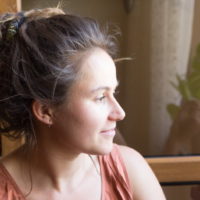
Naira loves beautiful things, and they absolutely must be good quality. Her home, filled with paintings and sculptures brought back from her many trips, smells of turmeric and a kind of unhurriedness. Our hostess is wearing a colourful summer sundress, a flawless manicure and pearl earrings. Her short, fair, greying hair is slightly tousled.
— What, you’re going to take photographs? And I haven’t even combed my hair, she laughs, smoothing it down with her fingers.
— And I thought it was a style, deliberately planned that way, Fyodor replies, setting up the light.
— You could say I only got hair after chemo, Naira goes on laughing. — It used to be long, but as they say, “three little hairs in six rows”. As a child I had my head shaved, they put laundry blue and egg yolk on it, but my hair still wouldn’t grow. Later I spent loads of time and money on expensive products to put a hairstyle together. Then after chemo it grew in nice and curly — “sheep’s wool”, as my friend christened it. Though it straightened out later. I even used to joke: if your hair won’t grow, have a round of chemo — you’ll get gorgeous hair.

Naira works as a senior specialist at the constitutional court and as a translator. A day after our conversation, she was leaving for a month in Kyrgyzstan as an OSCE election observer. She had just finished immunotherapy, but had decided not to go for a follow-up CT scan yet.
— I’ll go when I get back. What if they find the metastasis hasn’t gone away? I’ll be worrying. Besides, if it turns out the immunotherapy hasn’t helped, I’ll have to have chemo again, so at least I’ll earn the money for it, she says, and laughs again.
Chapter I. Two Months
In 2010 Naira was working as a translator in Ukraine. When friends suggested that she consult a doctor well known in Kharkiv who practised alternative medicine, she went out of sheer curiosity — Naira had no health complaints.
The doctor, however, found a lump in her right breast and advised her to have a CT examination. The specialist he recommended reassured her: yes, there was a tumour, but it was benign; better to leave it alone and monitor it with periodic blood tests for tumour markers.
Two years later she developed pain in the breast area. The CT scan again showed an adenoma, which the doctors again advised leaving alone. The tumour marker results came back clear.
Tumour markers are antigens that appear in a person’s blood or urine when malignant or benign growths develop. It is believed that detecting tumour markers makes it possible to suspect the presence of a tumour in the body at an early stage and to track the course of the disease during treatment.
The tumour marker tests were still coming back clear in April 2017, when Naira started coughing and struggling to breathe. She finally realised it was not “just an adenoma” when a large fistula opened under her right armpit.
— I’d just flown back from Mozambique, where I’d been working. I was 57 then, and my mother died at 58 from cirrhosis of the liver. I decided for myself: if I get past that age, I’ll live. In reality, of course, it was frightening — I wanted to bury my head in the sand and not think about anything. But I had to go for an X-ray.
The young radiologist’s face went pale at the sight of the developed image. “How could you let yourself get into this state?” She wrung her hands. “It’s one thing when they come from villages, uneducated, but how could a woman like you come so late?”

Too late for what, the radiologist did not explain. Nor did the physician at the district clinic, where Naira went for a referral to the oncology centre, tell her patient anything.
— She just started dictating to the nurse as though I wasn’t even in the room: “Write CR-4.” I ask her: what does CR mean? Cancer? I have cancer? 4 — stage four? And she replies: “Well, you understand yourself.” That was it. My sister and daughter were with me. We went down the stairs, and on the ground floor I fainted from the distress. They brought me round, and my blood pressure was 180. They called her, told her her patient was unwell, and she came down from the third floor to the ground floor 40 minutes later. Took my hand, patted it and said so reproachfully: “But you knew what you had, didn’t you?” As if to say, what did you go fainting for?
The diagnosis — bilateral breast cancer — was given at the oncology centre. And again, not to the patient but to her husband. Naira’s husband is a doctor; they knew him at the centre. And they warned him that Naira had two months to live at most.
Cancer patients were entitled to a free CT scan, but the couple paid for it. It was May, Naira had been given until July to live, and her turn for a free CT scan would not have come until January.
Chapter II. All Is Well, My Fair Marquise
The CT examination at the oncology centre revealed metastases throughout her body — in both breasts, her lungs, liver, aorta and on her spine. In the image, Naira thought she looked like a New Year tree with little glowing lights. Her right arm, under which there was an enlarged lymph node, is still a little bigger than her left.
Only later did Naira learn that the doctors had tried to persuade her husband “not to torment her, but to let her go peacefully” — the case was hopeless, after all.

But he decided they would fight and there would be chemo.
Before being admitted for chemotherapy, Naira went to work one last time to arrange sick leave. She gave her colleagues her jewellery and other things of hers they had ever liked. Both she and her colleagues understood that Naira was saying goodbye. Once she had finished with the gifts, Naira took her green mug of warm water — breathing was difficult, and she went everywhere with a mug, sipping water from it — and went to the personnel officer for her sick leave.
— The personnel officer looked at me closely, sat me down on a chair and asked: “What actually made you decide you’re dying?” I say: well, of course, stage four, for two months now I haven’t been able to breathe, I can’t walk, if I manage to sleep at all it’s only sitting up, and I’m an intelligent person, I understand everything. Suddenly she says: “God didn’t create us to suffer, he created us for love, for the beauty of life. Let’s pray together.”
— We started praying. And then something important happened: somehow I believed that God had created me not to suffer, but to live. I prayed a lot after that, and I still pray. And I think it was faith that cured me first and foremost. My husband doesn’t agree with me, of course, but he is a doctor, after all.

At the oncology centre, Naira was offered a place in a control group in a European programme testing a new curcumin-based drug.
She was to undergo 12 courses of chemotherapy over three months. Every Monday Naira received the anti-tumour drug Paclitaxel and the new drug, and every Friday she had blood taken.
During the first procedure she lost consciousness. She wanted a drink of water, choked, and remembers nothing after that.
— I came round and saw a doctor standing there looking at me. I could feel my upper dental bridge wobbling. It turned out that, to stop me biting my tongue, my husband had started squeezing it and broken my bridge with his finger. “Well, how are you?” the doctor asked. “Everything’s fine,” I reply, “everything will be all right.”
“You’re no ordinary patient,” she said, and left.
— Then the head came in (of the chemotherapy department at the Fanarjyan National Centre of Oncology — Kalemon), and by then I was completely out of it. She asks too: “Well, how are you?”
“You know, Lidia Georgievna, there’s a song: ‘But apart from that, my fair marquise, all is well, all is well,’” I reply, summoning my strength.
— She looked at me as if to say: I came to cheer you up, not the other way round. She told my husband then: “With that attitude, she’ll definitely pull through.”

Naira turned up for chemo in smart dresses and with a smile — she was coming to be saved, after all. Every Friday they took blood to check her white cell count — to determine whether chemo could continue or needed to be replaced with supportive therapy. The doctors were amazed that someone who had been given two months to live had the test results of an eighteen-year-old.
— I talked to every little orange drop flowing into me, imagined it was life flowing into me through the tube. Once, as I waited for the drip to finish, I was looking at the wall and had a vision: there was this plump, kind cell, with little evil ones scurrying around it. And the kind one was swallowing them. I even wondered if I’d gone mad, but then I realised that this vision was a visualisation of what was happening inside me.
By the end of the chemotherapy course, however, it emerged that the life-saving orange drops had been nothing but… a dummy.
It turned out there had been two control groups: one received the real drug, and the other a placebo. Naira was outraged — she had signed nothing, agreed to nothing; this was a criminal matter.
But in the end she did not take it to court. She was too weak physically; she needed to save her strength for recovery. Besides, she was alive. Of the 200 people in her group, 25 were still alive.
— They probably didn’t give us anything to sign because they thought: it’s stage four anyway, there’s no hope, we might as well experiment.
Chapter III: No Calls, No Tears
Chemo made Naira’s hair start falling out and her eyesight deteriorate — her astigmatism grew worse. Most frightening of all for a translator, her memory began to fail. During simultaneous interpreting, Naira would forget words — she remembered the first and last letters, the number of letters in the word, but the word itself would vanish completely from her head.
Chemo affected her heart — she still takes supportive medication, including homeopathic remedies. But the worst thing was the pain in her bones.
During chemotherapy Naira spent the whole day at home alone. Her husband was at work, her son and daughter lived separately. Sometimes she went hungry all day — she felt so bad that food was the last thing on her mind, and the smell of gas made her nauseous.
A housekeeper came to clean on Saturdays. But at some point Naira decided she did not want to lie in bed and lament her fate.
— I couldn’t bend down, I had half a litre of fluid in my pericardium and lungs, I was struggling to breathe. But I would put out a chair, sit on it and wash the floor — mop around myself, then move the chair and wipe another spot. It took a long time, but at least I did it myself.

Between bouts of cleaning, Naira looked out of the window at people bustling about their business and thought that they did not understand how lucky they were to be able to walk, bend down and wave their arms.
At first she herself was afraid to leave the house. When her husband suggested it, she would become hysterical — what if she couldn’t breathe, or lost consciousness and fell in the street, what would happen then? Later she pulled herself together — tied a pretty headscarf over her bald head, made a coquettish bow and went out.
The soul-searching over “Why me, why has this happened to me?” only lasted through the early days.
— Why did this happen to me? Because I was a fool, I wasn’t keeping an eye on things. Sometimes I’d tell my husband: it’s all your fault, you did this once, said that, I went through terrible stress and ended up giving myself cancer. But that was just women’s stuff, it soon passed. And when he came home from work and asked how I was, I invariably answered cheerfully: better today.
From the very beginning, Naira did not hide her diagnosis from friends and relatives. But she strictly forbade them to call her, sympathise and cry.
— But surely there were times when you told someone your diagnosis and they were at a loss, didn’t know what to say or how to behave? I ask.
— Of course. That’s a very important aspect of a diagnosis like this. You lose friends, well, relatives too. They stop calling, stop meeting up with you. They try to get away from the pain. They think you’ll start whining, talking about your ailments, how bad you feel. They understand it isn’t contagious, but behave as though they could catch it. Seeing your pain makes them feel bad. But alongside people like that there was, for example, my colleague, who called every day and told me about the daily routine at work. I couldn’t talk, I didn’t have enough breath. I just listened, and that helped me a great deal.
After a silence, Naira adds:
— Sometimes I regret not whining at all, so that my children, for example, didn’t understand how bad I actually felt. Chemo changes you so much. Psychologically, mentally, physically, it affects your character. You probably need to get that across to people, to put a stop to expectations you can no longer meet.
The grey-striped kitten starts meowing desperately and jumping on things, knocking them over. “He’s hungry,” says Naira, taking some jelly out of a pouch. Plump, glossy Johnny, who has been snoring at our feet, leaps up, finds his squeaky toy and runs over to Fyodor with it — throw it.
— Well-fed bastard, Naira smiles. — Say: “I’m Johnny Big Heart.”
— And did the animals support you in any way, sense how you were feeling?

— These (she points at the dogs), I don’t think they sensed anything. They were under my feet as usual. But my daughter’s cat would come and lie on me. She passed away after lymphoma. I had a cat too, a Persian. They took her away from me during chemo when I developed an allergy to fur. She died of cancer too — pancreatic cancer. Both were animals we had rescued. I think they took my pain away.
Chapter IV. Aubergines and Jam Buns
Diet is as important in cancer as faith and the right chemo, Naira believes. She and her husband had to find the information and put together the right diet themselves — the doctors only widened their eyes at Naira’s questions about what she could and could not eat. For the most part, the patients did not bother with the question either.
— There was a woman having chemo with me. Lunchtime would come. I had baked aubergines, she had jam buns. I say: you’re not allowed that, and she says: “But I want it.” So what? There are lots of things I want too, but I’m not allowed them. I saw how often people asked relatives to bring tolma, and minced meat is absolutely, absolutely forbidden.
A strict taboo on red meat, processed meat products, flour-based foods, yeast, sugar, dairy products, Naira lists. She is not particularly fond of flour-based foods anyway, but giving up cheese was very difficult. Now she sometimes allows herself a little piece, but she had to forget about her beloved Roquefort.

Naira drinks juices — carrot, celery, seasonal fruit and berries. Vegetables and fruit predominate in her diet. She uses only vegetable oils — flaxseed, hemp, grapeseed.
— During chemo I drank Narine. I also take curcumin tablets. It’s indispensable in treating cancer, but you have to be careful with it — curcumin leaches calcium out of cancer cells, which is good, but calcium disappears from the bones too.
Naira practised vegetarianism for a long time. But towards the end of chemotherapy she craved meat like mad — specifically, beef tenderloin with a thick layer of fat.
— I kept telling my husband about this craving and warning him just to listen, but under no circumstances to bring any. I understood it wasn’t really me who wanted it, but those bastards (the cancer cells — Kalemon), when they’re already dying off, they want something to eat. They need energy. They don’t like aubergine, it’s meat they want.
Chapter V. A Glass of Wine to Victory
After 12 courses of chemo, the CT scan showed just one centimetre-sized metastasis in her liver. The others had disappeared.
— When I returned to work three months later, everyone was in shock. They’d already buried me there, given my job to someone else.
— And when did you realise that was it, you’d won?
— When the CT scan showed only a little metastasis on the liver, that was when I realised. Ten months after the tumour was discovered. And when I managed to climb to the fifth floor for the first time, I told the Englishman I was working with then about my illness, and we each had a glass of wine to that victory.
— And when the two months you’d been given were over?
— A friend of mine is a numerologist. She worked some magic with her numbers and told me: if you can hold on until your birthday, you’ll live. I held on.

— Setting near-term goals is probably very important in such cases.
— Well, it wasn’t near-term then. I remember going for a biopsy, and there were women sitting in the ward — a mother and daughter. The daughter was having chemo. The ward was grey, depressing. The daughter says: “I had breast cancer, they operated.” I ask: when?
She says: “Two years ago.” “Two whole years,” I thought, “how lucky, that’s an eternity!”
— How did you take the passing of each person who didn’t recover?
— You see them from time to time, you’re not always together. Came in, had it (chemo — Kalemon), left. There was one woman, I still remember her name — Maro. Once I asked the nurse how Maro was doing, and it turned out Maro had died. I’d only sat with her twice. She told me she had nobody except her sick mother. And if anything happened to her, her mother would be completely alone. That was hard.
— And there’s probably the fear that this could happen to me too.
— Of course there is. Have you walked down the corridors at the oncology centre? It’s like walking among the dead — that’s the aura people have, that’s their attitude. There aren’t many like me, with little flowers on their headscarves.
The windows there look out onto a cemetery too. I tried not to look. But once, on the way back in a taxi, we went through the cemetery. Just try staying cheerful in circumstances like that.
Chapter VI. The Centre That Hasn’t Happened Yet
Naira had a big dream — to open a support centre for cancer patients in Yerevan. Patients would be offered psychological help there, a dietitian would work there, people who had beaten cancer would gather to help one another — share their stories and offer encouragement. There were plans for a hostel at the centre where patients coming from the regions could stay during treatment. And there would definitely be a priest.
— We have little faith, and that’s a big problem. You need to find your faith, your support. I don’t think there’s some old man sitting up there, but I believe in the existence of a Higher Intelligence. I was a believer before the illness too, really, but I still find reading the Bible boring. I love the psalms, though. When I was already ill, I opened the first psalm I came across at the first line I came across, and it said: “Your body will fester.” [probably, “My wounds stink and fester
because of my foolishness”, David. Ps 37:6]
— When I recovered, I started looking for that line, but never found it, couldn’t remember the psalm number. So I no longer needed it. Now I open it at random and get only good things, for example: “Believe, and you shall be rewarded.” [“But I am calm, and my soul is at rest, my soul is at peace, like a child in its mother’s arms. Israel, believe in the Lord, from now and for ever” Ps 130:2-3]
In our country, an adult diagnosed with cancer finds themselves alone with the disease, Naira says. While childhood cancers are mostly treated and the necessary funds are raised quickly, adults are often left without financial help. And the tests alone cost 10-20 thousand drams each.
A person facing cancer does not know where to go, what treatment is right, how to fight it — or rather, live with it. After all, doctors often avoid the word “recover” when it comes to cancer, preferring the word “remission”. Naira herself uses only the word “recover”. It immediately creates a different attitude, she is certain. [Recovery is usually understood to mean five-year survival after cancer. Remission is a state in which, after treatment, the symptoms of the condition disappear and the tumour does not develop — Kalemon].
At the centre Naira envisaged, people would be taught to live with cancer. Because now cancer very often means a death sentence and tears. Naira says she saw people who had stage two, but decided they were dying — and died. And there were people like her, at stage four, who wanted to live — and survived.

— Neither doctors nor relatives know how to behave properly with someone diagnosed with cancer. In the West, doctors talk directly to the patient; here they prefer to talk to relatives. It’s very important to have psycho-oncologists who know how to approach each individual patient.
Naira, for example, needs to be told everything as it is; then she will pull herself together, see the illness as a task that needs solving. But there are people who could die on the spot from the sudden news. Or turn into domestic tyrants, “threatening” their family with their imminent death at every opportunity.
Often the relatives themselves decide to hide the diagnosis from the patient. Once, Naira was having chemo in a ward with another woman when a young man came into the room and warned them that his father, who did not know his diagnosis, would soon be brought in, and everyone present should keep quiet about what they were actually receiving. He had been told there were only vitamins in the drip.
— They brought the man in. Started his drip. The woman and I sit there without a word — both bald, getting our “little vitamin” through a port-a-cath (a special device for long-term intravenous injections, implanted in the skin in the upper third of the chest and providing access to the jugular vein). The funniest thing is that he was getting real chemo but thought it was a vitamin, while I was getting a vitamin but thought it was chemo.

The centre would also work with oncologists. They often lack sensitivity, Naira believes. Once she was deeply upset by an incident she happened to witness. A woman who had been told at the hospital that chemo had not helped and nothing more could be done had found a clinic in France willing to continue treating her. The woman was sitting in the room, waiting to be given her patient form, while in the same room Naira was having her port-a-cath flushed, when the head of the chemotherapy department came in.
— “Hello, dear Naira, how are you?” she greeted me. Then she turned to that woman and said: “Off to France, are you? Expecting a miracle? There won’t be a miracle.” I was supposed to sit and wait about fifteen minutes so that no air got into the port-a-cath, but I shot out of there like a bullet. I tell my husband. And he says: “Well, yes, you’re an elite patient, you should see how they talk to other patients.”
I told that woman afterwards: get moving and go to France! Don’t listen to them.
Throughout her treatment and her observations of other patients’ treatment, Naira had the growing feeling that the doctors themselves considered cancer a death sentence and had absolutely no idea what to do with living people.
After finishing the chemotherapy course, Naira asked to be given a schedule for what came next — the next CT scan, X-ray, tests. The doctors waved her away: “Oh, you know yourself.” As though they did not understand what to do with a patient who should have died long ago but went on living. “Not just living, but walking around and making demands, the bastard.”
— I asked whether I could do yoga, and the doctor would pull me up: “Your bones.” Could I go swimming? And the doctor says: “Settle down already.”
— But I’m taking my swimsuit on the trip, Naira smiles slyly. — I’ll go swimming in Bishkek.

Chapter VII. We’ll Be in Touch If We Need You
Naira told her friends that there really ought to be television programmes about cancer — sharing stories, educating people, giving them faith. To her surprise, her friends did not support the idea.
— They’d say to me: “What, you’re going to sit in front of a screen and talk about it?” Why not? It’s not as if I’ve done something bad. It’s not my fault my cells started dividing the wrong way. I can quite calmly say: look, I’m alive, if I survived stage four, you can too.
Other cancer patients gradually began approaching the always smiling, smartly dressed Naira — telling her their stories, hoping for support. She became even more convinced of the need for a cancer support centre. She gathered the necessary papers. At city hall they first promised to help, then refused. Naira approached two organisations working with cancer patients.
The first was Henaran. Naira went to a conference on oncology organised by them. The doctors giving talks were rather boring to listen to, she says: she had the feeling they could not see the living person behind the disease.
At the conference she saw the very doctor who, two years earlier, had “prophesied” that she had two months to live.
When the conference participants introduced themselves, Naira spoke about her illness and healing. At the coffee break the doctor himself came over to her.
— Of course he didn’t recognise me. How many people like me had passed through his hands? Pieces of meat not worth paying attention to, they’ll be gone soon anyway. He said: “You can’t possibly still be alive. That means you were misdiagnosed.” I say: but you made the diagnosis yourself. I have all the papers. You don’t remember me, I came with my husband. You and your assistant talked about me as though I was already lying there a corpse.
— But he won’t let it go, asks what I did, how I recovered. Well, I took a placebo, kept to a diet, had chemo. And, to be honest, I didn’t want to die. He gave me a strange look and walked away.
Naira then tried to tell the head of Henaran about her idea for the centre. In response, the head suggested she train as a cancer patient advocate and defend other patients’ rights. She sternly scolded Naira for paying for the CT scan and port-a-cath instead of fighting to get everything for free.
— I’d been given two months to live, I couldn’t breathe, couldn’t walk, never mind fight to get anything. And cancer patient advocates are a good thing, of course, but there’s so much that’s important before you get to that. But the head of the organisation wasn’t very interested in my idea.

Then Naira wrote a letter to City of Smile. She offered her help as a volunteer. She planned mainly to meet the parents of children with cancer, tell her story, help them believe that if she, an adult at the final stage, had recovered, then their children would all the more surely overcome the disease.
A month later the organisation replied that they would certainly make use of her help when the need arose. The “need” never did arise.
Chapter VIII. A New Therapy
In November 2019 Naira had a relapse. The metastasis in her liver grew to 3.5 cm. She had to put the centre out of her mind for a while — too many obstacles, too much bureaucracy and energy.
At the oncology centre Naira was offered another course of chemotherapy. But there was a serious risk that her heart would not withstand it. Then she decided to try immunotherapy, so-called macrophage activators. She and her husband took out a bank loan, and he gave her the injections in her navel himself.
— Everyone experiments on me, Naira laughs.
Naira’s husband, the homeopathic doctor Vagharsh Khachikyan, who periodically looks in on us in the kitchen, explains how immunotherapy works.

— Chemotherapy, radiotherapy deal with the consequences, not the cause. Good chemotherapy at stage three gives you a year’s guarantee at most, that is, it puts death off by a year. Because along with the cancer cells it kills our immune system. Immunotherapy, on the other hand, helps the immune system recognise cancer cells so they can then be destroyed.
— Cancer happens because immune cells stop recognising foreign bodies, can’t tell whether they’re their own or not. You need something to “open the eyes” of the immune system. Then it starts recognising and destroying them itself. That’s what the drugs (which Naira takes), the so-called macrophage activators, do.
— Macrophages make up 5% of the white blood cells in the blood. They are important immune cells that “digest” viruses, bacteria and other foreign bodies that have invaded the organism. GcMAF (macrophage activating factors derived from Gc protein) occur naturally in our bodies and give macrophages the order to destroy foreign growths. Serious illnesses such as cancer destroy GcMAF — and there is no one left to give macrophages the order to destroy. The macrophages remain, as it were, asleep. Cancer cells start multiplying uncontrollably. In a laboratory, macrophage activators are produced from Gc protein, a kind of artificial GcMAF, which are introduced into the body and “wake up” the macrophages. And those start destroying the cancer cells.
In February 2020 Naira’s CT scan showed that the metastasis had become encapsulated and looked like a little dried bean, which meant the therapy was working.

***
It is already night when we leave Naira’s warm home. In the front garden outside the window, with its little clay jugs, flowers and trees, a cat lies curled up in a ball. He is not feeling well and will go to the vet tomorrow.
There is such a yearning for life in the house, in the front garden, that suddenly I too, like Naira in the hospital ward, have a visualisation — a “bad” cell that has peered into the house, resembling a prickly brown cactus, mutters in embarrassment that it has got the wrong address and, quietly pulling the door closed behind it, goes out into the night.