No Time for Sympathy
Fyodor: People in China are dying en masse from a new virus.
Me: What virus now?
Fyodor: Someone caught it from a bat.
Me: Well, then don’t eat everything that moves. Have you fed the dogs in the house?
I think it was January. It was cold. I had just come inside after several hours of feeding, cleaning and walking the dogs – chilled to the bone, tired and angry. I wanted just one thing: to bury myself in my laptop, mindlessly scroll through other people’s Facebook and YouTube pages, latch on to something funny and lose myself in it.
I didn’t want to know about the virus in China. New viruses that kill people turn up in the world all the time. Somewhere in a distant world that seems abstract for that very reason. Other people, strangers. I’ll feel sorry for them later. Right now, something to eat and refuge in my laptop.

But the Bee Survived
March the second. Fyodor is baking monastery gingerbread. His fast has begun — a strict Orthodox one, without vegetable oil. Gingerbread with mint and honey. I have coffee without milk and a week of raw food. Fyodor is talking about coronavirus again. It’s everywhere now.
Ulay has died. I’m thinking about Polish journalist Paulina Reiter’s interview with Marina Abramović — one of my favorites. The journalist asks Marina why, in the performance “Rest Energy,” the arrowhead is pointed at her heart while Ulay holds the bowstring taut. Abramović says that when another journalist asked Ulay the same question, he answered, “It was my heart too.”
Both of them, or rather the two of them together, were very important in the various stages of my becoming. Ulay’s death is tangible and sad. Coronavirus is still something distant. To me, coronavirus is simply a form of enteritis that dogs often get and that is easier on them than, say, parvovirus. Our Ramik recovered from it three years ago. I’m slightly annoyed that it has taken hold of Fyodor and makes up a substantial part of our conversations.

***
Fyodor has had a vein removed. They operated, kept him for twenty minutes, fed him and sent him home. We went down into town. It was warm, birds were singing, Fyodor was leaning elegantly on a cane. People in masks came toward us. Some ostentatiously stepped away as they passed; others brushed against us with their elbows. Fyodor sternly ordered them to keep their distance, which even made us miss our green light at one crossing.
At the bank, all the employees wore masks and asked people to keep their distance. Something alien had appeared in the air. I was still laughing at the precautions and the masks worn wrong.
We bought daffodils from an old lady at the corner of Mashtots and Moskovyan. As she put the remaining bouquets back in the bucket, I noticed two insects floundering in the water — a little bee and a fly. I rushed to pull them out. The fly, which apparently hadn’t been in the water long, began shaking itself off and even flying a little. The bee dragged itself laboriously across the asphalt.
– “We need to get the bee out of the way,” the old lady decided, and was about to move the insect to the patch of earth on the sidewalk where the trees grow.
– “Wait!” The man standing with her caught her by the arm. “You can’t do that. She’ll get dirt on her and won’t dry out.”
– “But we have to get her out of the way, she’ll get trampled. I’ll put her on a leaf,” the woman said.
She went and found the biggest leaf, put the bee on it. Moved the leaf to the patch of earth with the tree. When the man made a protesting movement, she said sternly:
– “A bee is an intelligent animal. She’ll wait on the leaf until she’s dry enough, and only then climb down onto the ground.”
What a lovely old lady. A pity Fyodor won’t let me hug her.
***
Mid-March. In Italy, people are dying of coronavirus in droves. At Zvartnots Airport, arriving passengers have their temperatures taken with remote thermal cameras and are half-heartedly sent into self-isolation.
A woman who has come from Milan isolates herself at her son’s big engagement party. A few days later, it turns out she is infected. A search begins for the people she has been in contact with. There are the many guests at the engagement party, the salon where she had her hair done, the shops where she chose things for the engagement.
While the woman lay in hospital with pneumonia, the country descended into full-blown hysteria — both real and virtual. The internet shook with curses directed at her and demands to prosecute her; memes and vicious jokes grew around her persona; relatives found and beat up one joker whose video had racked up a wild number of views.
The passengers on the Milan flight were sent into isolation at a five-star hotel in Tsaghkadzor. Videos appeared online of the staff serving them with their masks on wrong and their protective goggles pushed up onto their foreheads.
The farrier came to trim the horses’ hooves. Wearing a mask, I groom Salma, sneeze constantly — I’m allergic to horsehair — and secretly envy the elite isolators.

I’ve Woken Up
The prime minister stopped traveling around the country, suspending his campaign for the referendum on constitutional amendments. His famous “Whose dog is coronavirus, to scare us?” now drew anger rather than approving applause. The health minister stopped calling corona “a virus no more dangerous than the flu” and began teaching the country to wash its hands properly.
People in supermarkets are sweeping toilet paper, pasta and bread off the shelves. Those who have kept their heads call for calm and for leaving the toilet paper alone — corona causes diarrhea in only 5% of cases. For some reason, the main ingredient in our monastery gingerbread — rye flour — has disappeared. I note with satisfaction that my staple food — vegetables and fruit — remains almost untouched.

Our supplier of dry dog food called to warn us that people were buying up food and the warehouse might run out. We had to do the same. On the bright side: we won’t have to think about dog food for over a month.
***
I try to work on the article, but the general agitation has caught up with me. Schools, food establishments and cultural venues are closing. I’m annoyed that the orphanages have closed for quarantine and we’ve suspended dog therapy. And that we can’t start building the new enclosures. I’m also scared for the people who have lost their jobs.
I justify my procrastination by saying I’m looking for reliable information to understand the degree of danger. In reality, I spend hours scrolling through my Facebook feed.
Only recently, I dreamed of a week like this, when I wouldn’t have to think about feed, wouldn’t have to go to therapy, could shut myself away in Ushi for a week, spend time with the horses, take longer walks with the dogs, finish the article.
Now I have that week. More, even. But knowing that it isn’t by my own choice, and the anxiety in the air, weigh on me. I don’t want to walk, or write either. I don’t want anything. Just to scroll through the feed and pick out the rare pieces of encouraging news.
***
I took my mother sibekh, greens gathered for her every March, as tradition has it, by Kyubar — the only Kurdish woman in Ushi. On the phone, I sternly told her to come out onto the landing and keep her distance. I hadn’t seen my mother for a week.
We stood facing each other two meters apart. Talked for about five minutes. Mostly I did the talking. Frightened her and demanded she observe isolation strictly. Was horrified that my brother (a serviceman) went to work every day, and that there was no Alcogel in the house. Mom tried to keep from smiling, and I was angry that she wasn’t taking any of it seriously. The way Fyodor was angry with me just a week ago. It feels like several years have passed. As though all of us have somehow ended up in another dimension. Like in “The Challenger” — the Australian series from my childhood.
My little nephew kept trying to open the front door and run out to his aunt, but Mom wouldn’t let him.
I want my old life back. To sit on Mom’s sofa with a cup of bergamot tea, kiss her hello and goodbye. Cuddle my one-and-a-half-year-old nephew. Chase him all over the house. Hide in the darkest place and wait to give a yell when he cautiously approaches. Be amazed by his reaction yet again — the yell frightens him, he flinches, freezes for a second and bursts out laughing. And runs away, his ringing laughter spreading through the house. I’ve never seen a child who loved being frightened so much.
Everything makes him happy, really. He walks about, smiling. A new person comes — he’s happy. They put on a cartoon — he’s happy. Something breaks, someone falls over, some new dishes are brought out, the phone rings… everything makes him happy. He really likes this life he’s found himself in.
I Open Vonnegut
I — a strong, self-sufficient woman with feminist “notions” — cannot deal on my own with a tiny little cuticle that is making life very difficult. I am completely dependent on my manicurist.
I bite off my cuticles. Think with dread of the day I’ll have to pick up a nail file myself. No scissors. I solemnly promised the manicurist three years ago.
***
Bought a new hand cream. A rich one. My skin is cracking from the alcohol. But Fyodor is relentless. He sprays my hands every time we leave a shop or the vet — the only places we still go — before I get into the car.
At home, he makes me wash my hands every half hour. Even though we’re home alone. And no one visits us.
I can’t stand washing my hands. I’ve dodged it all my life. I hate water touching just one part of my body. A phobia like that. Maybe someone’s already given it a name.
But now I obediently comply. I tenderly pick up the little pale-green bar. Something in this world is stronger than coronavirus.
***
A state of emergency has been introduced, complete with a commandant, everything as it should be. Restrictions and prohibitions galore. In particular, gatherings of more than twenty people, mass events, soldiers’ leave, parcels and visits in the army and in prisons are banned. Even more establishments have closed, even more people are forced to leave work.

The anxiety grows. I ban myself from Facebook. At night, I can’t fall asleep. Around noon, I somehow get out of bed, drag myself to the laptop with a cup of coffee and get stuck on YouTube. All fifty-three animals have been left to Fyodor. He writes a grant application, edits an article, feeds and waters them all. In our little family, my depression counts as a valid excuse. Nothing can break through it anyway until it goes away by itself.
***
I’m rereading Vonnegut’s “Cat’s Cradle.” Coronavirus looks quite a bit like ice-nine. It destroys the world too. Our former world — so imperfect and, it turns out, so beautiful.
Kurt Vonnegut is my absolute, absolute favorite. I cried when he died. “Cat’s Cradle” is my favorite of his works, in which he invented a new religion, a “bible” according to Bokonon and a very interesting end of the world. If everyone were required to have a religion, I’d choose to be a Bokononist.
“The fourteenth volume of the Writings of Bokonon is entitled: ‘Can a reasonable person, taking into account the experience of past centuries, entertain even the slightest hope for a bright future for humankind?’
It doesn’t take long to read the Fourteenth Volume. It consists of just one word and a period: ‘No.’”
Everything as Usual
Twenty-five minutes of legs, fifteen minutes of abs, five minutes of burpees. My muscles ache to the point of exhaustion. No wonder, I haven’t worked out for a week — I saw no point in building muscle when the world was going to hell. In my beloved Italy, several hundred people die each day.
Looked in the mirror. Did a “Rambo.” That’s what we called it as children when we flexed our arm and shoulder muscles. Need to reduce the work on my arms — too muscular. That is the main task. Tomorrow, cardio only. Forty-five minutes.
It’s very important — to take yourself over to the mirror and look worriedly at the muscles in your arms. To fish out a problem that mattered in that other, normal life. To begin each morning as you did in that other, normal life. So as not to go mad from the present one.
***
We continue not to leave the house or have anyone over. With our immune systems, we’ll get off lightly, we’re sure. But we will spread the infection.
Just one last trip to the bank, finish the obligatory paperwork, and that’s it.
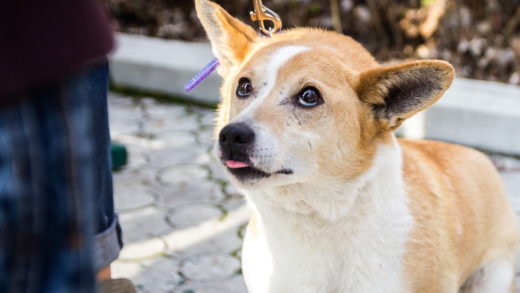
We got in the car, drove a little way and saw a ghost of a dog. One eye intensely blue from glaucoma, the other burst, hanging out. Bones sticking out beneath a shaggy but shiny coat.
Me: We need to catch him. I don’t think he can see.
Fyodor: We need to do the paperwork today. We can’t be late.
Me: We won’t be! We’ll catch him in a minute, look how friendly he is, he’s come to us for help himself.
We spent about two hours catching him. The skinny blind dog nimbly ran away from two strong, sighted people. If we managed to corner him, he bared his teeth and lunged. Two torn leashes and one horse lunge line, my horror at the mud on my favorite boots (it had been raining for several days), my fishwife’s swearing and Fyodor’s frightening silence later, the fugitive was caught and installed in a crate.
***
“We’ll quickly drop him at the clinic, leave him there, go to the bank and have time for everything,” I reasoned aloud on the highway. A nasty noise beneath the car intruded on the plans very suddenly. We docked at the shoulder, bent down beneath the car: the left front half-shaft was floundering helplessly underneath it.
On the bright side: the drive shaft ended its earthly journey on a downhill stretch, two hundred meters from the repair bays. Unlike catching dogs, pushing the car is something Fyodor likes.
The mechanic quickly assessed the situation, told us to leave the car, he’d do everything and get the parts himself.
We persuaded a taxi driver, who had just come out of the car wash, to take the crate with the dog and us to the vet. All the way there, the driver shared his homophobic and anti-feminist views and his bleak vision of the country’s future. We kept quiet and calculated how long the expressive smell of our horse lunge line would linger in his car, and how the crate itself had been clean, but the bottom, which we’d set on the muddy ground after the rain…
The driver charged two thousand drams, just four hundred more than the normal fare. He could have charged the full five thousand — we went without the meter, hadn’t agreed on a price beforehand.
***
Late in the evening, finished with the bank and with the car collected, we return to the vet. We’re falling asleep on our feet. The dog needs eye surgery, he can’t see and never will, he also has venereal sarcoma, he growls and lunges, he’ll take a lot of fuss and time we don’t have, so by every measure it’s better to put him to sleep, the vet says.
I translate all this for Fyodor and start crying. No one even thinks of comforting me. Everyone knows I always cry when I’m about to do something monumentally stupid — the dog will live.
It’s Good to Live on Top of a Mountain
Quarantine. You can only go out with a completed piece of paper and a passport, and only out of strict necessity. In all other cases, staying home is recommended. Fifty cases a day are being detected in Armenia, or even more.

I have fields. Endless ones. Where I can go for a walk whenever I want. Many people are locked in their apartments. Many — nine to a room. Spouses who haven’t divorced up to now only because they had an outlet in work, a manicurist, beer at the pub with their mates, a café with their girlfriends; wives with husbands who beat them, have lost their jobs and grown even angrier; daughters-in-law who stayed late at work to see less of the mothers-in-law tormenting them over infertility; men twisting themselves into knots trying to slip a message past their wife’s watchful eye to the mistress saved in their phone as “Sergo the Running-Gear Guy”; men playing a game with balls who are really thinking about how to scrape together next month’s utility bills and food; children demanding entertainment in place of schools, kindergartens, the yard, friends. All of them are locked in the little squares of their apartments.
***
Tried writing a haiku.
Me: Drunk is the last Alcogel
The commandant is sad.
What word should I use to rhyme with “Alcogel”?
Fyodor: Sings the Tsaghkadzor maître d’hôtel.
***
Aslan bulldozes through the fields, privatizing every stone, every bush with meager streams of urine. The sofa picturesquely sprawled in the apple orchard takes an especially long time — it needs to be peed on from three sides. The seat, for obscure reasons, perhaps out of respect for the owners of the apple trees — never.
In the neighboring orchard, Aslan runs up to a tree, stops, thinks for a very, very long time and makes the same decision as every time before — to pee. On the owner’s galoshes, neatly placed on a thick branch.
“Aslaaan,” I half-heartedly scold him.
Half-heartedly, because the owner of the orchard — Uncle Surik, a man of very many years — has called me a whore twice to my face alone, and countless times behind my back. Let’s call it even, Uncle Surik.
A whore, because that’s what the village elders call everyone who lives a life they don’t understand or does things they don’t understand. Dyed your hair — whore, keep forty dogs — whore.
Nikita runs ahead with her nose to the ground like a tracking hound. The melted snow has uncovered leaves that fell last year. In places, the wind has swept the leaves into little soft mats. Nikita finds them, theatrically throws herself onto the rug and starts rolling about, sneezing the dust she herself has stirred up in every direction.
Tequila immediately runs up to her and starts barking. That’s her reaction to any unexpected phenomenon or process that’s gone on too long. “Things, things, things,” she’d whisper instead of barking if she were a Bokononist.
Everything is as it was for the dogs. They run, enjoy life. And I enjoy it too. I breathe in the clean, somehow triumphant air of the fields, filling my lungs. For the first time in the month and a half since Bassit died. I miss his big face so, so much. I walk along in mud-caked galoshes, smiling and crying. Somehow crying light-filled tears.
Procrastination. The Second Wave
In the morning, the Aragatsotn regional administration called.
“Did you sign up to volunteer to deliver groceries to elderly people and people with disabilities?”
“Yes,” I answer, half-asleep. They’ve woken me.
“There’s work. Calling people with disabilities to find out whether they still live at the addresses we have, and whether they’re alive? We don’t have phone numbers for many of them at all.”
“And how are you planning to find them?”
“We’ll call someone who lives on the same street and ask. It’s a small town, everyone knows each other. You live in Ashtarak, right?”
“No, in Ushi.”
“Ahh. Then this isn’t for you. We need someone who knows the people in town. You have a car, yes? We’ll check, then, and call you. We’ll need drivers, then.”
The woman hangs up; I’m fully awake. Well, well. To check whether they’re alive? Good thing an occasion came up.
***
I’ve fallen off the wagon again. Spending hours on Facebook. Just a look, I coax myself. I do need to know the news. And plunge into the conveyor belt of meaningless accusations, hatred, everyone disagreeing with everyone, expert opinions from yesterday’s political scientists — today’s virologists, memes, fresh jokes, criticism of home learning, which many children can’t access because they have no internet at home, complaints about the presence of children in the house and their number, discontent with quarantine, discontent with too many people in the streets.
People who used to like and dislike things and keep scrolling now have time for long comments too. I too leave my valuable opinion under every other post, granfallooning, as Bokonon would have it.
***

I take selfies. Lots. With different expressions. Very therapeutic. Danced a lot this morning. The collection of pagan movements was called “The Death Dance of the Naked Maja” (“The Naked Maja” is a painting by F. Goya). I don’t know, don’t ask. The soul is like that, it feels however it wants to feel.
***
My head is buzzing, the panic attacks I seemed to have dealt with are coming back. It’s been pouring nonstop for several days, the sound of rain is constantly in my ears — our roof is thin, too.
I can’t sleep at night, and reach for the laptop again. The words and pictures people post arrange themselves before my eyes in ultra-bright pieces of a kaleidoscope, my brain is feverish, but with a kind of masochistic pleasure I keep turning the kaleidoscope of unnecessary information.
I hate it when it gets dark. I feel cut off from the world and helpless. The internet gives me a sense of being with people and of safety.
The End of the World
I fall asleep toward morning and have a dream. Fyodor and I walk slowly down a London street, holding hands. On both sides are two-story houses with bright-red tiled roofs. Suddenly some commotion begins; we stop and turn toward the houses on the left side of the street. And everyone stops and turns. Tension arises in the air: when you realize something is going to happen but it’s not yet clear what. “One minute before.”
And then a huge wave rises from behind the houses and rushes at us. “What’s a sea wave doing among houses?” I have time to think. And suddenly, in the two or three seconds as the wave approaches, everything falls silent inside and around me, and I understand everything. That this is the end of the world. That in a moment there will be nothing, nothing left. And in this silence arises an enormous, never-before-experienced terror that I don’t want to die now. I’m not ready, I need time to prepare myself, finish important things, see all the people I want to see.
“It’s a dream, wake up,” I tell myself twice. And understand that it isn’t a dream, that some force is drawing us toward the advancing wave, toward the end of this life and perhaps the beginning of another. And that I’m afraid, deathly afraid of that unknown, and I need to hold Fyodor’s hand very, very tightly so we can be together in that life too.
But I can’t hold on and let go of his hand at exactly the second the wave snatches him away. My hand too sinks into the depths and… I wake up.

***
Over breakfast I tell Fyodor my dream. I’m still shaking.
Me: I don’t know how to describe that atmosphere to you. My feelings. It wasn’t like anything I’d ever experienced before. It really was the end.
Fyodor: I understand.
Me: No, you can’t understand. I’m telling you, it’s impossible to feel something like that.
Fyodor: When I was still in secondary school, on Sakhalin, I dreamed we were walking with my dog Druzhok — for some reason at night. We saw a hurricane, a spiral of savage wind reaching high into the sky. It was full of lightning, so it stood out against the night sky, glowing like the filament in a light bulb. Very quickly it swallowed the two of us, and we were carried upward into the thundering sky, and everything vanished — for the first time I felt what death was. We ceased to exist, but I had time to feel it.
Me: Yes, yes, that piercing feeling that this is the last second in which we still exist.
Fyodor: Another dream like that was here already, at Centaur. It was “shot” entirely in one long Lynchian take. Half the planet was immersed in an otherworldly white light, half in darkness. Everyone on Earth understood it was dying. A “death star” was approaching. I didn’t look at it directly and didn’t know where it was, but it was very close, and it was clear it would soon arrive — and then there would be nothing. Everyone was evacuating onto ships and flying to another galaxy. I ran from ship to ship, helping everyone board, volunteering.
At some point I sighed with relief as I saw off the last ship and began smiling — until I realized that all the ships had gone and I was left on Earth. A dreadful sense of emptiness had long filled the air, but now I felt truly uneasy. I realized this was the end, there was no hope.
I began going from house to house, strange futuristic laboratories like in “The Martian,” though I hadn’t seen the film then. There was a woman in one of the buildings, though I don’t know how she got there, since everyone had left. I knocked; she didn’t open the door.
I went to another house. There was some guy there. He opened the door, I went in, but there was no one inside.
The dream had no ending; apparently the sun came up and it was time to get up and clean the stable. But the feeling of the end, the emptiness and that hopelessness — not the kind that causes sadness or panic, but a kind filled with acceptance — that feeling stayed with me for many days.
Terrible fear and acceptance — how differently we reacted to the same feeling beyond all limits. Suddenly I feel very, very good.
For Want of a Psychotherapist
I decided to write down my fears. To pick out the real ones from the abstract general unease, look them in the face, accept them.
I’m afraid that:
- the world around me will go mad;
- after this horror ends, things will be as bad as in the nineties, when there was nothing;
- I’ll get sick, not know it and infect people with weaker immune systems;
- my mother will get sick. Or my aunt;
- the hospitals won’t be able to hold all the sick people;
- I and/or Fyodor will get seriously ill, we’ll be put in quarantine, and our animals will starve to death;
- all the gloves will be bought up and I’ll have to hand out meat to the dogs with bare hands;
- people will run out of money by the time quarantine is lifted, our sponsors will unsubscribe, and there’ll be no money to buy food for the dogs and horses;
- organizations helping people with various problems will cease to exist for lack of money, and those people will die.
On another sheet I wrote down what I miss terribly from my former everyday life:
- Mom;
- my nephew;
- therapy at the shelter;
- two friends who came every weekend — to talk and help;
- hugs;
- interviews for articles.
It got easier. The desire to exercise, which had vanished, came back.
***
During oblique exercises, my phone explodes with music from Sherlock. The insurance agent. Reminds me there are two days left on the car insurance and it needs renewing. I return to my six-pack with redoubled energy. Someone still cares about insurance. Things aren’t that bad.
***
I pick up nail scissors and cut my nails. Some promises don’t count in wartime. I cut them “down to zero,” just as I like. As I haven’t done for three years. Put almond oil on my nails and cuticles. Enjoy it.
The Black Stocking
My laptop broke, or rather the little socket the cable goes into. The battery lasts just two minutes.
First we stuck a toothpick in the socket to make it hold the cable. That didn’t last long. Fyodor wrapped the cable in electrical tape. That didn’t help either. Then he built a contraption out of the cable, a tiny USB lamp and hair elastics. The laptop started working. Only now it couldn’t be moved from the bed where he’d assembled all this. In case the elastics suddenly came apart. Then my only work tool and means of virtual contact with the outside world would collapse — you can’t find anyone to repair a laptop now.
***
At four in the morning my pupils are dilated again, my eyelids won’t close, not a wink of sleep in either eye. Today we’re both anxious. We tell each other about it — Fyodor briefly and concisely as always, me at length and with digressions.
It gets easier. We laugh and can’t stop.
Me: Just try installing a geolocation-tracking app on my BlackBerry.
Fyodor: Or on Kyubar’s push-button phone. When that came out, the first Soviet satellite hadn’t even gone up into the sky yet.
Me: I wonder, am I laughing my head off because it’s funny, or because of nerves?
Fyodor: Maybe you’re just hysterical? Maybe we could get some sleep now?
Me: Wait! First let’s do an interview with you. So, Fyodor, how did you “fix” the laptop?
Fyodor: You’d need a hundred grams to get your head around it. I thought: how can I get the cable to stay put? I needed to apply exactly the same pressure as if I were pressing on the cable with my hand. So I took the elastics some woman brought from America, absolutely useless for hair — made in China, by the way — they’re thin, they don’t hold hair.
I took them, looped one around the wire, linked the rest to one another like a chain and stretched them very, very tight under the bottom of the laptop. Plugged the USB light into a port on the opposite side and fastened the last elastic link to the light.
That created pressure going down and to the left, as if I were constantly pressing on the cable with my hand. But it didn’t work until, by chance, one half of the elastic slipped a little to one side and began pressing on the cable in two places. It was like two fingers pressing on the cable. And then it stayed put.
Me: Like Edison’s light bulb, that… the one that by accident… (I think I’m falling asleep already).
Fyodor: The apple?
Me: What apple?
Fyodor: The one that accidentally fell on Newton.
Me: No, no, no. Not the light bulb, not the apple… penicillin… that’s it, the one discovered by accident. Can you imagine, my brain was so occupied with anxiety that it only occurred to me several days later: how did you do it? Imagine if the laptop hadn’t worked? And the repair shops aren’t working. I’d have been left without my work tool.
Fyodor: And without Facebook, ha-ha. But now every night we have to deal with the side effects of my invention. Because you can’t pull out the USB light without breaking the chain, and it’s blasting straight into our eyes. So we cover it with my black stocking. How I came to have a black stocking — that’s in the next episode. Sleep now.
Me: Since there probably won’t be a next episode, let’s not keep the listeners in suspense. In short: Fyodor had a vein removed — a big, unknottled, unbridled one…
Fyodor: Unknotted.
Me: Yes, and he wears an erotic black stocking. The stocking is multipurpose. By day it works as a lampshade for veins, by night as a lampshade for the light bulb. Also, since the laptop can’t be moved, I can no longer work with it on my lap, surrounded by pillows like Scheherazade. Now I have to sit on a backless pouf all day. And at night tuck my legs under me so I don’t crush the laptop or knock it off the bed. All right, all right, we’re sleeping.

Suppressing the Proper Woman
Mickey Mook has run away. I let her out to pee. Mickey peed and spent a very long time pretending she also needed to poop, but what a nuisance — constipation had turned up most conveniently. I was distracted by something for a second and she slipped off into the fields. She mustn’t, after the operation to remove her spleen with a tumor. She’s still in a cone. In which she can’t see anything and can barely hear.
I ran to look for her. My faithful Cerberuses — Lotta the cat and Ktsan the dog — immediately got up and followed me. Ktsanik can’t run; she can barely walk anymore because of her injured back.
I slowed to a walk. The Cerberuses followed me, strictly maintaining social distancing of a meter and a half. Ktsan — because she’s disgusted by all other four-legged creatures, and Lotta — because she’s afraid of all other four-legged creatures.

While I was looking for her, Mickey came home. Fyodor took Phoebus, Salma and Zheffa out into the arena. I opened my mouth to shout — it’s muddy, they’ll get dirty, I’ll be the one who has to groom them. Silently closed my mouth. Admired the inspiration with which Phoebus rolled in the mud. The only one of all our horses who can do a full 180-degree roll. He wants to roll now. He wants to live this very moment. To hell with the mud.
Finished with the animals, went home. Fyodor got out his going-out sweater and put it on. The proper woman jumped up inside me again. We’re strict about this. Going-out clothes are what we wear to Yerevan. Wear them at home for even five minutes and you’ll smell like a horse. Everyone and everything at our place smells of horses.
I reined in the proper woman. He wants to wear that sweater now. I think I’m beginning to truly value the moment and allow everyone to be in it. It’s silly to control little joys when the whole planet is controlled by one little virus. Shaped like a crown.
***
The price of ginger has soared to unprecedented heights: 12 000-17 000 drams per kilogram. How good that it isn’t spinach that’s “the best remedy for coronavirus.” I don’t like ginger; I can eat spinach by the ton. Felt sad for ginger lovers. Felt happy for ginger — it always lay so inconspicuously on the shelves, and now its star has risen. It woke up famous.
Thought about the two enormous jars recently brought to me from America. I divided them among little jars and gave them away to enthusiasts. Talentlessly squandered my chance to become a millionaire.
Flowers from the Not-So-Recent Past
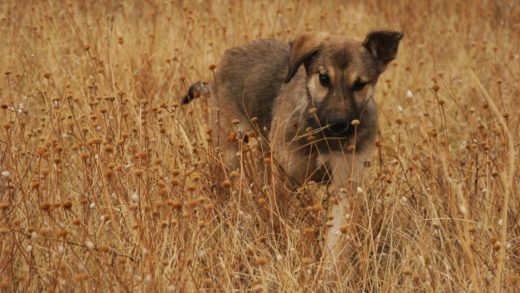
We brought the blind dog home from the clinic. With just one eye operated on so far. There’s a chance, a very tiny one, that the other eye will begin to see. We need to feed him well so he can withstand chemotherapy for venereal sarcoma, squirt Levomekol into the hole where the operated eye was and inject an antibiotic.
It goes like this. The blind fellow, whose name is Ugolyok, starts growling as soon as we enter the stall where he’s been put. I squat beside him, talk to him for a long time in my softest voice, tell him that although all the grounds for it are there, we aren’t going to put him to sleep, that this is his home now and he shouldn’t be afraid.
I reach a thick work mitten toward his head. He growls and lunges at the mitten. The fabric, despite the danger threatening it, keeps rubbing over the dog’s head. A hand imperceptibly replaces the mitten. After a while Ugolyok stops growling and lowers his head.
Now Fyodor begins stroking him. Then takes him by the scruff, explaining each action in the same gentle voice. I tie his mouth shut with a bandage, squirt Levomekol into the hole at his eye and two ml of antibiotic into his thigh. We untie him, let him rest, and pester him with stroking again. Every day. Twice a day.

***
April the first. I don’t feel like playing tricks on anyone. For the fourth year now I haven’t felt like it. April is the most beautiful and the most terrible. Four years ago, we froze in horror just like this when the war began. Our whole little world was paralyzed and froze.
“Perhaps, when remembering wars, we ought to take off our clothes and paint ourselves blue, get down on all fours and grunt like pigs. Surely that would be more appropriate to the occasion than grand speeches, and flags flying, and the firing of well-oiled cannons.” Definitely, Mr. Vonnegut.
***
Finally started spring-cleaning the bedroom. Carefully ran the vacuum hose along the walls and ceiling. Sucked up the old, abandoned cobwebs, left the new dwellings still under construction.
Moved the antique dressing table to sort through the spiders’ dwellings behind it too. We don’t have a single piece of new furniture in the house. All bought cheap or given to us and restored. The dressing table came from an old lady who lived alone. Her family gave away her things after her death. She had been a kind, quiet old lady. And full of light. I deliberately spent a long time making sure. Mirrors are my only superstition. After all, they retain information. It matters that it be good information.

I’d only just stepped away to fetch the vacuum when there was a crash. The enormous mirror came off its stand and crashed onto the wooden boxes on the dressing table’s top. By some miracle, the mirror wasn’t even scratched and broke nothing. A postcard was stuck to its back — a vase of flowers. There were lots of postcards like that in my childhood, when giving one another birthday cards was still customary.

On the back of the card, Melada and Vitalik wished the most beloved aunt in the world a happy birthday. Dated 1976. I wasn’t even planned yet, but life existed, and in that life a beloved aunt was given a card with red tulips and delicate white flowers. Forty-five years ago. The marks of my fingers lay over the fingerprints of people, one of whom is definitely no longer alive.
Attached the card to the stand. Got out old printed photographs I’d taken in different lives, postcards from Nottingham, and added them to the flower card. Felt like a teenager in a room with Prodigy posters. Thought I could make shelves out of old boards and get rid of the dressing table, which will soon fall apart after the mirror anyway. Felt happy. I had a plan. Plans are an important part of normal life.
Kurosawa, Jesus and the Dawn
I finally sit down to the article and decide I’ll write all night. The article is about prison. During hours-long interviews, I tried to imagine what it was like to be locked in one room, imprisoned in a closed world. I have claustrophobia, after all. I think I’m beginning to imagine it, little by little.
***
Fyodor is watching Kurosawa’s “Dreams” in the living room. Sometimes we visit each other. Take turns bringing the fan heater — the only heater in the house — into our “offices.” The compressed-sawdust briquettes we heated the house with ran out a month ago. We exchange internet news, for which we break off from time to time.
I tell him about our economy minister, who advised that instead of complaining about the high prices of buckwheat and lentils, people should replace them with other, affordable foods. Someone commented that they couldn’t think of a substitute for those, but ginger could be replaced with Jerusalem artichoke. Well, they look almost the same. People who manage to joke in any circumstances are the true saviors of the world.
Fyodor shows a video of a guy named Jesus being detained at Patriki in Moscow while walking his dog. He swears, imploring them to leave him alone or at least let him take the dog, but they twist his arms behind his back and shove him into a car. In that same Patriarch’s Ponds area, workers are working on a building site. No masks, no gloves.
The dog returns home; neighbors take him in. The dog’s name is Plato. They drag the guy around all day, thinking up an article of law to pin on him. Each country has its own ways of fighting coronavirus. And of exploiting its side effects to the fullest. Russia is locking people up with triple the vigor. Not letting lawyers see prisoners or witnesses into court hearings. Quarantine.
***
We greet the dawn — misty, full of raindrops that haven’t fallen yet, Kurosawan. There’s a humming in my head, as though an iron wall separates me from the me deep inside. But the anxiety is gone. I catch myself thinking I like the lull the world has fallen into. There was too much meaningless running in our life. Pauses are very important. Time for cappuccino.

Jung Would Have Clapped His Hands
My dreams are always chaotic, vivid, with distinctly defined smells and sounds. Now they’re somehow electrified, with wild colors but no smells or noises. The only conversations are whispers.
In my dream, Mickey Mook got frightened by something and ran away. I searched for her for a long time. Finally found her on the fourth floor, on the outdoor balcony of the apartment block where I grew up. The very same one where, twenty-two years ago, a guy from our seventh floor sat on the parapet with his legs hanging down on the outside, threatening to jump — because of unrequited love.
They got the guy off the parapet then. A year later, a boy from the neighboring building and I stood on that same balcony, discussing the modern “Romeo and Juliet” that had just come out. Moved on to suicides and launched into a heated argument: is taking one’s life a sign of weakness or of strong will?
And meanwhile, down from his bedroom window on the seventh floor flew the father of that guy with the unhappy love. He was mentally ill; the next day he was to be sent to a clinic for two weeks of compulsory treatment, which he feared more than death.
The boy and I kept offering our expert opinions; his sons were watching television, thinking Dad was asleep in his room. A neighbor discovered him when, back from work, he was driving his car into the garage. We heard his cries on the balcony.
For all those twenty-two years, even thinking of that balcony made me shake. And if someone in my presence went close to the parapet, and even leaned on it, and even looked down, I almost went into hysterics.
It was on that very balcony that I found Mickey Mook. A terribly beautiful cat had latched onto her throat and was choking her. Mickey was gasping, her eyes bulging out of their sockets. I pried the cat off and threw her from the fourth floor. The cat landed with a thump on her back, but got up, screeched angrily and ran away.
Mickey shook herself off, the scars on her neck healed instantly, and she ran up to me. I picked her up and woke up.
***
An hour later the vet wrote that the histology results for the tumor removed from Mickey had come in: lymphoma.
Cried for a long time. Calmed down. We dug around on the internet. Consulted the vet. Decided not to do chemotherapy for now. She’s ten years old. She feels wonderful. Besides, I did pry the cat off. Mickey will live happily ever after.
***
Thought about the dream all day. Something amazing had happened. I threw the cat off the fourth floor, she fell on her back and survived. It was as though this fact overlaid those dreadful associations with the balcony; I caught myself thinking I’d been thinking about it all day and wasn’t shaking. The cat had rehabilitated the balcony.
Only why did Mickey end up on the fourth floor? Why was the cat so pointedly beautiful? Why didn’t she land on her paws? She certainly had time.

When this horror ends, I’ll go to a psychologist. A Jungian one. We’ll enjoy discussing my dreams.
Ambivalence
I put on soft, loose trousers and a big sweatshirt. I feel fat and unathletic. Felt my ab muscles, my biceps. Didn’t help, still uncomfortable. Amazing how an image created with clothes and accessories influences your inner sense of yourself. I live through this image, listen for its ever-new manifestations.
I go out to Fyodor, who’s watching anime in the next room. To ask whether I’m fat. He starts enthusiastically telling me about the camera we’ll buy as soon as we have money. Its functions, good price, merits and few shortcomings.
Fyodor rapidly reels off terms, forgetting punctuation. I feel very stupid, and him very clever. Catch myself thinking I’m pleased he’s cleverer than I am. A remnant of my few “gender” stereotypes.
Three in the morning. I cut myself an orange and wolf it down in a minute.
***
We go to bed. Again I can’t manage it. Forgot to ask whether I’m fat.
A psychologist once advised me not to try forcing myself to sleep, but to use insomnia for reflection. A situation that’s been troubling me for several days comes to mind.
There’s a guy, S., who lives in Ushi. He and his brothers built our stable and the house we live in. When we were building, I really wanted local people to do all the work and earn some money. I felt very tenderly toward them. I asked the brothers if they could manage it. They said, offended, that I simply hadn’t seen the work they’d done in distant Yakutsk.
When construction began, it became clear they could do nothing apart from putting up walls. Though the walls weren’t much either. After just two years, it was clear that even a five-point earthquake would bring us down. A couple of years ago, a stall wall collapsed five minutes after we’d taken the horse out.
We had a terrible falling-out with the brothers. I hated them, especially S., for his insolence, for his unwillingness to admit his mistakes and help put them right. For his smirking “sue me” — we had no contracts. I stopped even saying hello to him.
***
But that same S. rushed to help immediately when Poisk lay down and wouldn’t get up. I didn’t yet know that this is how horses die. We tied ropes around Poisk, S. climbed onto a wall and pulled the ropes while the rest tried to lift him from the ground.
S. was afraid of dogs. S. was afraid of Poisk. We struggled long and unsuccessfully. By evening Poisk was dead.
S. had meant to come for ten minutes or so and left the water running — he was watering the vegetable garden. The garden flooded and everything died. S. theatrically asked for coffee to be served to him on the wall; he’d wait it out there while his mother shouted loud enough for the whole neighborhood to hear, calling him names, many of which were new to me.
As the bravest of us all, I went to ask her forgiveness and explain everything. She listened to the reason and was silent for a while. I offered to pay for the damage. She refused: said that life was always more important than any vegetables or greens.
We weren’t yet planning to build back then and were on good terms.
But this January, when Shlyakhtich was dying, Kyubar called the neighbors and asked them to come and help. Everyone refused: it was cold, they couldn’t be bothered. Suddenly S. appeared in the doorway and simply asked: what needs doing? He was still afraid of dogs.
We tried to lift Shlo, and I remembered how we’d searched for Dora the missing foxhound in S.’s car and how we’d broken it, how we’d rushed Ketty to the clinic early in the morning with a severe concussion, getting caught by every camera, the fines from which he paid himself.
***
And now I’m all muddled inside. I don’t know how to feel about him — on one hand, the house and stable are falling apart before my eyes through his fault, on the other… Hate him or love him?
Why does defining a clear status for my feelings matter so much to me? Could it be because I need to keep everything under control, a trait I keep trying to rid myself of? I don’t get to finish that thought. I think I’m falling asleep.
With a Single Notebook Sheet
On the day checkpoints were set up on the highways, we got it into our heads to drive through three regions and take a stork with an injured wing to the clinic. The Facebook post asking for help had been up for three days and, apparently because of quarantine, no one was in a hurry to help the bird.
The officers at the checkpoints are puzzled — they haven’t received instructions for a situation like this. It takes a long time to persuade them that an injured stork is a perfectly valid reason. At one checkpoint an officer tosses out:
“Let them through, they’re animal defenders, they’re dangerous.”
At all four checkpoints we pass, we’re advised to turn around, because Ararat, where the stork awaits us, is a “super-super-closed” region and they’ll turn us back on the approach anyway. At the last checkpoint a smiling guy advises us to get a stamped piece of paper from work; otherwise, even if we get into Ararat, they won’t let us out without a stamp.

A stamp? Easy as can be! We pull over, I cut a sheet out of my notebook, write on it that Centaur’s employees have been sent into the very thick of the infection on an important mission to rescue a stork, leave room for a description of further movements, which depend on the time spent on the stork, and sign. Pressing with all the might of his strong masculine hand, Fyodor puts the almost-dried-out stamp on the paper.
***
In the Ararat region, at the most unsuitable spot on an uphill stretch, Fyodor got it into his head to check whether any gas remained in the car from the last refill. We usually run on gas, it’s cheaper, but a few times a month we fill up with gasoline so the engine won’t forget what real food is.
I switched the button to gas, the engine revs dropped sharply, we confirmed there was no gas, I switched back to gasoline, and the car stalled. The button froze in neutral and refused to work any further.
Fyodor was going to unscrew the dashboard and fix the problem, and we got out to flag down cars and ask for a screwdriver. While Fyodor was flagging them down, I kept sneezing because of my allergy to the sun, and I suspect this was precisely why, instead of stopping, the drivers stepped on the gas.

Eventually a truck stopped and supplied us with a screwdriver and a knife. Fyodor rummaged in the wires, cut something, attached something to something, and the car started. It even drove. You did have to keep a finger on the button, though, or it would spring back to neutral. We took turns holding it.
***
The stork ran away from us, dragging its injured wing.
“How are you going to catch it?” asked the man on whose land the stork had appeared.
“No idea. This is my first time.”
“I thought they’d send professionals,” the man drawled in disappointment.
Quite a disappointment for someone who’d spent three days waiting in vain for anyone at all to respond.
We managed to drive the stork into something like a shed, where it suddenly lay down. I approached slowly, threw a towel over it and picked up the first stork of my life. It was unexpectedly light. We put it in a box and drove to Yerevan almost without incident. Still keeping one hand on the stork, one on the button.

***
Leave the stork at the clinic. Go to Ushi and bring to the vet Ugolyok, whose operated eye needs checking, Mickey Mook, who needs her stitches removed, and Kayuk, who’s been constipated for four days.
I added our other movements and purposes to the already rather crumpled piece of paper. As there wasn’t much room on it, I marked each destination and each purpose with a single word and connected them with arrows. In the margins I added our expected time at each stop. It came out picturesque.
The heavyset checkpoint officer didn’t appreciate the creativity. He looked at the paper for a long time, then tossed out contemptuously:
“Is this how the director of your organization puts on a stamp? On a crumpled scrap of paper?”
The driver, who was also the important missionary, who was also that very director, meaning me, replied indignantly:
“You see, the director’s printer cartridge has run out, and where can one get a cartridge now, with everything closed?”
The uniformed guys beside him nodded vigorously — everything really was closed. The heavyset officer nodded and let us through.
***
Gods. Centaur has never had a printer in its life.
The evening officers were different ones. They threatened that if we didn’t return by 23:00 we’d be left on the highway; the checkpoint would close. We pulled up at 23:23. It is good, after all, to live in a country where you know that even the nastiest checkpoint officer won’t leave you on the road, but will scold you and let you through.
Checkpoint officer: Where are you headed?
Me: Home, to Ushi, we’re bringing the dogs back from the clinic.
Checkpoint officer: What dogs?
Me: Ours.
Checkpoint officer: No, what breed?
Me: What difference does it make? Mixed-breed.
Checkpoint officer: Don’t you have a pit bull? I want a pit bull.
About six more cars were waiting behind us, and his colleagues didn’t let the officer describe in detail exactly what sort of pit bull he wanted. But we know — definitely a boy, definitely only just torn from his mother’s teat so he’d get used to him. And definitely a vicious one.
A Train in the Bathroom
We decided to stock up so we wouldn’t have to go out again for at least a week. There are as many people as ever in the supermarket. No distancing; people stand right up against one another at the checkouts.
I got myself vegetables and fruit. Fyodor got eight packs of his favorite Barilla pasta, four bags of rice and nine bottles of Krušovice.
Fyodor: Shall we get you some whisky?
Me: No, I don’t want to waste money.
Fyodor: It’s out of your Kalemon salary. You can treat yourself sometimes, can’t you?
Me: No, I really don’t want to spend money on whisky now.
Half an hour later, at eighty, I pass a camera on a highway I know by heart. For the first time since the camera was installed, I exceed the sixty km/h permitted here. A bright flash hits my eye unpleasantly. There’ll be a fine. Should have said yes to the whisky.
***
Fyodor: Have you ever spent a long time on a train?
Me: Ten hours is my maximum.
Fyodor: Then you probably haven’t had this feeling. It starts after three or four days. You ride and ride, arrive at your destination — either a hotel or home. You always go into the bathroom, most likely — you’re dirty, you want to wash. You go into the bathroom, close the door, turn on the water and then, leaning over the sink, you realize the bathroom is moving underneath you, and your body is moving in sync with the bathroom, and there’s a chug-chug, chug-chug.
It’s a very strange feeling — all the tiles, the whole room rattle and move, and you move and shake along with them, because your body has got used to living in a state of rocking, and it seems to continue. A very strange feeling; I’ve always liked it.
Me: So you’re still rocking from the car now?
Fyodor: I was very tense all day. We did make it home, despite all the thorns in our path, here’s the house standing still, but inside I feel as if some obstacles are still ahead, as if we still have to save someone. And it’ll have to be something dodgy — crawling into slime or mud, or prying the dashboard out of the car with a fingernail, connecting wires to get the engine started. And the virus everywhere. All those tensions are behind us already, but inside I’m still going thud-thud, thud-thud.
Me: How will you ease the tension?
Fyodor: Eat spaghetti and watch anime.

The proper woman in me, who was about to jump out — “at two in the morning you’d be better off drinking some water and going to bed” — falls silent before she begins. Spaghetti it is, then.
Surganova and the Mitten
The stork’s wing had to be amputated. Our vets assured us that, given proper conditions, a bird with a sedentary way of life could go on living on the ground too.
They suggested bringing the bird to Ushi. I terribly wanted to agree. It would be our Mademoiselle Negodi (the crane from “Waiting for Bojangles”). But supplying it with live fish every day — no, thank you.
On a rainy gray Saturday a miracle happened: the stork was taken to a wonderful place — with a pond, fish and other storks. I don’t know how right a decision it is to leave a bird alive without the ability to fly. I hope it’s right.
***
The dogs have all conspired to get sick on these very days. We’re taking Narek to the clinic with colitis.
“Senior Lieutenant So-and-so,” a young man introduces himself cheerfully, “have you got a travel paper?”
“Let them through, don’t ask for a paper,” his comrades shout from behind him, “we remember them, they take dogs to the clinic!”
The famous dog haulers. Has a ring to it.
***
Narek has been prescribed treatment and allotted treats for the inconvenience inflicted on him in the form of car rides and injections.
One in the morning. Before going to collapse into bed, I stop by the stable to see Ugolyok. I think his sense of smell is poor too. An aftereffect of the distemper he had, in the form of pus in his nasopharynx. Which, we hope, will go away.
I start cooing in a gentle voice at the stall door. The dog sprawled in the middle of the stall jumps up and cowers in a corner. I set a bowl of food nearby. Set it down loudly. He pricks up his ears. I take the mitten, approach from the side and touch his head with it. He bares his teeth and snaps at the air beside the mitten. I quickly put my hand on his head and begin stroking until the growling stops.
With Ugolyok, it’s important now to create rituals and stick to them. So he develops a sense of stability. If Fyodor and I go together, he is the first to approach the dog. The snapping of teeth in the air affects me worse than if he bit me.
***
I sit on the floor, stroke him, sing him Surganova’s “My Path.” A few days ago, we chose it together out of several songs. At the first words he stops growling and listens closely.
I’ll find the words so I won’t forget, lose myself in sleep to sail away
To those uncounted shores where waves have washed the footprints away.
I’ll trust the sails to the wind, let it fill their breast taut.
My path is like a crumpled sheet of rough draft…
The acoustics in the stable are amazing. I get carried away and strike up too loudly:
Oh, let it beeee…
He begins to tense up. By the chorus, he’s growling. I obediently break off, switch to the quiet part. He lowers his head, listens. It feels as though his eyes are half closed. Or rather, his eye.
I stroke and stroke and stroke. By alternating growls and silence, he tells me at what pace and where to stroke. I touch his throat, he throws up his head, “he’ll grab me now,” I think, but no, he lowers his head. I almost cry with joy: he let me touch his most vulnerable place. There’s hope.
How defenseless he is. In complete darkness, in the unknown. Our connection is so fragile. One wrong move, and the emerging trust will vanish. If he bites, we’ll have to do something. Can’t punish him; say nothing — he’ll remember.
I tell him how I love him and that this is his home from now on. Repeat it many times. I believe that one day he’ll understand and accept it.
Cogs in the Same Machine
We need to find a human surgeon who’ll agree to operate on Ugolyok’s eye. And find out how much laser surgery will cost. There is still a small chance he’ll be able to see.
I write a post on our Facebook page, and many people respond in comments and private messages with ophthalmologist recommendations. And not a single word about how crazy it is to think of surgery for a dog at a time like this.
I’ve always had a feeling of being chosen, of my own uniqueness and significance. That my life is unlike other people’s, and I won’t die like everyone else. Actually, though, I won’t die. Probably everyone has this special sense of themselves.
For the first time in my life, that feeling disappears. In the night, whether under the influence of the responses to the post about Ugolyok or of Vonnegut, suddenly comes a clear realization that I’m exactly like everyone else. And anything at all can happen to me, and I can die in a very absurd and ordinary way. I feel like a cog. And everyone else too. A cog in the same machine. And it feels very good to “lose” my uniqueness and share something with the other cogs.
“The fifty-third calypso Bokonon wrote for us goes like this:
Drunks in the park, lords and cooks,
A Jeffersonian chauffeur and a Chinese tooth-puller,
Children, women, men — cogs in the same machine.
We all live on Earth, all stew in the same pot.
Good, good, This is very good.”
Thank you for reading to the end!
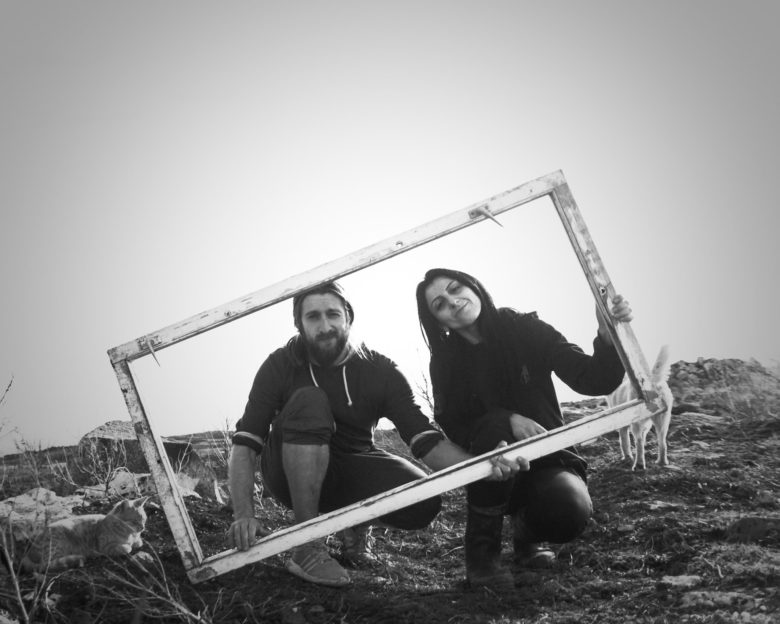
Hasmik and Fyodor don’t only create Kalemon. Half the life described in this article also consists of Centaur — Armenia’s first and only animal-assisted therapy center. Centaur works with children in orphanages and rescues animals in trouble. You can support its work on the website.
If you want to support Kalemon, you can become its Patron and gain access to additional content on a special page. To do so, click the button in the box below. Thank you!
Become a Patron
We’re creating a community of caring, free and unbiased people. If you want to support our work examining deep social problems through the personal stories of ordinary people, the best way to do it is to become our Patron.
The text is finished, the story continues
Our mission is to foster change in society by breaking taboos and freely discussing important subjects such as violence, poverty, discrimination, parental and medical ethics — and so on.
The stories told here will always remain honest and unbiased — thanks in part to our Patrons. You too can join by clicking the button and choosing your level of support.
Every subscription, starting at 2 dollars a month, will help authors create new material. Thank you!


The creation of this article was supported by NGO NESEHNUTÍ’s Armenian civil society development program (the Czech Ministry of Foreign Affairs’ TRANSITION Program)