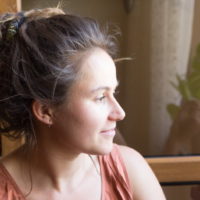
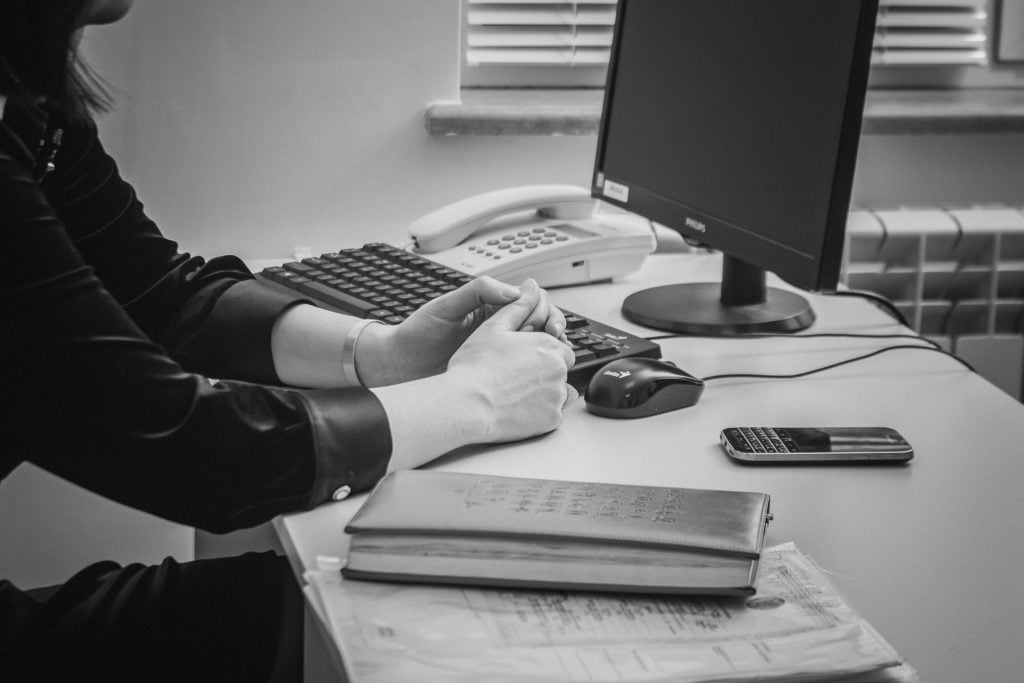
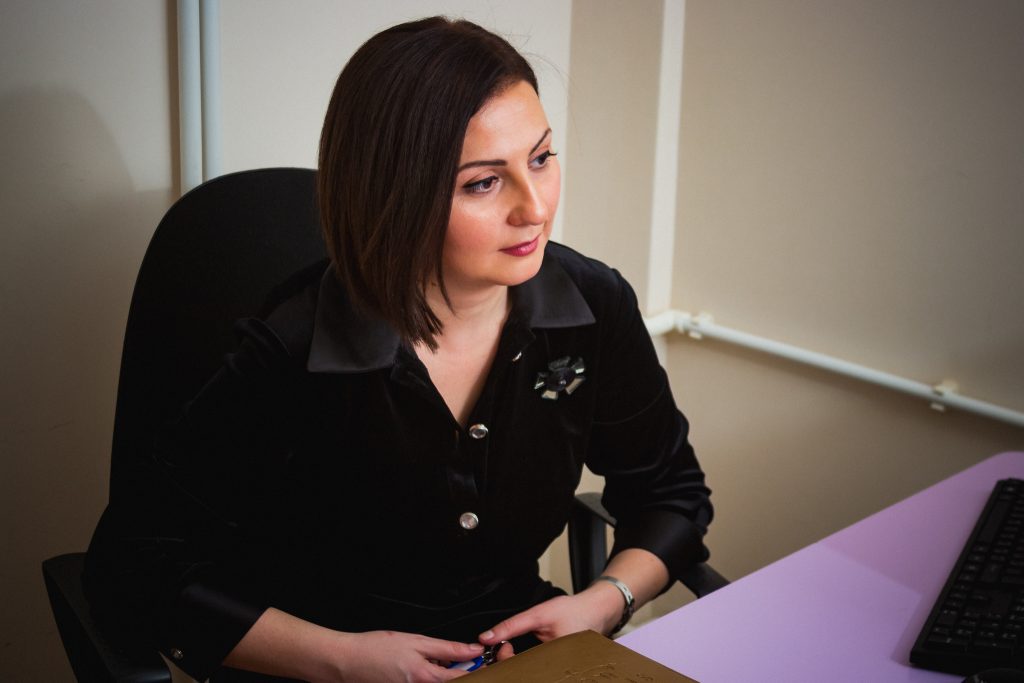
The door to the cosy, bright office that Elena is temporarily using at the Arabkir Medical Centre keeps swinging open, and another visitor pokes their head through the doorway with papers and questions for the “doctor”. Elena patiently explains that she is not a doctor, looks through the papers and directs them to the right office.
The visitors often miss the correction and keep referring to her as “that doctor without a white coat”.
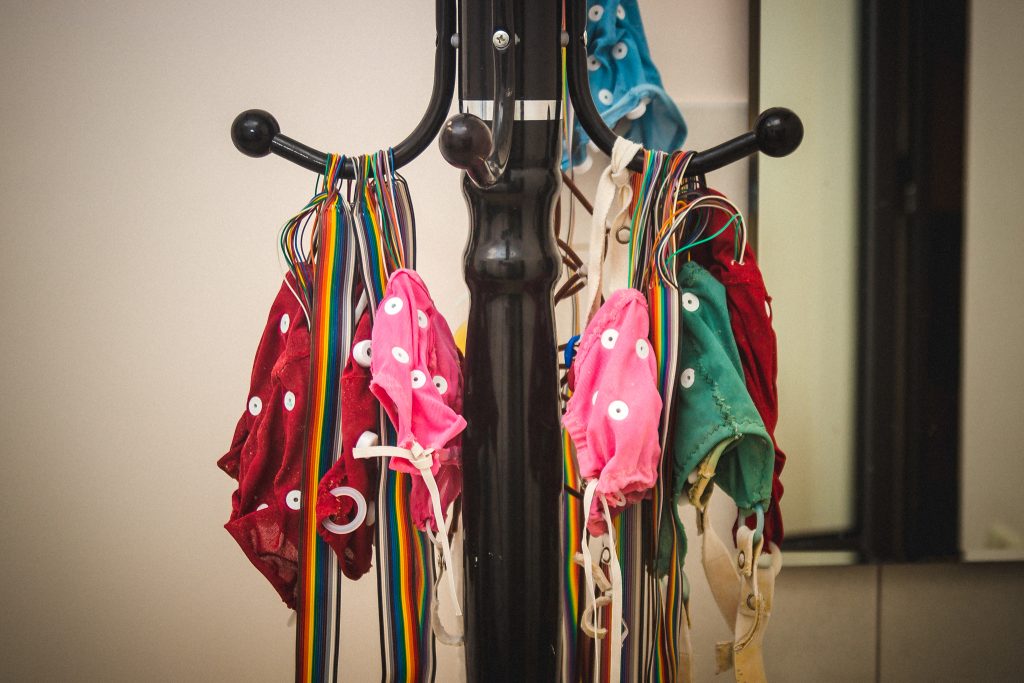
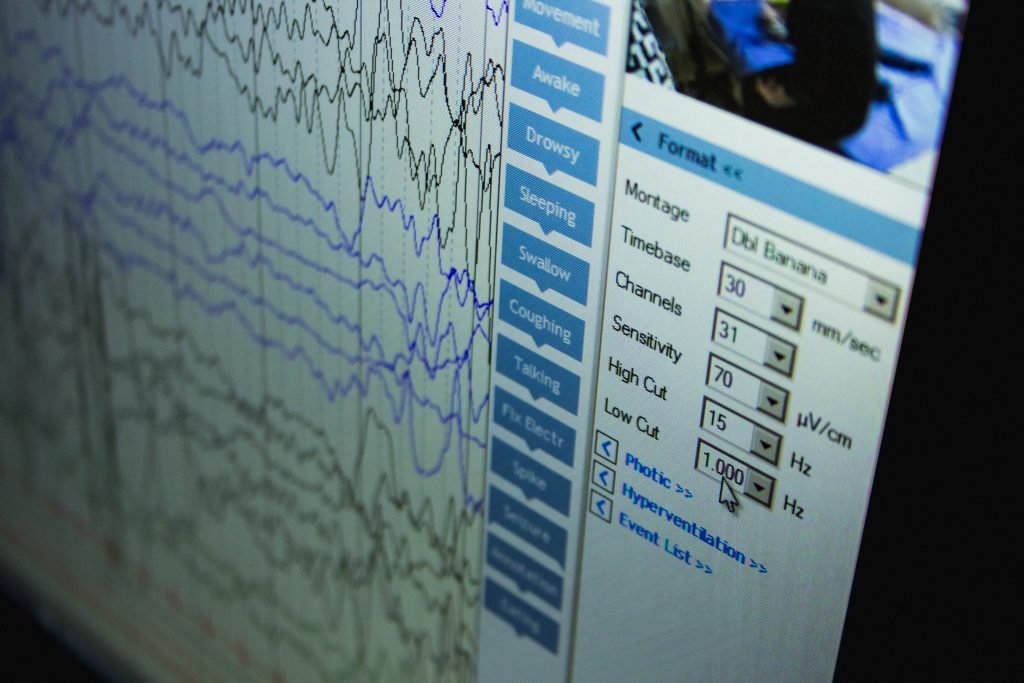
The “doctor without a white coat” finishes sorting through the stack of children’s medical records on the desk, discusses some of them with doctors as she goes, and heads to the “encephalography room”. A thin little girl is sitting in a hospital wheelchair in the room. She is wearing a pretty green cap with electrodes attached to it, which pick up electrical impulses from brain cells and transmit them to a computer screen. For about two hours, the screen will display lines that mean nothing to me; then a doctor will interpret them and obtain information about the child’s condition.
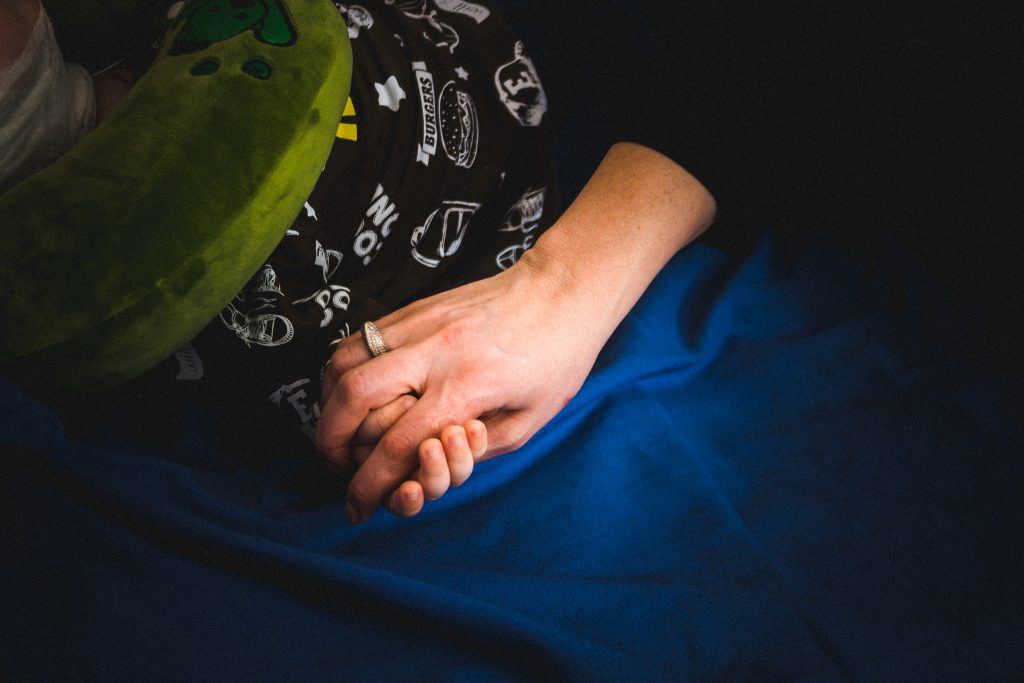
Her mother is standing in front of the wheelchair. Like her daughter, she is bewildered. The nine-year-old girl was brought into intensive care with an epileptic seizure a couple of days ago, and she does not quite understand what has happened to her yet.
“Don’t worry,” Elena tells the mother. “Let’s hope it doesn’t happen again. And if it does, we have very good doctors, all kinds of tests are available, and together we’ll work out what to do.” I don’t know about the child’s mother, but I feel calmer because Elena is not cooing over her or assuring her that everything is bound to be all right, but promising to be there and help, whatever happens.
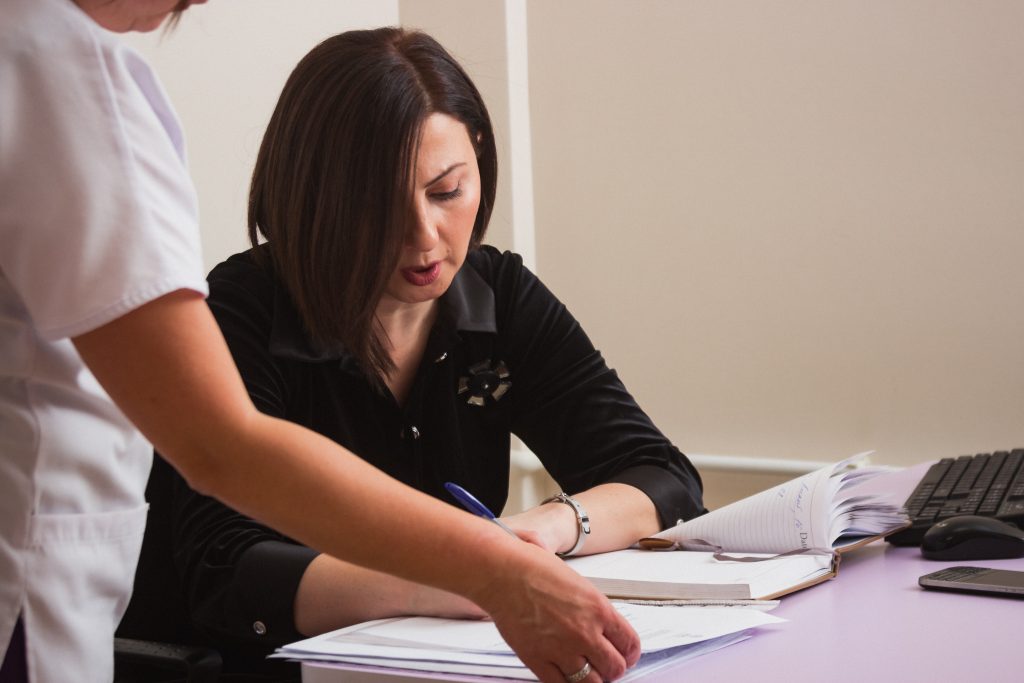
We return to the office and begin talking, repeatedly interrupted by all kinds of hospital business, calls from the parents of young patients, and the never-ending knocking at the door.
— Do you remember the very first child you helped?
— It was about eight years ago. My own child had developed epilepsy a year earlier. I had come to the hospital for the results of another round of tests. I’m standing in the queue and suddenly notice a man sitting in the corridor, crying.
I’ll never forget his face; it was terrible to see him cry like that. He told me he had a little daughter with epilepsy, and she needed a medicine called Keppra, which wasn’t available in the country. Once we realised Keppra was helping our son, we had started asking all our friends and relatives to buy it and send us packets of it, so we would never find ourselves without the medicine. Well, I told him: come home with me, I’ll give you some.
Some time later, Biayna Gagikovna [head of the neurology department at Arabkir] calls me and says: “You know, he brought a chicken. One for me, another for you.” Can you imagine? The man hadn’t forgotten; he had brought what he had on his farm all the way from the village near Sevan where he lived, to say thank you.
That’s the child it all started with. Then I saw a woman in a pharmacy who was crying and asking for an anticonvulsant medicine. I gave her my business card and started helping her. It’s something mystical, really—“chance” encounters like these used to happen all the time, and still do.
That woman in the pharmacy was very active and started passing my number on to other mothers, and one day we discovered that our supplies of Keppra had run out. My husband and I had a row—he said, your child is ill, and you’ve given it all away? (laughs)
My son Danya was lucky—he had benign myoclonic epilepsy, which can appear from six months of age and usually goes away at six years old. But even after he recovered, our friends kept sending medicines out of habit, and I didn’t stop them; I passed them on to other children. It was all spontaneous, something I was doing on my own initiative; I never thought it would turn into anything professional.
— At what point did it become necessary to formalise this work as a foundation?
— I’d wanted to start a foundation for a long time. But I kept putting it off because it takes far more resources and responsibility than just helping people.
I used to help only with medicines; there weren’t many tests. No one transferred money to me. The sponsors were mostly friends of mine who would buy a medicine or pay for a child’s MRI scan.
A year and a half ago, I realised that was it, I needed to start a foundation now, to have more opportunities to help. We now provide children with epilepsy with medicines and tests, including tests carried out abroad, and also try to inform people about epilepsy.
— About three years ago, a priest told an acquaintance of mine whose son has epilepsy that the child was possessed by the devil, and even set about exorcising him. Why, when information is so readily available, is epilepsy still treated like the plague?
— People here really do fear epilepsy like leprosy. They think they’ll catch it, while parents think someone will find out and people will start talking. Parents often prefer not to tell even their children that they have epilepsy: what if no one will marry their daughter, or a neighbour starts spreading gossip?
Even now, when I tell my story, people say: “Why? It’s all over for you now, you have a daughter, she still needs to get married.” Honestly, I don’t know how to respond to that: laugh or cry.
There is such a powerful stereotype that children with epilepsy are abnormal, incurable, mentally ill. Yet epilepsy is a neurological illness, not a mental illness, and is successfully treated in 70% of cases. Most children with epilepsy are no different from their peers and lead socially active lives if their seizures are controlled with good, modern medicines. They go to school, play in the yard, and no one looking on would even say that the child has epilepsy.
Many people, even in my own circle, don’t want to know anything about epilepsy. They think it will never affect them or their loved ones, because “everyone in our family has always been normal”.
Parents often prefer not to tell even their children that they have epilepsy: what if no one will marry their daughter, or a neighbour starts spreading gossip?
Yet we are an old nation with many genetic mutations, walking bombs that could go off at any moment. It only takes a trigger for a mutation to turn into an illness. In my child’s case, for instance, it most likely manifested itself because of intrauterine hypoxia during pregnancy.
I really want to write stories about the children we’ve helped on the foundation’s Facebook page. Stories with happy endings that show epilepsy is not a life sentence, where everyone can see that their attitude can help bring about an ending like that.
When I shared this idea on my page, lots of comments came pouring in from followers saying they wouldn’t read it, their nervous systems were too unstable. I believe we need to talk about epilepsy anyway, because myths are born precisely out of ignorance. Some will protect their mental wellbeing and not read, while others will learn something, change their attitude and want to help.
— How ready were you yourself, nine years ago, to hear that your child had epilepsy?
— I was also sure epilepsy existed somewhere in a parallel universe and couldn’t happen to us. Danya’s seizure started while he was having a bath. His eyes rolled back, his jaws clenched, he turned blue. It was a terrifying sight. I thought he had… simply died. One of the neighbours called an ambulance, and he was brought to intensive care at Arabkir. I was told straight away: either a brain tumour or epilepsy.
We had a CT scan. Then we went to Tbilisi for an MRI (there wasn’t one in Armenia at the time). We were told there was no tumour, but the seizures continued. I had to film the seizures so the doctor could identify the type from the nature of the seizure and prescribe treatment. Only a year later was it possible to make a precise diagnosis and find a treatment regimen for him.
They think it will never affect them or their loved ones, because “everyone in our family has always been normal”.
— Was it local doctors who found the regimen?
— Yes. We have amazing doctors, with a God-given gift. When Danya had his seizure, I immediately started thinking about what I could sell to take him abroad. I contacted doctors abroad and they told me: you have Biayna Gagikovna Sukhudyan, who could give any doctor abroad a run for their money; go to her.
We later became friends, and I set up the foundation not only to look after the children and their parents, but also to express my gratitude to the doctors and make their work at least a little easier. These are doctors who fight for every child. But how can they treat children if they don’t know the diagnosis? To get a diagnosis, you need to undergo terribly expensive tests, and the parents have no money. No money, so they turn around and leave. Or the doctor prescribes the right medicines, but again the parents have no money to buy them, and the child goes without treatment.
We had to bring new, effective medicines from abroad at outrageous prices. [But when] we brought Keppra from America, the seizures stopped the next day. We could afford it, but thousands of mothers couldn’t.
— What happened to their children, then?
— They were prescribed the medicines available here. Some were high-quality medicines suited to treating a particular type of epilepsy, such as Depakine (valproate), which is considered a classic medicine for controlling epileptic seizures.
But sometimes they were cheap, not very effective medicines or Indian generics that won tenders and were far from helpful for everyone. There were few high-quality, modern antiepileptic medicines in the country at the time. Those who could found every possible way of obtaining the medicines their children needed and bringing them from abroad.
Depakine, for example, didn’t suit my son: his liver function indicators began to deteriorate, he refused to eat, and meanwhile the seizures weren’t being controlled. Until we found Keppra, which we then brought from America for years, and Suxilep from France. With that regimen, we achieved remission and forgot what seizures were. But we could afford to buy these expensive medicines. The overwhelming majority of mothers of sick children couldn’t.
But how can they treat children if they don’t know the diagnosis? To get a diagnosis, you need to undergo terribly expensive tests, and the parents have no money.
— You often say “mothers”, rather than “parents”.
— Unfortunately, many fathers leave the family when they learn their child’s diagnosis. One reason we didn’t have expensive medicines here was that if you bring in a medicine costing 150 euros, it won’t pay for itself, because in Armenia 70% of mothers [of children with epilepsy] are single mothers. While both parents fight for a child with cancer, for example, with neurological conditions the mother is, unfortunately, often left alone.
A father often has a defensive reaction—what genetic problems, what are you talking about? I’m a man, I’m a hero, I’m as healthy as an ox. If the child makes me doubt that every day, I’ll go to another woman and have another child who’ll be healthy.
In my experience, men don’t even want to take a genetic test, although the cause is often precisely the father’s gene mutations. If it turns out the cause lies with the mother, accusations often start that she knew about her problem but concealed it.
To avoid finding out who is “to blame”, many deny the illness for years and don’t give their children medicines. We currently have parents for whom we’re willing to pay for genetic testing—both the parents and the child—but for the second year running, the mother hasn’t brought blood for the test. She’s afraid of discovering that one of them is a carrier. Families often fall apart precisely after these tests. Yet instead of looking for someone to blame, all efforts should immediately go towards helping the child.
— What support does a parent need in order to help their child and influence society’s attitude towards them? How can we keep fathers from leaving?
To be fair, of course not all fathers leave. We have wonderful fathers who fight for their children while the mothers are bewildered and unwilling either to acknowledge the illness or to start treatment. [Also,] families often fall apart because the mother and father grow estranged from one another. Sometimes they fight together for the child’s recovery and split up when the child has already recovered. Because it’s hard to remember the atmosphere you lived in.
That’s why there need to be professionals who know how to help properly. We have no psychological support service for parents. They go through all the stages of accepting an illness—denial, struggle, acceptance—on their own. I dream of developing our foundation to the point where we can change that. Apart from talking to parents as a mother who has been through the same thing, there is nothing else I can do myself.
I can’t imagine how anyone can endure it without support and not go mad. Constant seizures, sleepless nights, not knowing where to find medicines or the money for them, and you still have to live, eat, clothe yourself. You can’t go to work because there would be no one to leave the child with.
Families often fall apart precisely after these tests. Yet instead of looking for someone to blame, all efforts should immediately go towards helping the child.
I think mothers always have it hardest. I was lucky: my child’s father shared all the hardships with me. But even with a nanny and a father there, when Danya had a seizure everyone would run out to the stairwell, and I would be left alone with him. I supported Danya with one hand, held the phone and called doctors with the other, and also drew diazepam into a syringe (for rectal administration).
— How did you get through all those stages at the time?
— At first I behaved like many of the mothers I now tell not to do this: I shut myself away at home, didn’t talk to anyone, mourned my misfortune. I felt that this surreal thing couldn’t be happening to me and my child; sometimes I wanted to disappear.
After the first seizure, which lasted more than ten minutes and involved a loss of consciousness, Danya stopped talking. I knew nothing about epilepsy then, what an epileptic seizure looked like or what happened during one. It was a classic generalised seizure, a prolonged one, and it happened twice more afterwards.
If a seizure lasts more than five minutes, the child must urgently be taken to hospital; otherwise there is a risk of status epilepticus—a constant succession of seizures with loss of consciousness and respiratory arrest, potentially leading to coma and death. Everything must be done to prevent this.
I can’t imagine how anyone can endure it without support and not go mad.
Keppra only controlled my son’s major seizures; he had minor ones (which could turn into a major one) every day for a year, until we found the right combination of medicines. Children with the same form of epilepsy are often prescribed different treatment regimens; there is no universal gold standard, there are recommended medicines. For my child, these were Keppra and Suxilep—both expensive and both unavailable in Armenia (Suxilep is still unavailable).
I was afraid of the seizures and preferred to stay at home so no one would see them. We even bought a flat near Arabkir so we could get him to the hospital quickly if anything happened. Danya once had a seizure in the park, and we stopped going there. People gathered around us, wailing. I simply froze at all the shouting, noise and hysterics, and couldn’t focus on my child.
Biayna Gagikovna gave me enormous support, answering my calls at five in the morning when my child was having a seizure or I thought he was about to have one. She pulled me out of it, helped me not to go mad.
Biayna Gagikovna told me to film the seizures and wait—in a year she would be able to say exactly what kind of epilepsy he had. I pestered her with questions about what else I could do, how to speed up the process, because the uncertainty is killing. On the other hand, you are afraid of certainty [too]; it may not be what you want it to be. Before the diagnosis, you live in limbo; afterwards, you are happy if it’s a good one, and turn into a robot programmed to give medicines according to the regimen every day and have an encephalogram done from time to time.
— And if it’s a bad one?
— I’ll be honest: I don’t know how I would behave if I were told my child wouldn’t get better. I am always at a loss with the parents of children like that, can’t find the right words, feel guilty towards them, although intellectually I understand I am not to blame for anything.
Danya had benign myoclonic epilepsy of infancy, which began at two and a half years old and was completely gone by the age of six. Danya started school perfectly healthy, and he does very well. But for a long time after the medicine doses were reduced and then stopped altogether, I couldn’t believe it was all behind us. For another couple of years, I carried the medicines with me just in case and took them on trips.
If a seizure lasts more than five minutes, the child must urgently be taken to hospital; otherwise there is a risk of status epilepticus.
Even with our “good” diagnosis, it wasn’t easy. A close friend who was there for me helped enormously—she spent days and nights with me in intensive care. My other friends stopped talking to me then. People on the outside feel uncomfortable. They don’t know how to behave. You used to be one person, and your child used to be one child, but now you are someone completely different, and your child is different, and your concerns are different. And you’re not interested in which club they went to yesterday or what they listened to. And they’re not interested in hearing about your new concerns.
— How many children with epilepsy are registered in our country? How many of them are supported by Road of Life, and what criteria do you use to choose them?
— I mainly work with the Arabkir Medical Centre. It has the country’s only children’s neurology department, which is very well equipped. But of course I’m ready to work with any doctor and help any child, regardless of which hospital they are registered with.
Arabkir has about four thousand children under eighteen (five thousand are registered in the country altogether). Two and a half thousand of them are definitely children we support. There are regions in Armenia where not a single case is registered, but that doesn’t mean there aren’t any; they simply don’t come and register. Some, again, are afraid of publicity. Many parents have low levels of literacy, awareness and, I would say, responsibility. People have a sick child, refuse genetic testing, and carry on having children.
It is mainly doctors who refer children to our foundation. Enormous thanks to the doctors and residents who write up the children’s cases and pass them on to me, even though it’s extra work for them. We try to prioritise children from large families, with single mothers, from the regions. I’m always very enthusiastic about helping parents who are fighting for their child. I can see they need that boost. But boosting people who’ve already given up… I don’t have the strength to invest that much in them. If the parents themselves aren’t fighting for their child, how do you teach them to?
Sometimes I sit in on appointments and listen. The parents have no idea who I am. Those we already work with pass my phone number on to one another themselves. But we are cautious about telling people about the foundation. On the one hand, we need it to be known. On the other, I’d be swamped with parents, and our resources are still limited.
We don’t provide one-off help, after all. I try to make all our cases last at least six months, so that in that time a parent can pull themselves together and think about what to do next on their own, and how. This includes medicines and ongoing tests during treatment to see how well it’s working and what needs to change. There are parents whose children we have been supporting for years because they can’t afford medicines.
— Foaming at the mouth, convulsions—that’s the picture that immediately comes to mind at the word epilepsy. What is epilepsy really, and how can a parent tell it’s time to see a doctor?
— Epilepsy is repeated, spontaneous, identical and short-lived seizures during which the electrical activity of neurons in the brain increases. Seizures vary greatly in their manifestations and nature.
A seizure that lasts several minutes or longer, with loss of consciousness or convulsions, is called a classic generalised seizure (when neurons throughout the brain become excited and active). During a seizure like this, the body goes into severe spasms and convulsions begin, often accompanied by vomiting and involuntary urination; the child may roll their eyes back and make various sounds. But generalised epilepsy can also manifest itself in non-convulsive seizures, for instance absences, when a child may simply “switch off” for a while, freeze, or jerk with myoclonus.
As of today, about forty different forms of epilepsy and different types of seizures are known, a large proportion of which are seizures of focal (localised) epilepsy, when a specific part of the brain is affected. Depending on where exactly the neurons become excited, the seizures manifest differently. For example, an arm or leg, or part of the face, twitches. Sometimes there are hallucinations in the form of unpleasant smells, sounds, flashes of light, and so on.
If the parents themselves aren’t fighting for their child, how do you teach them to?
Parents and others often don’t realise it is cause for concern, and naturally it doesn’t initially occur to them that it might be epilepsy. Many children have a single seizure, which may frighten a parent terribly but never happen again. If seizures and unexplained “blackouts” recur, happen spontaneously but periodically, that is a reason to visit a neurologist, who will decide on further diagnostic procedures after examining the child and taking a medical history.
The causes may be genetic mutations associated with severe neurological syndromes, immunological and metabolic syndromes, structural changes in the brain, injuries, strokes and cerebrovascular diseases, infections—both intrauterine and those contracted later.
— Speaking of convulsions, we have stereotypes about those too—force the jaws open, stick a spoon in the mouth, pull the tongue out… What should you actually do to help someone having a seizure?
— You don’t need to pull anything out; turn the person onto their side so they don’t choke on their own saliva or vomit, and put something soft under their head. During a seizure, a person doesn’t feel pain and isn’t aware of what is happening to them.
Don’t wrench out the tongue, don’t rip out the tonsils, don’t break the jaw. Seizures mostly stop on their own. If a seizure lasts longer than five minutes, you must call an ambulance. The main thing is not to panic, not to take out your mobile phones and start snapping, but to help the person having the seizure.
— Should parents tell the school that their child has epilepsy? When applying for a job, should a person inform management about their diagnosis, and are there jobs that people with epilepsy shouldn’t do?
— Parents must inform the nurse, the teachers and the school management as a whole that their child has epilepsy. Many use every means and every possible way to hide the “entry in the medical record” that seems shameful to them, for themselves and their child’s future; they see it as a label.
There are cases where parents hide the diagnosis even from the child, instead of explaining the illness in detail and telling them how to behave if they feel unwell.
I would suggest explaining it to friends in an accessible way as well, so they can help the child properly in the event of a seizure. Why don’t parents who suffer from stigmatisation, discrimination and stereotyped attitudes towards their children in society try to change those attitudes through their own behaviour? Because our society isn’t ready to take in information like that appropriately, to reset its perception of others. But water wears away stone.
The same goes for getting a job. People with epilepsy hide their diagnosis for fear of not getting the position. In practice, that’s what happens in most cases, whereas in fact the only prohibited activities are those involving extreme conditions: driving a car in some countries, serving in the police, fire services or security at important facilities, working with moving machinery (conveyor-belt production), chemicals, near bodies of water, surgery, and so on.
Epileptologists never tire of repeating that their patients, most of whom are no different from healthy people between seizures, don’t need any special restrictions. What’s more, seizures often occur precisely during passive, relaxed states. Mental activity, on the other hand, helps reduce epileptic activity.
— What diagnostic and treatment methods are available here, and which do people need to seek abroad? What exactly does the foundation pay for?
— First, the hospital does a CT scan, an encephalogram and an MRI, ruling out everything it can. Not all tests here are free, but many are covered by the state budget up to the age of eighteen. However, quotas are limited, and children have to wait months for their turn.
There are cases where parents hide the diagnosis even from the child, instead of explaining the illness in detail and telling them how to behave if they feel unwell.
MRI scanners in Armenia are mostly 1.5-tesla. But in many cases they don’t show the full epileptic picture, and we need a three-tesla machine with EPI mode (an epilepsy protocol used to visualise small structural abnormalities of the brain)—there is one only at the Astghik clinic, and its referral waiting list is booked up until June.
Paid tests are expensive. So in urgent cases, we pay for an MRI. If the MRI shows an epileptic focus in the brain that can be removed (meaning it is not, for example, next to the motor area—in that case it must not be touched, or the child could be paralysed), this still needs to be confirmed with a PET-CT scan.
It’s a machine that visualises the epileptic focus in detail for surgeons. If that focus is removed, the child forgets they ever had epilepsy. We have a PET-CT machine in this country, but it isn’t working; isotope production hasn’t been set up. We are now sending a child and a parent to St Petersburg, to the Bekhterev Institute of the Human Brain. We pay for the test itself, the ticket and accommodation.
Also, since October, 24-hour video EEG monitoring, which used to be very expensive—75 000 drams—has been covered by the state budget. And it is done on a state-of-the-art machine that has no equivalent. We often pay for routine [monitoring]—two, four or six hours.
— You also managed to push through licensing for medicines that really help and don’t have severe side effects, and even get some covered by the state budget.
— I managed to convince the health ministry of the urgent need to import and register anticonvulsant medicines that have no equivalents. I managed to get through to them about the inadmissibility of ineffective Indian generics, which the state was buying cheaply, taking part in tenders.There was a time when I went to the ministry every two days. Everyone knew me by then.
I recently saw the minister at Arabkir. I hadn’t been able to get an appointment with him for a year—they kept booking me in with his deputies. I asked him: “Could you book me in with a deputy minister you won’t fire in six months?” Because all my nerve cells die off talking to them: not all of them have a medical education, not all of them understand what you’re even talking about, not all of them want to listen; you establish contact, agree on something, come back next time, and he’s already been fired.
At the same time, though, there are people in the ministry who are ready to listen and help, and I’m very grateful to them. Since last year, two important medicines—French-made Depakine Chrono and Russian Letiram, an equivalent of Keppra—have been provided to children (Letiram to adults too) through the state budget.
We also managed to officially import into Armenia a one-off batch of the previously unavailable Sabril, an irreplaceable medicine used for infantile spasms and other types of epilepsy. Our parents used to either smuggle it in their suitcases—I’ve done it myself many times—or buy it on the black market. Now the medicine is sold in pharmacies, and its price has fallen severalfold compared with the black-market price.
So the state provides one of the necessary medicines, for example, and the parents have to buy the others, because they work only as part of a regimen. And these medicines are expensive. So the foundation helps buy them. But of course it has become easier for us because the two main expensive, highly effective medicines we once couldn’t even dream of are now supplied free.
— What happens to the children the foundation supports when they turn eighteen? Do they switch to more affordable, poor-quality medicines?
— That’s a very painful question. When the children we support turn eighteen, they move to the Erebuni Medical Centre, where the outpatient service no longer provides the expensive, high-quality medicines and diagnostic tests they received with us.
We have a young man with whom we’ve come a very long way. He had surgery, it was successful, but he still needs to take medicines. His father died; his mother doesn’t work. He has already been transferred to Erebuni, but we continue to support him. And in several other cases, too. However, this is an overarching problem that must be resolved at state level; the foundation cannot help everyone.
— You said that in 70% of cases the seizures either go away altogether or are controlled by medicines. How can medicines help in the other, “hopeless” cases?
— Both parents and sponsors often ask me that. Every generalised seizure accompanied by loss of consciousness causes the brain to shut down for a certain amount of time. This worsens quality of life, because with every seizure the child’s brain and nervous system functions may be suppressed, which may lead to the loss of intellectual and motor skills.
Every seizure can cause a major leap backwards in development: we must prevent it so the child can walk, talk, eat, chew—in other words, retain functions that could be lost without help.
Not all of them have a medical education, not all of them understand what you’re even talking about, not all of them want to listen; you establish contact, agree on something, come back next time, and he’s already been fired.
— How do you find sponsors? How do you convince people that helping a child with epilepsy is a great thing to do?
— I just tell them about it. Some people are moved, while others don’t want to look into it at all. It’s ten times easier to raise money for a child with cancer, which everyone understands. It’s harder for a child with epilepsy or a neurological condition in general, because of the stereotypes entrenched in our society.
I work with a system of donations earmarked for individual children. For example, there is a child who needs seven hundred and twenty Vigabatrin tablets for six months. The amount needed for that many tablets is what I’ll ask the sponsor for. Afterwards, I’ll bring them an invoice and all the reporting documents for that amount.
That’s good for the sponsor: they understand that their help went to a specific child, everything is transparent, but it’s not good for the foundation’s development, because we don’t add a percentage for administrative costs—for events and marketing, for paying an accountant’s salary, for instance, so I don’t have to do everything myself.
Our sponsors are mostly local companies. We work productively with several restaurants and shops. I very rarely run fundraising appeals; I write fundraising posts only for friends, with reports afterwards—when there’s really no money left at all. Then most of the help comes from the diaspora. But that shouldn’t be overused either.
— Which cases tend to catch a sponsor’s attention most?
— Naturally, ones with happy endings. Given the case of a child who will recover with their financial help and a child who needs the same money “just” to have fewer seizures, a sponsor will usually favour the first case.
They are very receptive to children who can be operated on, who have focal epilepsy—remove the focus, and it’s as if the child starts a new life. You give money and see a miraculous recovery. No one even wants to think that there are children who won’t get better.
I struggle with this every time. I have to either tell the truth or say nothing. I always say it as it is—this child will recover, this one won’t, but I’m asking you very much to give money for both, because we have no right to help only those with the potential to recover.
Sometimes I, too, feel the temptation, let’s call it, to help a child with better chances, but I think that’s wrong. We have no children’s hospices, like Russia’s House with a Lighthouse, for example, where a child like that is given care. So as a foundation, I have no right to separate children with the potential to recover from children with a poor prognosis.
It is also very difficult to find money for genetic tests. In a sponsor’s mind, that’s somehow not direct help for the child. Many genetic tests are very expensive and have to be done abroad. But the parents need to know if they have a mutation. It’s important both for the child’s treatment and for planning a subsequent pregnancy.
— Should the state support foundations? What other obstacles are there to the foundation’s development?
— I believe it should—charitable giving needs to be promoted at the highest level. But in our country, charity isn’t developing because of a certain “amateurishness” and a lack of joint efforts to develop this culture.
We now have something of a trend for charity in paediatric oncology, as sacrilegious as that may sound. Many foundations work in oncology, including under the patronage of the first lady, who has unlimited financial and publicity resources.
Children with cancer are very important. The problems are urgent and serious, a matter of life and death, but they are not the only sick children in Armenia. Many children with epilepsy can’t wait either, or the consequences will be irreversible and could even lead to death.
And it’s not just epilepsy. At Arabkir, on the second floor, we have an immunology and allergy department. There are children there with primary and secondary immunodeficiencies and other syndromes who need immunoglobulin to survive. Immunoglobulin costs no less than chemotherapy. And there isn’t a single foundation to help them.
Given the case of a child who will recover with their financial help and a child who needs the same money “just” to have fewer seizures, a sponsor will usually favour the first case.
If, roughly speaking, we used to have ten sponsors, we now have two. People pay whoever is on trend, hoping for certain privileges and perks. We, on the other hand, are a foundation unaffiliated with the authorities and exist outside political changes. Many of my projects with companies with whom we’d already reached agreements fell through because of the changed political situation in the country. People said: sorry, but we need to go over there. What are the thousands of other children supposed to do?
— So, to put the foundation’s main needs briefly—money and people, right? What sort of amount are we talking about, and what specialists and volunteers do you need?
— It depends on how many cases the doctors give us and how many people contact me directly. On average, my capacity allows me to handle cases worth four to five million drams a month.
We need all sorts of specialists—marketers, PR managers, social media managers who could suggest interesting ideas and write grant applications. As it is, I do everything on my own, except the accounting. March 26 is coming up—Purple Day, the international day for fighting epilepsy, [for which we] had planned lots of themed events, appearances on programmes, broadcasts, high-profile flash mobs. But because of the coronavirus situation, we cancelled everything we’d spent long months working on.
I’m a person who is bursting with ideas, but there’s simply not enough of me to put them all into practice on my own. We need people to help me realise them. At the same time, the foundation must have stable funding to pay those people for their work, must receive grants and take part in international projects.
— It would be wonderful if we developed a culture of small donations and small acts. For example, someone transfers a thousand drams from their salary to a foundation every month. It’s a small amount for them, but for foundations, such important financial stability.
— That’s absolutely right. We pay that thousand drams to the army, after all. And it doesn’t make us poorer. But we have problems with payment methods, for example. Russia has a very good online payment system. There, once you’ve made a donation to a foundation, you receive a notification saying you can make it regular in two clicks. Online payments are poor here, though. Few people will make the effort to go to a bank and make a contribution. We also have no online platform [for fundraising]. Many people don’t have cards at all.
Many of my projects with companies with whom we’d already reached agreements fell through because of the changed political situation in the country. People said: sorry, but we need to go over there.
— We also have this hang-up—it’s embarrassing to transfer a thousand drams, but I can’t afford more. I’d rather stay out of it.
— Yes. For many, many years I’ve been trying to separate the idea of charity from almsgiving. So people stop tossing in a little money and ticking a box in their souls: there, I’ve done something pleasing to God. So people give their pennies consciously. So they get involved rather than buying their way out.
For some reason there’s also a superstition that if I start getting involved in all this, I’ll draw it [the illness] onto myself. This “devil” will move into my child.
— Another thing, about the right terminology. Words like “illness”. I read an interview with an epilepsy surgeon in which the journalist asked: “Is epilepsy a congenital defect?” And it jarred with me that the surgeon didn’t pull him up on it. But is it really so important to dwell on definitions, and what is the right way to describe epilepsy?
— I’m constantly faced with that contradiction. If we’re speaking from a medical perspective, then of course it’s an illness, the most common neurological illness. But I often say that people with epilepsy shouldn’t be treated as sick, meaning as somehow abnormal, inferior.
And the word “suffering”. You can say that people with epilepsy suffer. From society’s attitude, from living in constant anticipation of a seizure. Their disposition changes for the worse; they become anxious, depressed. I think their whole life changes. So yes, of course they suffer, like people with any other chronic illness.
But on the other hand, words like “sick”, “defect”, “suffering” drive children and adults into a dead end, deprive them of a chance to get out. When we say “someone sick with epilepsy”, it’s as though we are passing sentence on them, giving them no chance ever to become healthy in society’s eyes. But in a great many cases they will. Of course it’s a difficult, thorny path, but there’s a good chance it will end at a good finishing line.
— About small acts and volunteers. What could each of us help with right now? For example, befriending a mother whose child has a severe form of epilepsy, and once a week getting her out for coffee, a manicure or a film—to take her mind off things—would that be good help?
— That would be very good help. We often give mothers presents for the holidays, for example. So they can feel like women at least on that day. A beauty salon has offered to give the women gift certificates so they can have their hair styled, get a manicure, and not forget they are women.
Though I don’t know how they will physically find the time for all of it. Often it’s a large family with one sick child. But it’s very important—to get a mother out of her “Groundhog Day” state so she can switch her attention.
— Is it difficult dealing with the children’s parents?
— Our parents are naturally all different. Some are very grateful. Some have constant complaints and take a lot of energy to deal with.
One big problem for the foundation is that parents ask for help but refuse to let us publish photographs of their children. We organise celebrations, give gifts, buy medicines, but as soon as publishing a photograph of the child comes up, it’s no, don’t, what will people say?
For many, many years I’ve been trying to separate the idea of charity from almsgiving.
I understand their worries and help without publishing. But that often gives the impression that the foundation isn’t working.
When I work with regular sponsors, the reporting stays between me and them. Some want to remain anonymous, others don’t want the amount publicised. You don’t know how to act so it is right in moral and ethical terms. Sponsors help more than 100 children every month, but at their request, details and stories aren’t published.
Parents are often dissatisfied with our doctors’ diagnoses and start raising money to go for treatment in Germany, for example: either because it is a life sentence, or because some parents want to use their child’s illness to live in a more prosperous country.
We had a case like that a year ago. We already constantly fight fraudsters who collect money in the streets using our children’s photographs and pocket it; on top of that, a mother who had declined the foundation’s services filmed her child’s seizure, posted it on social media, gathered “fans” and huge sums of money for which she essentially gave no accounting.
— I remember the press conference you organised with the heads of other foundations about dishonest fundraising after that case. You also got caught up in an unpleasant incident there.
— Yes, the child’s “fans” wrote to me and threatened me. They even shamed me for not wanting to help a suffering child. The girl had actually been examined by all the local neurologists; a serious metabolic disorder had been found, and to identify [its cause] precisely, she needed to undergo tests at a good French clinic that had been recommended to her.
I met the parents and said the foundation would pay for the tests, provided they stopped their own opaque and illegal fundraising. Parents have the right to raise money themselves if a number of conditions are met: there is an invoice from a clinic abroad for diagnosis and treatment if this is impossible in Armenia (with confirmation of that impossibility), with a full calculation of the anticipated costs; there is an officially opened bank account in one parent’s name, and ongoing reporting. But we have no such cases; I haven’t seen a single properly organised appeal like that, although we have repeatedly explained in detail to parents who declined our services how to run a fundraiser correctly.
In the girl’s case, it turned out that her parents had already raised several times the required amount with their videos, but they didn’t want to go to France; they wanted a German clinic where the same tests cost much more. Yet they couldn’t provide any contact details or an invoice from the clinic calculating the forthcoming expenses.
I wrote about this on my Facebook page, and threats against me and my children came pouring in. Unfortunately, this happens to us often; criminal cases are even opened from time to time over blackmail by fraudsters, and they come to nothing.
Unfortunately, parents who prefer to raise money for their child’s treatment themselves, even if they are honest, often fall into the hands of fraudsters. All over the city, dubious young women wander around with strange plastic food-storage boxes, showing a “frightening” photograph of a sick child and collecting considerable sums.
We, representatives of official foundations, have repeatedly appealed to people’s sense of responsibility, including at press conferences and in numerous interviews—to think and analyse before tossing money into boxes like these and helping all parents indiscriminately. But it’s impossible to get this information to everyone. We have no punitive measures against [such] fraud. Clear oversight by the state and the police is needed here. It is also needed to protect us, the heads and staff of foundations.
— There’s also the belief that foundations and NGOs exist to launder money, whereas a mother would never wish her child harm, so we’d better help her directly.
— I constantly have to listen to such unfair, unfounded accusations and experience [first-hand] the degree of distrust towards foundations in general. Charitable foundations in Armenia are only at the beginning of their development and establishment; we are still trying to shape and develop a culture of charity in the country.
Yes, there are foundations that operate dishonestly or without transparency, but don’t attach that label to all of us. I answer only for the work of our foundation, which operates exclusively through donations earmarked for individual children, in as transparent a format as possible.
— Do you often feel like throwing the whole damn thing in and living a “normal life”, but you can’t?
— I have periods of emotional burnout, when there are far more stories than possibilities and I freeze up. I try to think about new projects and connections that need developing; on the other hand, some routine work has to get done too.
There are also a whole lot of responsibilities towards my own family and children; those haven’t gone away. Working on autopilot and chronic sleep deprivation take their toll. And at some point I realise that’s it, I can’t, one person is no army. Then I want to run away, switch off from all of this.
— What helps you cope?
— I try to work on myself. I’ve concluded that we need to live one day at a time; we don’t know what will happen next. Sometimes, when you do know, it’s frightening; information isn’t always necessary. The happiest people are those who know how to ignore it.
You can’t take everything to heart. You have to keep a cool head to be able to help as effectively as possible. Otherwise it’s easy to burn out. I don’t know how to detach myself, but I try somehow to keep my emotions in balance. When people tell me I’m doing something noble, I reply that this work helps me survive. Yes, it creates plenty of reasons for depression and burnout itself. I often feel as though I’m battering at locked doors.
Then, just like that, a door opens, something works out. And then I simply grow wings; I realise I’m not living here for nothing, that I’ve done someone some good. I think a person’s ability and desire to do good isn’t nobility; it’s an absolutely essential need to feel useful. When you understand you have a mission you consider important, life becomes easier.
Thank you for reading to the end!
Road of Life is the only charitable foundation in Armenia helping children with epilepsy and other neurological illnesses. You can contact the foundation and help it on the foundation’s Facebook page. Your support will enable Road of Life to pay for medicines and diagnostic tests for children who need them.


The creation of this article was supported by the Armenia civil society development programme of the NGO NESEHNUTÍ (the Czech Ministry of Foreign Affairs’ TRANSITION Programme)
Become a Patron
We are building a community of caring, free and open-minded people. If you want to support our work exploring deep social problems through the personal stories of ordinary people, the very best way to do so is to become our Patron.
The text is finished, the story continues
Our mission is to have a positive impact on society by breaking taboos and freely discussing important subjects such as violence, poverty, discrimination, parental and medical ethics—and so on.
The stories told here will always remain honest and unbiased—in part thanks to our Patrons. You too can join by clicking the button and choosing a level of support. Thank you!